

Illuminated Universe explains the pictures that space telescopes send back. The detectors on Hubble and Webb record brightness, not color, one filter at a time, and every finished image is the result of calibration, stacking and a series of choices about which color stands for which light. The articles here take those steps apart using real, published images, so that a reader can look at a picture of a nebula or a galaxy and understand what each part of it shows. This website is an independent editorial publication and is not operated by the Space Telescope Science Institute.
What the articles cover
The site is organized in four sections. How images are made deals with the process itself: filters and their names, color assignment, resolution, camera artifacts, and the history of photographing the sky since the first daguerreotype of the Moon in 1840. The Hubble Heritage Archive is a set of object pages, each built around one picture and a data table listing the camera, the filters, the observation date and the distance. The Solar System covers the planets, moons and small bodies Hubble has followed since 1990. Hubble anniversaries and Webb cover the pictures released each April for the launch anniversary and the infrared images that Webb has produced since 2022.
Every article is written for a reader with no training in astronomy. Technical terms appear when they are needed to read a picture, such as the name of a filter or the difference between narrowband and wideband light, and they are explained where they first come up. The full list of articles can be filtered by section.
How an article is put together
Each page starts from one published Hubble or Webb image and from the information released with it: the instrument, the filters, the dates of the observations and of the release, and the measured distance to the object. That information is the backbone of the page. Where a later measurement replaced a number, the newer value is used. Where a figure could not be confirmed against a release or a mission page, it is left out.
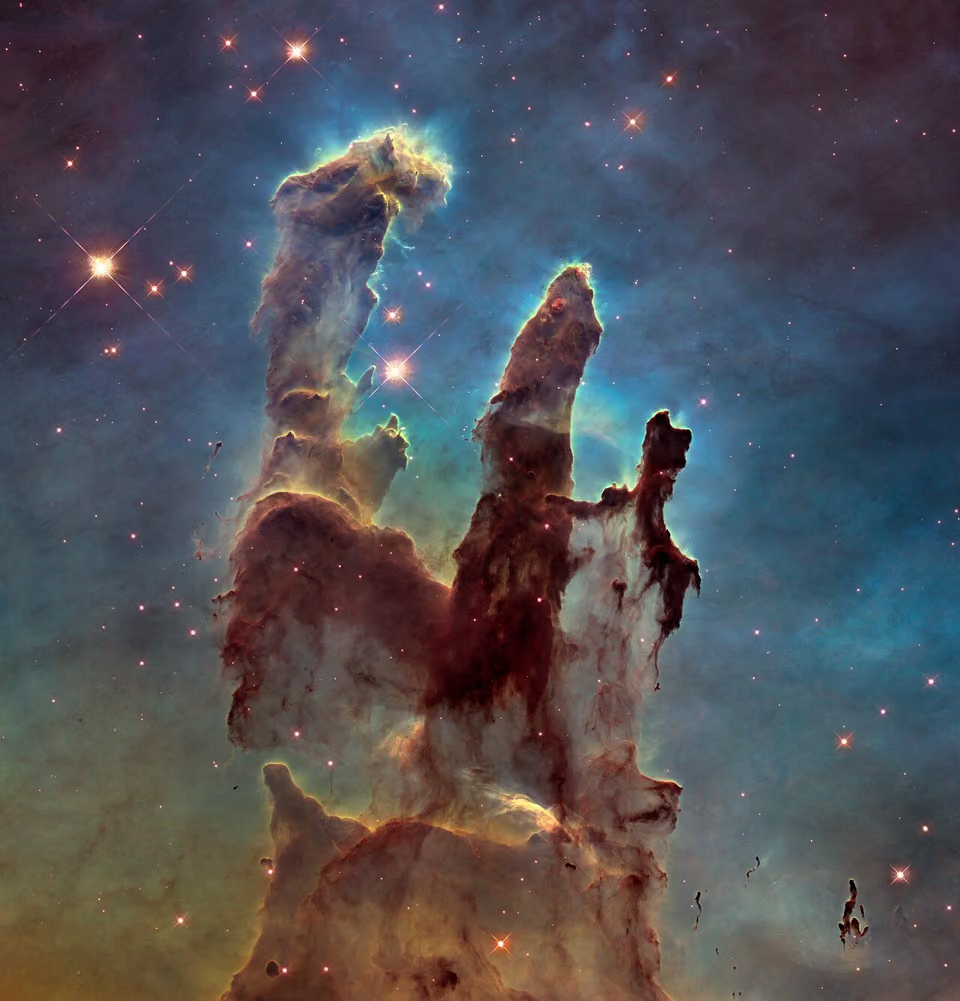
Pictures of space are shown as they were published. None is generated, retouched or redrawn. The one exception is decorative: the telescope optics that frame the entrance to the atlas on the home page are an AI-generated illustration and are labelled as such, while the Saturn inside them is a Hubble photograph. When a page compares two versions of the same object, for example the Eagle Nebula photographed in 1995 and again in 2014, both images are original releases, and the caption names the camera and the year of each. Interactive figures, such as the channel switch on the Heritage pages, split a published picture back into its red, green and blue channels and add nothing new to it.
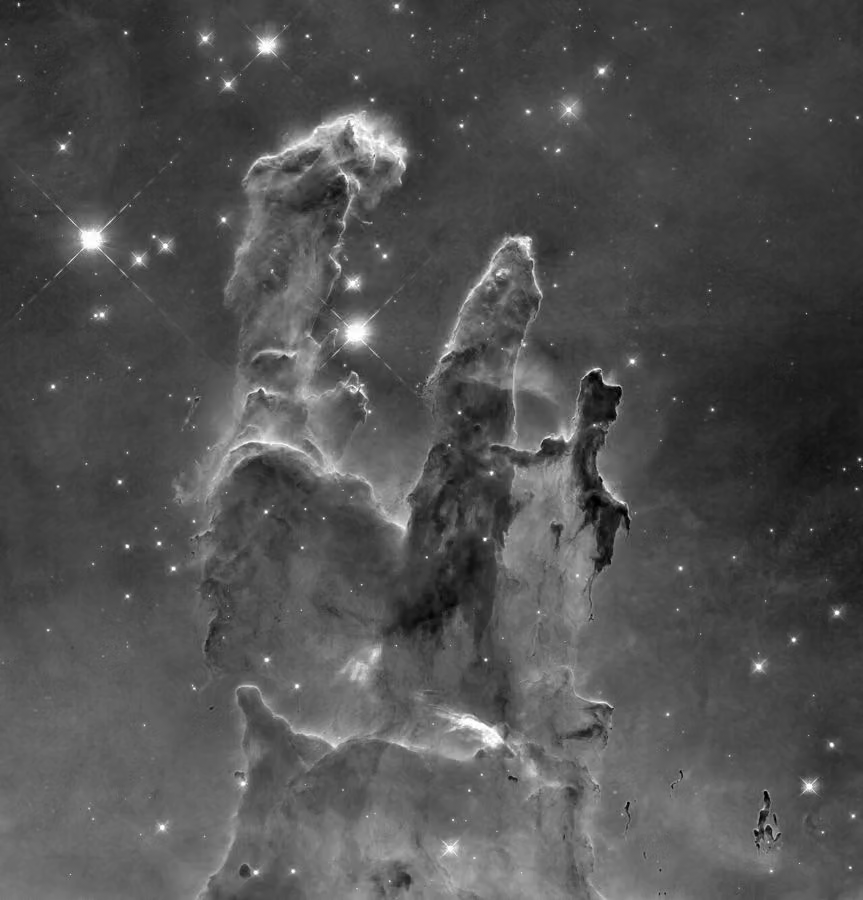
The strip above shows the idea in its simplest form. Wide Field Camera 3 recorded the pillars through three narrowband filters, each tuned to the glow of one element. In the finished image sulfur was shown in red, hydrogen and nitrogen in green and oxygen in blue. The three gray frames carry all of the information; the colors are a key that lets the eye tell the gases apart, a convention explained in Are the Colors Real?
Two dates appear on most pages, and they mean different things. The date under the headline is the day the article was first published. The release date of the image, which may be years earlier, sits in the text or in the data table next to the camera and the filters. A Heritage page written in 2020 can describe a picture that NASA released in 1995, and both dates matter: the first tells a reader how current the explanation is, the second tells which instrument and which processing methods produced the picture.
Where the pictures come from
The images are taken from the public archives of ESA/Hubble, ESA/Webb and NASA, including the NASA/JPL Photojournal for planetary pictures. ESA/Hubble and ESA/Webb release their images under the Creative Commons Attribution 4.0 license, and most NASA images are not subject to copyright in the United States. Both ask for credit, so every picture carries its credit line exactly as the release prints it, often naming the scientists who processed the data along with the agencies.
The underlying observations are kept in the Mikulski Archive for Space Telescopes (MAST), a public archive that holds the raw and calibrated data from Hubble, Webb and other missions. Anyone can search it. Most observations become public after a proprietary period, usually twelve months, during which the observing team has sole access, and many well-known pictures were later assembled from those public data.
Where to begin
- Are the Colors Real?Why the pictures begin in black and white, and how a color is chosen for each filter.
- Image artifactsSpikes, ghosts, trails and seams: what the camera adds and how to recognize it.
- Hubble HeritageOne nebula, galaxy or star per page, with the camera, the filters and the colors they were given.
- Solar SystemMars at opposition, Jupiter and Saturn year by year, moons in transit.


Questions readers ask
Who took the pictures shown on Illuminated Universe?
Every picture is a published Hubble or Webb image, taken from the public release that first presented it. The credit line printed under each image names the source exactly as that release gives it, including the scientists who processed the data where they are credited.
Can the images on this site be reused?
Images released by ESA/Hubble and ESA/Webb carry the Creative Commons Attribution 4.0 license, so they can be reused with the credit line. Most NASA images are not subject to copyright in the United States. Some releases carry other conditions, and the original release page is the place to check before reusing a picture.
Are the colors in these pictures what an astronaut would see?
Sometimes, but often not. Many Hubble images assign colors to narrowband filters that isolate one gas, and Webb records infrared light the eye cannot see at all. Each article says which filters were used and what color each was given, and the article on whether the colors are real explains the conventions behind those choices.
How are the articles kept accurate?
Facts on each page are taken from the release that published the image: the camera, the filters, the observation and release dates and the measured distance. Where a later study changed a number, such as a revised distance, the article uses the newer value and says so in the text.