Hubble and Webb, three exposures
Yes, Hubble images are realHow Webb and Hubble space telescope images are made, gray first and colored by rule
Every exposure comes back gray. That is how space telescope images are made. Hubble and Webb count light one filter at a time, and color is assigned afterwards by wavelength: the longest light is toned red, the shortest blue. Change the filters below and the picture changes. The data never does.
The three exposures
Pick a filter, then an exposure. Or drag the filter onto it.
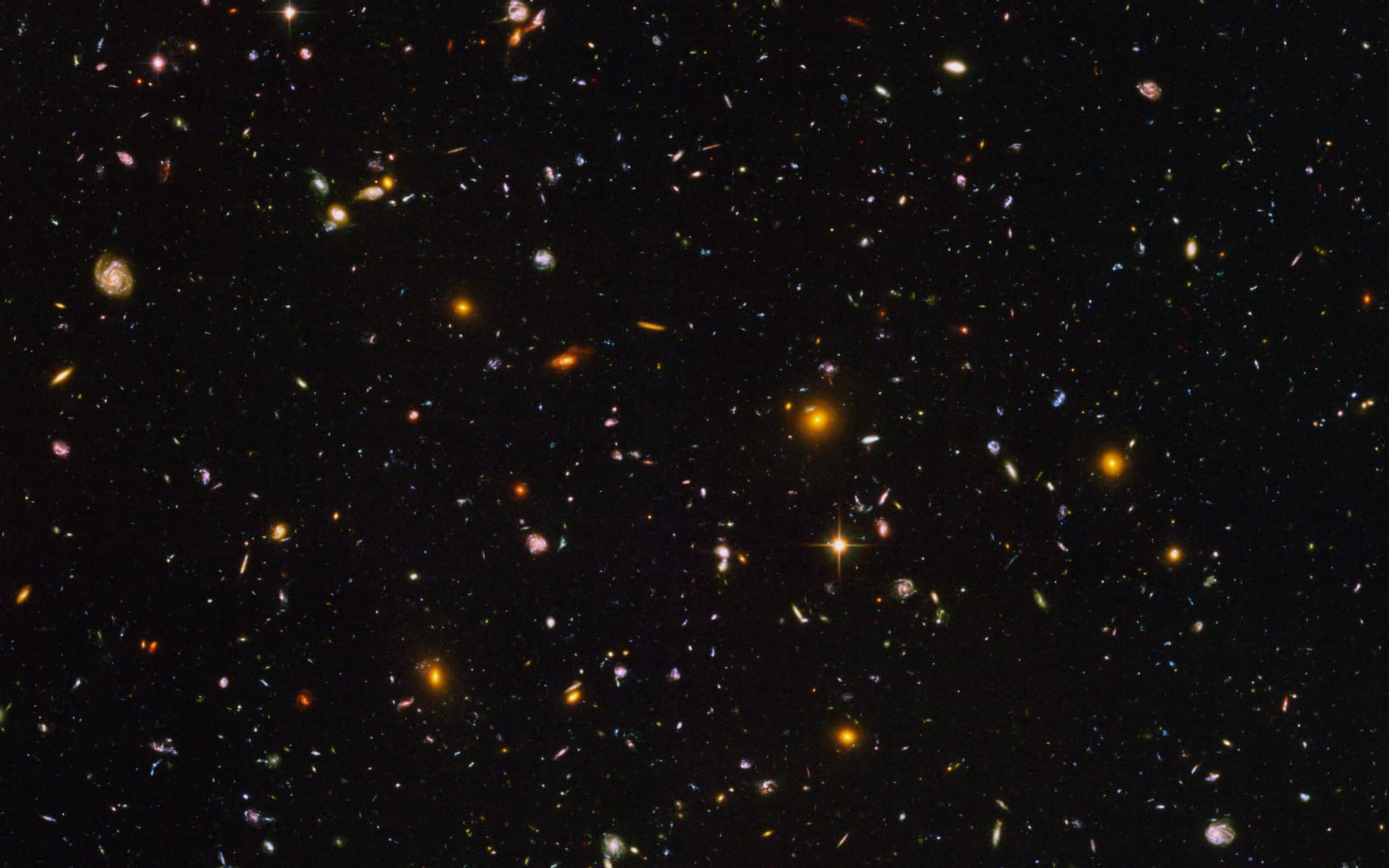
Background: Hubble Ultra Deep Field. Image: NASA, ESA, and S. Beckwith (STScI) and the HUDF Team
SOLAR SYSTEM · DEEP SKY
An atlas of the planets and the sky
Set any date between 1900 and 2100 and the planets move to their computed positions around the Sun. Switch to the sky for the 88 constellations and the Hubble and Webb pictures that lie inside them.
9 solar bodies · 10 deep-sky fields. Positions are calculated when you enter.
FIELD GUIDE
Every object in the atlas
Distances and periods for the planets, field centers
and observing bands for each photograph.
Our solar neighborhood 9 objects
Sun
Our nearest star powers the Solar System. Its visible surface is the photosphere; different wavelengths reveal very different layers.
Mean distance: 0 AU · Orbital period: not applicable
Mercury
A heavily cratered world with almost no atmosphere. Its surface preserves a long record of impacts.
Mean distance: 0.387 AU · Orbital period: 87.969 days
Venus
Bright clouds hide the surface of Venus. Ultraviolet observations reveal structures that visible light barely shows.
Mean distance: 0.723 AU · Orbital period: 224.701 days
Earth
Our ocean planet is a dynamic mosaic of atmosphere, land and water. Satellite colours depend on the wavelengths being measured.
Mean distance: 1 AU · Orbital period: 365.256 days
Mars
Iron-bearing dust gives Mars its familiar colour. Compare visible and infrared observations to discover what a single image cannot show.
Mean distance: 1.524 AU · Orbital period: 686.98 days
What color is Mars?Jupiter
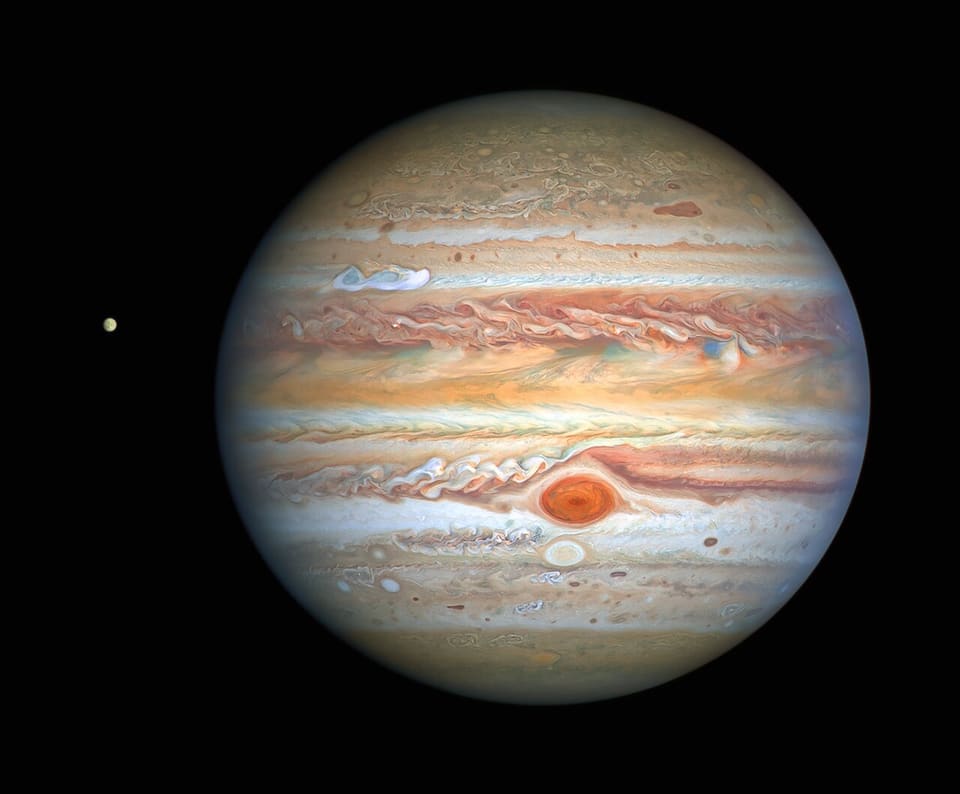
Cloud belts and enormous storms trace a turbulent atmosphere. Different filters reveal cloud height, haze and chemistry.
Mean distance: 5.203 AU · Orbital period: 4332.589 days
Jupiter and SaturnSaturn
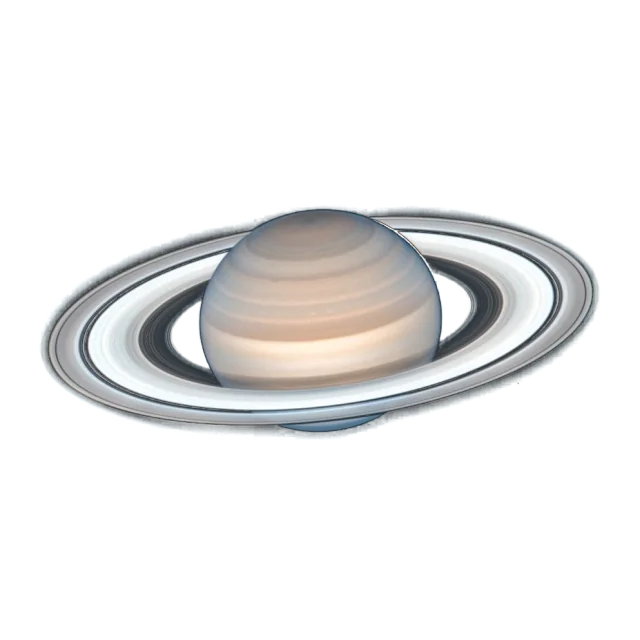
A world of ice and light. Saturn’s rings are countless orbiting fragments, separated by delicate gaps and sculpted by its moons.
Mean distance: 9.537 AU · Orbital period: 10759.22 days
A Saturn yearbookUranus
Uranus rotates almost on its side. Atmospheric methane absorbs red light, contributing to its pale blue-green appearance.
Mean distance: 19.191 AU · Orbital period: 30688.5 days
Neptune
Beyond the familiar worlds, Neptune carries powerful winds and changing clouds. Published colours vary with processing and wavelength.
Mean distance: 30.069 AU · Orbital period: 60182 days
Beyond the Solar System 10 objects
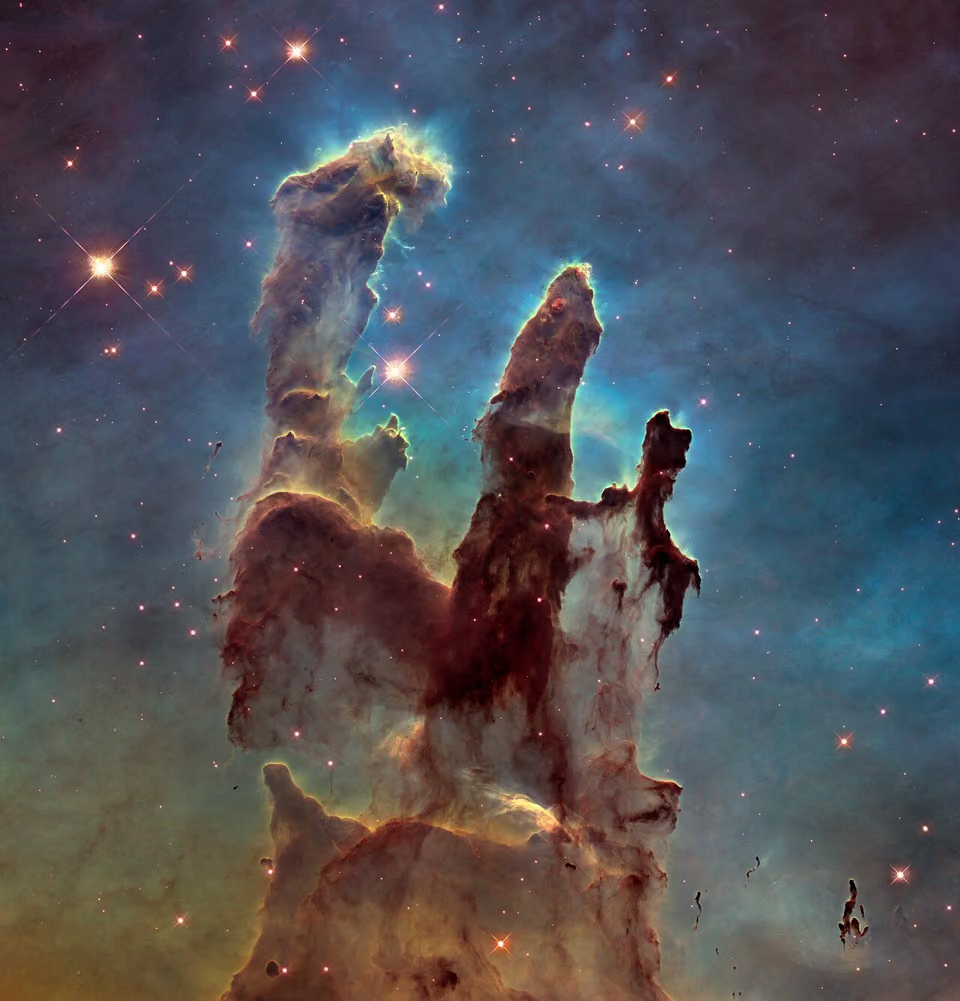
Eagle Nebula M16 · Pillars of Creation
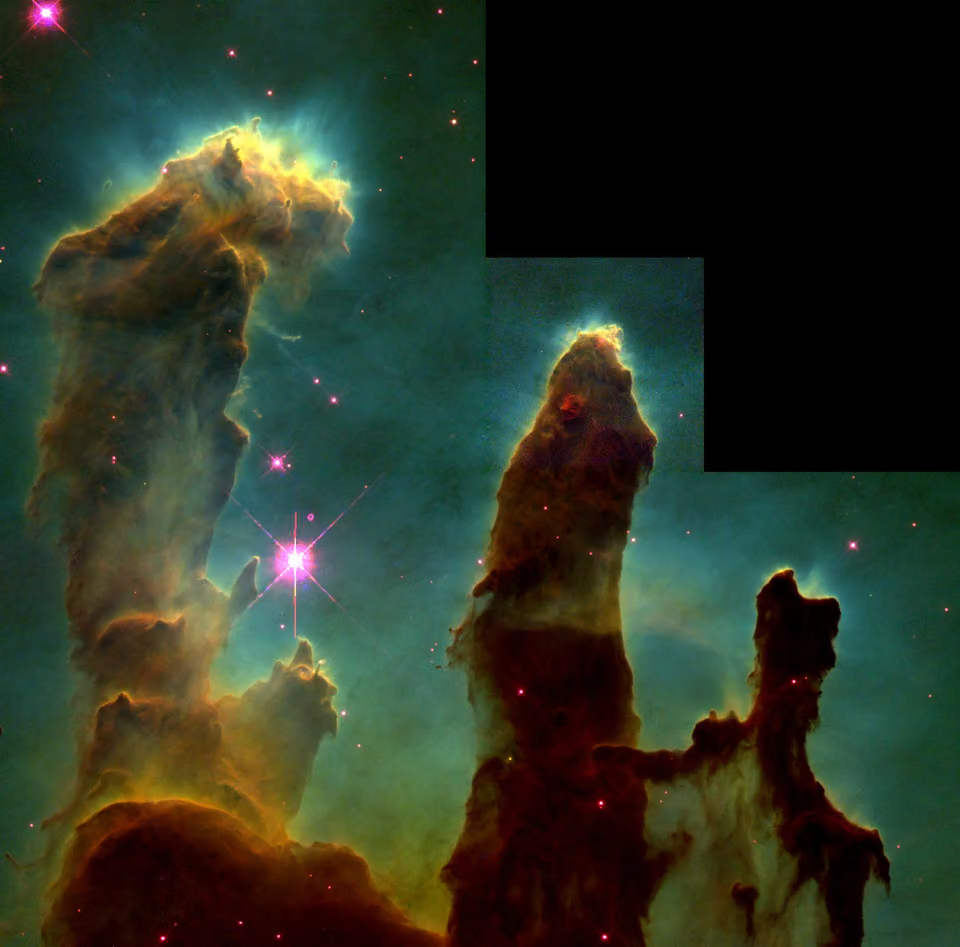
Hubble’s visible-light portrait of the Pillars of Creation shows dense dust silhouetted against glowing gas. This is a small star-forming field within the Eagle Nebula.
How this image was made
Narrow filters isolate emission from oxygen, hydrogen and sulphur. Combining those measurements reveals structure in the gas; displayed colours help distinguish the selected wavelength bands.
Hubble WFC3 · Oiii · 502 nm; H-alpha · 657 nm; Sii · 673 nm
J2000 field center: RA 274.71966667° · Dec -13.83943611°
Read about the Eagle NebulaRing Nebula M57 / NGC 6720
A dying star has shed the glowing shell seen in this planetary nebula. Its central opening is a projection of a three-dimensional structure, not an empty hole.
How this image was made
Separate wavelength exposures are aligned and combined into a display-colour image. Filter labels and wavelengths below follow the publication metadata; they do not describe RGB channels extracted from this picture.
Hubble WFC3 · Hß · 487 nm; H II · 469 nm; OIII · 502 nm; Continuum · 645 nm; H-alpha · 656 nm; S II · 673 nm; NII · 658 nm
J2000 field center: RA 283.39670833° · Dec 33.028925°
Read about the Ring NebulaCrab Nebula M1
Filaments of stellar debris surround the Crab pulsar. This Hubble mosaic records a supernova remnant, with narrow-band observations assigned visible display colours.
How this image was made
Separate wavelength exposures are aligned and combined into a display-colour image. Filter labels and wavelengths below follow the publication metadata; they do not describe RGB channels extracted from this picture.
Hubble WFPC2 · OI · 631 nm; SII · 673 nm; OIII · 502 nm
J2000 field center: RA 83.63554167° · Dec 22.01524167°
Read about the Crab NebulaSombrero Galaxy M104
An almost edge-on galaxy with a bright central bulge and a dark lane of dust. The dust absorbs visible light and outlines the galaxy’s disc.
How this image was made
Separate wavelength exposures are aligned and combined into a display-colour image. Filter labels and wavelengths below follow the publication metadata; they do not describe RGB channels extracted from this picture.
Hubble ACS · B · 435 nm; V · 555 nm; R · 850 nm
J2000 field center: RA 189.99704167° · Dec -11.62274722°
Read about the Sombrero GalaxyCarina Nebula NGC 3372
Intense radiation and winds from massive stars reshape the Carina Nebula. This mosaic combines Hubble hydrogen detail with ground-based colour observations.
How this image was made
This composite combines Hubble detail with ground-based colour measurements. The publication lists both Hubble and other-telescope contributions; the colours separate selected emission bands.
Other / Hubble ACS · Oiii · 501 nm; H-alpha + Nii · 658 nm; Sii · 672 nm; H-alpha + Nii · 658 nm
J2000 field center: RA 161.12° · Dec -59.596525°
Read about the Carina NebulaWestern Veil Nebula NGC 6960 · Witch’s Broom detail
This close view covers a small part of the western Veil, NGC 6960. Shock waves from an ancient stellar explosion trace delicate, glowing filaments.
How this image was made
Separate wavelength exposures are aligned and combined into a display-colour image. Filter labels and wavelengths below follow the publication metadata; they do not describe RGB channels extracted from this picture.
Hubble WFC3 · OIII · 502 nm; V · 555 nm; SII · 673 nm; I · 814 nm; H-alpha · 657 nm
J2000 field center: RA 311.42758333° · Dec 30.96497778°
Read about the Veil NebulaCat’s Eye Nebula NGC 6543
Nested arcs surround the bright core of this planetary nebula. Its intricate structures record repeated episodes of mass loss from a dying star.
How this image was made
Separate wavelength exposures are aligned and combined into a display-colour image. Filter labels and wavelengths below follow the publication metadata; they do not describe RGB channels extracted from this picture.
Hubble ACS · Oiii · 502 nm; Oiii · 505 nm; H-alpha + Nii · 658 nm
J2000 field center: RA 269.63858333° · Dec 66.63281944°
Read about the Cat's Eye NebulaOrion Nebula M42 / M43
A broad view of the Orion star-forming region, including the Trapezium and neighbouring gas and dust. The published mosaic combines Hubble observations with ground-based data.
How this image was made
Separate wavelength exposures are aligned and combined into a display-colour image. Filter labels and wavelengths below follow the publication metadata; they do not describe RGB channels extracted from this picture.
Hubble ACS · B · 435 nm; V · 555 nm; H-alpha · 658 nm; I · 775 nm; Z · 850 nm
J2000 field center: RA 83.79054166666666° · Dec -5.413977777777778°
Andromeda Galaxy M31 · PHAT field
This mosaic samples a section of Andromeda’s disc. Dense fields of stars and dark dust lanes reveal structure within a nearby spiral galaxy; it is not a portrait of the entire galaxy.
How this image was made
Two published bands, 475 and 814 nm, sample visible and near-infrared light. The final display colours combine those measurements; the image covers only part of the galaxy.
Hubble ACS · b · 475 nm; I · 814 nm
J2000 field center: RA 11.154125° · Dec 41.592725°
Whirlpool Galaxy M51 / NGC 5194
A face-on spiral and its companion: follow the dust lanes, star clusters and glowing star-forming regions along the Whirlpool’s arms.
How this image was made
Separate wavelength exposures are aligned and combined into a display-colour image. Filter labels and wavelengths below follow the publication metadata; they do not describe RGB channels extracted from this picture.
Hubble ACS · B · 435 nm; V · 555 nm; H-alpha + Nii · 658 nm; I · 814 nm
J2000 field center: RA 202.46808333333334° · Dec 47.213175°
The 88 constellations 88 objects
Andromeda And · Andromeda
Andromeda — Andromeda. A classical constellation included in the tradition of Ptolemy’s star catalogue.
Reference stars: Alpheratz (V 2.07), Mirach (V 2.07), Almach (V 2.10). History reference
IAU sky region · And · Andromeda
Antlia Ant · Air Pump
Antlia — Air Pump. An eighteenth-century addition associated with Nicolas Louis de Lacaille.
Reference stars: Reference star (V 4.28), Reference star (V 4.51), Reference star (V 4.60). History reference
IAU sky region · Ant · Air Pump
Apus Aps · Bird of Paradise
Apus — Bird of Paradise. A southern figure included in Johann Bayer’s Uranometria (1603), following Dutch southern-sky observations.
Reference stars: Reference star (V 3.83), Reference star (V 3.86), Reference star (V 4.23). History reference
IAU sky region · Aps · Bird of Paradise
Aquarius Aqr · Aquarius
Aquarius — Aquarius. A classical constellation included in the tradition of Ptolemy’s star catalogue.
Reference stars: Sadalsuud (V 2.90), Sadalmelik (V 2.95), Skat (V 3.27). History reference
IAU sky region · Aqr · Aquarius
Aquila Aql · Eagle
Aquila — Eagle. A classical constellation included in the tradition of Ptolemy’s star catalogue.
Reference stars: Altair (V 0.76), Tarazed (V 2.72), Okab (V 2.99). History reference
IAU sky region · Aql · Eagle
Ara Ara · Altar
Ara — Altar. A classical constellation included in the tradition of Ptolemy’s star catalogue.
Reference stars: Reference star (V 2.84), Reference star (V 2.84), Reference star (V 3.12). History reference
IAU sky region · Ara · Altar
Aries Ari · Ram
Aries — Ram. A classical constellation included in the tradition of Ptolemy’s star catalogue.
Reference stars: Hamal (V 2.01), Sheratan (V 2.64), Bharani (V 3.61). History reference
IAU sky region · Ari · Ram
Auriga Aur · Charioteer
Auriga — Charioteer. A classical constellation included in the tradition of Ptolemy’s star catalogue.
Reference stars: Capella (V 0.08), Menkalinan (V 1.90), Mahasim (V 2.65). History reference
IAU sky region · Aur · Charioteer
Boötes Boo · Herdsman
Boötes — Herdsman. A classical constellation included in the tradition of Ptolemy’s star catalogue.
Reference stars: Arcturus (V -0.05), Izar (V 2.35), Muphrid (V 2.68). History reference
IAU sky region · Boo · Herdsman
Caelum Cae · Graving tool
Caelum — Graving tool. An eighteenth-century addition associated with Nicolas Louis de Lacaille.
Reference stars: Reference star (V 4.44), Reference star (V 4.55), Reference star (V 5.04). History reference
IAU sky region · Cae · Graving tool
Camelopardalis Cam · Giraffe
Camelopardalis — Giraffe. A seventeenth-century constellation introduced by Petrus Plancius.
Reference stars: Reference star (V 4.03), Reference star (V 4.21), Reference star (V 4.26). History reference
IAU sky region · Cam · Giraffe
Cancer Cnc · Crab
Cancer — Crab. A classical constellation included in the tradition of Ptolemy’s star catalogue.
Reference stars: Tarf (V 3.53), Asellus Australis (V 3.94), Acubens (V 4.26). History reference
IAU sky region · Cnc · Crab
Canes Venatici CVn · Hunting Dogs
Canes Venatici — Hunting Dogs. One of the constellations retained from Johannes Hevelius’s late-seventeenth-century atlas.
Reference stars: Cor Caroli (V 2.89), Chara (V 4.24). History reference
IAU sky region · CVn · Hunting Dogs
Canis Major CMa · Great Dog
Canis Major — Great Dog. A classical constellation included in the tradition of Ptolemy’s star catalogue.
Reference stars: Sirius (V -1.44), Adhara (V 1.50), Wezen (V 1.83). History reference
IAU sky region · CMa · Great Dog
Canis Minor CMi · Little Dog
Canis Minor — Little Dog. A classical constellation included in the tradition of Ptolemy’s star catalogue.
Reference stars: Procyon (V 0.40), Gomeisa (V 2.89). History reference
IAU sky region · CMi · Little Dog
Capricornus Cap · Capricorn
Capricornus — Capricorn. A classical constellation included in the tradition of Ptolemy’s star catalogue.
Reference stars: Deneb Algedi (V 2.85), Dabih (V 3.05), Algedi (V 3.58). History reference
IAU sky region · Cap · Capricorn
Carina Car · Keel
Carina — Keel. One of the three modern regions descended from the older ship constellation Argo Navis.
Reference stars: Canopus (V -0.62), Miaplacidus (V 1.67), Avior (V 1.86). History reference
IAU sky region · Car · Keel
Cassiopeia Cas · Cassiopeia
Cassiopeia — Cassiopeia. A classical constellation included in the tradition of Ptolemy’s star catalogue.
Reference stars: Schedar (V 2.24), Caph (V 2.28), Ruchbah (V 2.66). History reference
IAU sky region · Cas · Cassiopeia
Centaurus Cen · Centaur
Centaurus — Centaur. A classical constellation included in the tradition of Ptolemy’s star catalogue.
Reference stars: Rigil Kentaurus (V -0.01), Hadar (V 0.61), Rigil Kentaurus (V 1.35). History reference
IAU sky region · Cen · Centaur
Cepheus Cep · Cepheus
Cepheus — Cepheus. A classical constellation included in the tradition of Ptolemy’s star catalogue.
Reference stars: Alderamin (V 2.45), Errai (V 3.21), Alfirk (V 3.23). History reference
IAU sky region · Cep · Cepheus
Cetus Cet · Whale
Cetus — Whale. A classical constellation included in the tradition of Ptolemy’s star catalogue.
Reference stars: Diphda (V 2.04), Menkar (V 2.54), Kaffaljidhma (V 3.47). History reference
IAU sky region · Cet · Whale
Chamaeleon Cha · Chamaeleon
Chamaeleon — Chamaeleon. A southern figure included in Johann Bayer’s Uranometria (1603), following Dutch southern-sky observations.
Reference stars: Reference star (V 4.05), Reference star (V 4.11), Reference star (V 4.24). History reference
IAU sky region · Cha · Chamaeleon
Circinus Cir · Compass
Circinus — Compass. An eighteenth-century addition associated with Nicolas Louis de Lacaille.
Reference stars: Reference star (V 3.18), Reference star (V 4.07), Reference star (V 4.48). History reference
IAU sky region · Cir · Compass
Columba Col · Dove
Columba — Dove. A late-sixteenth-century constellation introduced by Petrus Plancius.
Reference stars: Phact (V 2.65), Wazn (V 3.12). History reference
IAU sky region · Col · Dove
Coma Berenices Com · Berenice's Hair
Coma Berenices — Berenice's Hair. Recognised separately in Renaissance star mapping, with roots in the older story of Berenice’s hair.
Reference stars: Reference star (V 4.23), Reference star (V 4.32), Reference star (V 4.35). History reference
IAU sky region · Com · Berenice's Hair
Corona Austrina CrA · Southern Crown
Corona Austrina — Southern Crown. A classical constellation included in the tradition of Ptolemy’s star catalogue.
Reference stars: Meridiana (V 4.11). History reference
IAU sky region · CrA · Southern Crown
Corona Borealis CrB · Northern Crown
Corona Borealis — Northern Crown. A classical constellation included in the tradition of Ptolemy’s star catalogue.
Reference stars: Alphecca (V 2.22), Nusakan (V 3.66). History reference
IAU sky region · CrB · Northern Crown
Corvus Crv · Crow
Corvus — Crow. A classical constellation included in the tradition of Ptolemy’s star catalogue.
Reference stars: Gienah (V 2.58), Kraz (V 2.65), Algorab (V 2.94). History reference
IAU sky region · Crv · Crow
Crater Crt · Cup
Crater — Cup. A classical constellation included in the tradition of Ptolemy’s star catalogue.
Reference stars: Alkes (V 4.08). History reference
IAU sky region · Crt · Cup
Crux Cru · Cross
Crux — Cross. Separated from the older Centaurus figure in early modern mapping.
Reference stars: Acrux (V 0.77), Mimosa (V 1.25), Gacrux (V 1.59). History reference
IAU sky region · Cru · Cross
Cygnus Cyg · Swan
Cygnus — Swan. A classical constellation included in the tradition of Ptolemy’s star catalogue.
Reference stars: Deneb (V 1.25), Sadr (V 2.23), Aljanah (V 2.48). History reference
IAU sky region · Cyg · Swan
Delphinus Del · Dolphin
Delphinus — Dolphin. A classical constellation included in the tradition of Ptolemy’s star catalogue.
Reference stars: Rotanev (V 3.64), Sualocin (V 3.77), Aldulfin (V 4.03). History reference
IAU sky region · Del · Dolphin
Dorado Dor · Goldfish
Dorado — Goldfish. A southern figure included in Johann Bayer’s Uranometria (1603), following Dutch southern-sky observations.
Reference stars: Reference star (V 3.30), Reference star (V 3.76), Reference star (V 4.26). History reference
IAU sky region · Dor · Goldfish
Draco Dra · Dragon
Draco — Dragon. A classical constellation included in the tradition of Ptolemy’s star catalogue.
Reference stars: Eltanin (V 2.24), Athebyne (V 2.73), Rastaban (V 2.79). History reference
IAU sky region · Dra · Dragon
Equuleus Equ · Colt
Equuleus — Colt. A classical constellation included in the tradition of Ptolemy’s star catalogue.
Reference stars: Kitalpha (V 3.92). History reference
IAU sky region · Equ · Colt
Eridanus Eri · Eridanus
Eridanus — Eridanus. A classical constellation included in the tradition of Ptolemy’s star catalogue.
Reference stars: Achernar (V 0.45), Cursa (V 2.78), Acamar (V 2.88). History reference
IAU sky region · Eri · Eridanus
Fornax For · Furnace
Fornax — Furnace. An eighteenth-century addition associated with Nicolas Louis de Lacaille.
Reference stars: Dalim (V 3.80). History reference
IAU sky region · For · Furnace
Gemini Gem · Twins
Gemini — Twins. A classical constellation included in the tradition of Ptolemy’s star catalogue.
Reference stars: Pollux (V 1.16), Castor (V 1.58), Alhena (V 1.93). History reference
IAU sky region · Gem · Twins
Grus Gru · Crane
Grus — Crane. A southern figure included in Johann Bayer’s Uranometria (1603), following Dutch southern-sky observations.
Reference stars: Alnair (V 1.73), Tiaki (V 2.07), Aldhanab (V 3.00). History reference
IAU sky region · Gru · Crane
Hercules Her · Hercules
Hercules — Hercules. A classical constellation included in the tradition of Ptolemy’s star catalogue.
Reference stars: Kornephoros (V 2.78), Rasalgethi (V 2.78), Sarin (V 3.12). History reference
IAU sky region · Her · Hercules
Horologium Hor · Clock
Horologium — Clock. An eighteenth-century addition associated with Nicolas Louis de Lacaille.
Reference stars: Reference star (V 3.85), Reference star (V 4.93), Reference star (V 4.98). History reference
IAU sky region · Hor · Clock
Hydra Hya · Sea Serpent
Hydra — Sea Serpent. A classical constellation included in the tradition of Ptolemy’s star catalogue.
Reference stars: Alphard (V 1.99), Ashlesha (V 3.38), Ukdah (V 3.90). History reference
IAU sky region · Hya · Sea Serpent
Hydrus Hyi · Hydrus
Hydrus — Hydrus. A southern figure included in Johann Bayer’s Uranometria (1603), following Dutch southern-sky observations.
Reference stars: Reference star (V 2.82), Reference star (V 2.86), Reference star (V 3.26). History reference
IAU sky region · Hyi · Hydrus
Indus Ind · Indian
Indus — Indian. A southern figure included in Johann Bayer’s Uranometria (1603), following Dutch southern-sky observations.
Reference stars: Reference star (V 3.11), Reference star (V 3.67), Reference star (V 4.39). History reference
IAU sky region · Ind · Indian
Lacerta Lac · Lizard
Lacerta — Lizard. One of the constellations retained from Johannes Hevelius’s late-seventeenth-century atlas.
Reference stars: Reference star (V 3.76), Reference star (V 4.14), Reference star (V 4.34). History reference
IAU sky region · Lac · Lizard
Leo Leo · Lion
Leo — Lion. A classical constellation included in the tradition of Ptolemy’s star catalogue.
Reference stars: Regulus (V 1.36), Algieba (V 2.01), Denebola (V 2.14). History reference
IAU sky region · Leo · Lion
Leo Minor LMi · Little Lion
Leo Minor — Little Lion. One of the constellations retained from Johannes Hevelius’s late-seventeenth-century atlas.
Reference stars: Praecipua (V 3.79). History reference
IAU sky region · LMi · Little Lion
Lepus Lep · Hare
Lepus — Hare. A classical constellation included in the tradition of Ptolemy’s star catalogue.
Reference stars: Arneb (V 2.58), Nihal (V 2.81). History reference
IAU sky region · Lep · Hare
Libra Lib · Balance
Libra — Balance. A classical constellation included in the tradition of Ptolemy’s star catalogue.
Reference stars: Zubeneschamali (V 2.61), Zubenelgenubi (V 2.75), Brachium (V 3.25). History reference
IAU sky region · Lib · Balance
Lupus Lup · Wolf
Lupus — Wolf. A classical constellation included in the tradition of Ptolemy’s star catalogue.
Reference stars: Reference star (V 2.30), Reference star (V 2.68), Reference star (V 2.80). History reference
IAU sky region · Lup · Wolf
Lynx Lyn · Lynx
Lynx — Lynx. One of the constellations retained from Johannes Hevelius’s late-seventeenth-century atlas.
Reference stars: Alsciaukat (V 4.25). History reference
IAU sky region · Lyn · Lynx
Lyra Lyr · Lyre
Lyra — Lyre. A classical constellation included in the tradition of Ptolemy’s star catalogue.
Reference stars: Vega (V 0.03), Sulafat (V 3.25), Sheliak (V 3.52). History reference
IAU sky region · Lyr · Lyre
Mensa Men · Mensa
Mensa — Mensa. An eighteenth-century addition associated with Nicolas Louis de Lacaille.
Reference stars: Reference star (V 5.08), Reference star (V 5.18), Reference star (V 5.30). History reference
IAU sky region · Men · Mensa
Microscopium Mic · Microscope
Microscopium — Microscope. An eighteenth-century addition associated with Nicolas Louis de Lacaille.
Reference stars: Reference star (V 4.67), Reference star (V 4.71), Reference star (V 4.80). History reference
IAU sky region · Mic · Microscope
Monoceros Mon · Unicorn
Monoceros — Unicorn. A seventeenth-century constellation introduced by Petrus Plancius.
Reference stars: Reference star (V 3.76), Reference star (V 3.94), Reference star (V 3.99). History reference
IAU sky region · Mon · Unicorn
Musca Mus · Fly
Musca — Fly. A southern figure included in Johann Bayer’s Uranometria (1603), following Dutch southern-sky observations.
Reference stars: Reference star (V 2.69), Reference star (V 3.04), Reference star (V 3.61). History reference
IAU sky region · Mus · Fly
Norma Nor · Level
Norma — Level. An eighteenth-century addition associated with Nicolas Louis de Lacaille.
Reference stars: Reference star (V 4.01), Reference star (V 4.46), Reference star (V 4.63). History reference
IAU sky region · Nor · Level
Octans Oct · Octant
Octans — Octant. An eighteenth-century addition associated with Nicolas Louis de Lacaille.
Reference stars: Reference star (V 3.73), Reference star (V 4.13), Reference star (V 4.31). History reference
IAU sky region · Oct · Octant
Ophiuchus Oph · Ophiuchus
Ophiuchus — Ophiuchus. A classical constellation included in the tradition of Ptolemy’s star catalogue.
Reference stars: Rasalhague (V 2.08), Sabik (V 2.43), Yed Prior (V 2.73). History reference
IAU sky region · Oph · Ophiuchus
Orion Ori · Orion
Orion — Orion. A classical constellation included in the tradition of Ptolemy’s star catalogue.
Reference stars: Rigel (V 0.18), Betelgeuse (V 0.45), Bellatrix (V 1.64). History reference
IAU sky region · Ori · Orion
Pavo Pav · Peacock
Pavo — Peacock. A southern figure included in Johann Bayer’s Uranometria (1603), following Dutch southern-sky observations.
Reference stars: Peacock (V 1.94). History reference
IAU sky region · Pav · Peacock
Pegasus Peg · Pegasus
Pegasus — Pegasus. A classical constellation included in the tradition of Ptolemy’s star catalogue.
Reference stars: Enif (V 2.38), Scheat (V 2.44), Markab (V 2.49). History reference
IAU sky region · Peg · Pegasus
Perseus Per · Perseus
Perseus — Perseus. A classical constellation included in the tradition of Ptolemy’s star catalogue.
Reference stars: Mirfak (V 1.79), Algol (V 2.09), Miram (V 3.77). History reference
IAU sky region · Per · Perseus
Phoenix Phe · Phoenix
Phoenix — Phoenix. A southern figure included in Johann Bayer’s Uranometria (1603), following Dutch southern-sky observations.
Reference stars: Ankaa (V 2.40), Wurren (V 3.94). History reference
IAU sky region · Phe · Phoenix
Pictor Pic · Painter
Pictor — Painter. An eighteenth-century addition associated with Nicolas Louis de Lacaille.
Reference stars: Reference star (V 3.24), Reference star (V 3.85), Reference star (V 4.50). History reference
IAU sky region · Pic · Painter
Pisces Psc · Fishes
Pisces — Fishes. A classical constellation included in the tradition of Ptolemy’s star catalogue.
Reference stars: Alpherg (V 3.62), Alrescha (V 3.82), Torcular (V 4.26). History reference
IAU sky region · Psc · Fishes
Piscis Austrinus PsA · Southern Fish
Piscis Austrinus — Southern Fish. A classical constellation included in the tradition of Ptolemy’s star catalogue.
Reference stars: Fomalhaut (V 1.17). History reference
IAU sky region · PsA · Southern Fish
Puppis Pup · Poop Deck
Puppis — Poop Deck. One of the three modern regions descended from the older ship constellation Argo Navis.
Reference stars: Naos (V 2.21), Tureis (V 2.83), Azmidi (V 3.34). History reference
IAU sky region · Pup · Poop Deck
Pyxis Pyx · Compass
Pyxis — Compass. An eighteenth-century addition associated with Nicolas Louis de Lacaille.
Reference stars: Reference star (V 3.68), Reference star (V 3.97), Reference star (V 4.02). History reference
IAU sky region · Pyx · Compass
Reticulum Ret · Net
Reticulum — Net. An eighteenth-century addition associated with Nicolas Louis de Lacaille.
Reference stars: Reference star (V 3.33), Reference star (V 3.84), Reference star (V 4.44). History reference
IAU sky region · Ret · Net
Sagitta Sge · Arrow
Sagitta — Arrow. A classical constellation included in the tradition of Ptolemy’s star catalogue.
Reference stars: Sham (V 4.39). History reference
IAU sky region · Sge · Arrow
Sagittarius Sgr · Archer
Sagittarius — Archer. A classical constellation included in the tradition of Ptolemy’s star catalogue.
Reference stars: Kaus Australis (V 1.79), Nunki (V 2.05), Ascella (V 2.60). History reference
IAU sky region · Sgr · Archer
Scorpius Sco · Scorpion
Scorpius — Scorpion. A classical constellation included in the tradition of Ptolemy’s star catalogue.
Reference stars: Antares (V 1.06), Shaula (V 1.62), Sargas (V 1.86). History reference
IAU sky region · Sco · Scorpion
Sculptor Scl · Sculptor
Sculptor — Sculptor. An eighteenth-century addition associated with Nicolas Louis de Lacaille.
Reference stars: Reference star (V 4.30), Reference star (V 4.38), Reference star (V 4.41). History reference
IAU sky region · Scl · Sculptor
Scutum Sct · Shield
Scutum — Shield. One of the constellations retained from Johannes Hevelius’s late-seventeenth-century atlas.
Reference stars: Reference star (V 3.85), Reference star (V 4.22), Reference star (V 4.66). History reference
IAU sky region · Sct · Shield
Serpens Ser · Serpent
Serpens — Serpent. A classical constellation included in the tradition of Ptolemy’s star catalogue.
Reference stars: Unukalhai (V 2.63), Gudja (V 4.09). History reference
IAU sky region · Ser · Serpent
Sextans Sex · Sextant
Sextans — Sextant. One of the constellations retained from Johannes Hevelius’s late-seventeenth-century atlas.
Reference stars: Reference star (V 4.48), Reference star (V 5.07), Reference star (V 5.08). History reference
IAU sky region · Sex · Sextant
Taurus Tau · Bull
Taurus — Bull. A classical constellation included in the tradition of Ptolemy’s star catalogue.
Reference stars: Aldebaran (V 0.87), Elnath (V 1.65), Alcyone (V 2.85). History reference
IAU sky region · Tau · Bull
Telescopium Tel · Telescope
Telescopium — Telescope. An eighteenth-century addition associated with Nicolas Louis de Lacaille.
Reference stars: Reference star (V 3.49), Reference star (V 4.10), Reference star (V 4.52). History reference
IAU sky region · Tel · Telescope
Triangulum Tri · Triangle
Triangulum — Triangle. A classical constellation included in the tradition of Ptolemy’s star catalogue.
Reference stars: Mothallah (V 3.42). History reference
IAU sky region · Tri · Triangle
Triangulum Australe TrA · Southern Triangle
Triangulum Australe — Southern Triangle. A southern figure included in Johann Bayer’s Uranometria (1603), following Dutch southern-sky observations.
Reference stars: Atria (V 1.91). History reference
IAU sky region · TrA · Southern Triangle
Tucana Tuc · Toucan
Tucana — Toucan. A southern figure included in Johann Bayer’s Uranometria (1603), following Dutch southern-sky observations.
Reference stars: Reference star (V 2.87), Reference star (V 3.99), Reference star (V 4.23). History reference
IAU sky region · Tuc · Toucan
Ursa Major UMa · Big Dipper
Ursa Major — Big Dipper. A classical constellation included in the tradition of Ptolemy’s star catalogue.
Reference stars: Alioth (V 1.76), Dubhe (V 1.81), Alkaid (V 1.85). History reference
IAU sky region · UMa · Big Dipper
Ursa Minor UMi · Little Dipper
Ursa Minor — Little Dipper. A classical constellation included in the tradition of Ptolemy’s star catalogue.
Reference stars: Polaris (V 1.97), Kochab (V 2.07), Pherkad (V 3.00). History reference
IAU sky region · UMi · Little Dipper
Vela Vel · Sails
Vela — Sails. One of the three modern regions descended from the older ship constellation Argo Navis.
Reference stars: Alsephina (V 1.93), Suhail (V 2.23), Markeb (V 2.47). History reference
IAU sky region · Vel · Sails
Virgo Vir · Virgin
Virgo — Virgin. A classical constellation included in the tradition of Ptolemy’s star catalogue.
Reference stars: Spica (V 0.98), Porrima (V 2.74), Vindemiatrix (V 2.85). History reference
IAU sky region · Vir · Virgin
Volans Vol · Flying Fish
Volans — Flying Fish. A southern figure included in Johann Bayer’s Uranometria (1603), following Dutch southern-sky observations.
Reference stars: Reference star (V 3.77), Reference star (V 3.78), Reference star (V 3.93). History reference
IAU sky region · Vol · Flying Fish
Vulpecula Vul · Little Fox
Vulpecula — Little Fox. One of the constellations retained from Johannes Hevelius’s late-seventeenth-century atlas.
Reference stars: Anser (V 4.44). History reference
IAU sky region · Vul · Little Fox
Planet distances above are mean values, not live measurements. The interactive view uses geometric heliocentric positions for its displayed UTC time. Deep Sky maps directions on the celestial sphere; photographs open as separate observations.
Star and constellation data: d3-celestial, XHIP and CDS VI/49. Data and software notices · CC BY 4.0
The key
How the colors are chosen
Most image processors follow one rule for Hubble and Webb images, called chromatic order: the filters are lined up from the longest wavelength to the shortest and given hues in the same order as the visible spectrum, red to blue. For Webb the rule carries the whole picture, because every filter it uses records infrared light that no eye can see.
The Cosmic Cliffs in the Carina Nebula were photographed through six filters of the Near-Infrared Camera, from 0.9 to 4.7 micrometers. On the scale below, the whole visible spectrum is the short strip at the far left. Five of the six filters were toned in order. The longest one was not.

Wavelength in micrometersFilter list and colors: the release page
Pick a filter to see what it records and the color it was given.
The series
Are Hubble images real?
One picture, three questions about whether space telescope images are real. The Whirlpool Galaxy as Hubble released it in April 2005, taken apart to show what was measured, what was done to it and where the color came from.
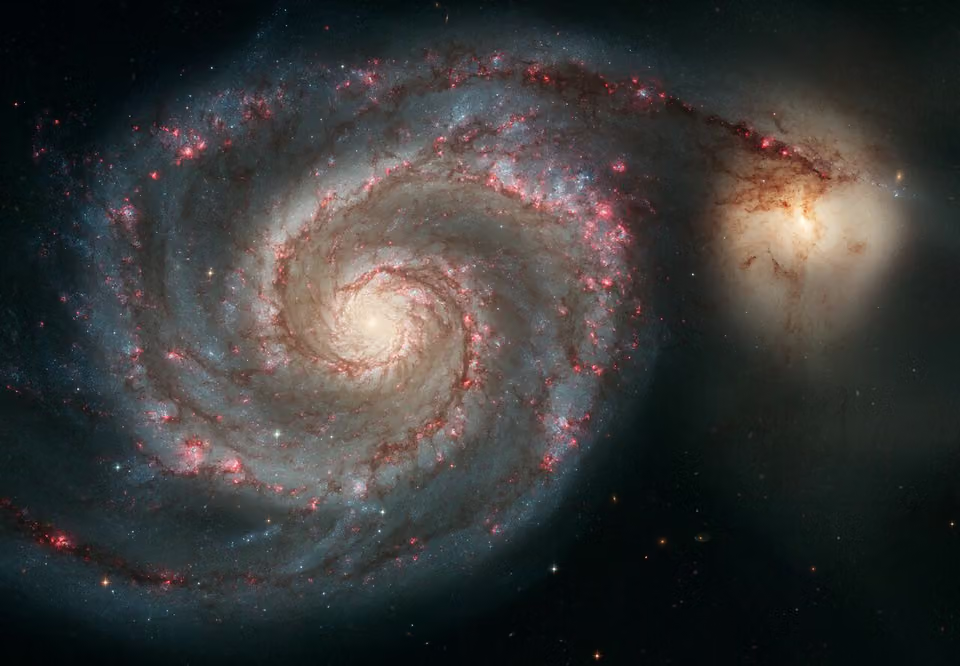

Light, counted pixel by pixel. In January 2005 the Advanced Camera for Surveys photographed the Whirlpool through four filters: blue at 435 nanometers, visible at 555, hydrogen-alpha at 658 and near-infrared at 814. Each exposure records how bright every point is and nothing about its color, so each one is a gray frame like the one shown.
In calibration, cleaning and stitching. Detector effects are removed, cosmic-ray hits are rejected by comparing exposures, and the frames are joined into one mosaic 11,477 pixels wide. Nothing is painted in: the yellowish core of older stars and the smaller companion galaxy passing behind the Whirlpool are both in the measurements.
Each filter is given a hue, and the channels show what each one carries. The red channel lights up the pink star-forming knots along the arms, where hydrogen glows in the 658-nanometer filter. The blue channel shows the dark dust lanes most sharply. The color is a key to which light came from where, not a coat of paint.
Choose a question. The answer appears here and the picture changes to show it.
- Start hereAre the Colors Real?Why color in a space image is a translation rather than a snapshot.
- Part IImage ArtifactsCosmic rays, bleeding stars, spikes and seams: what the camera adds.
- Part IIA Brief History of AstrophotographyFrom a twenty-minute daguerreotype of the Moon to a telescope in orbit.
- Part IIIWhat Makes Them Real?Calibration, documented processing and one firm rule about the data.
Method
How space telescope images are made
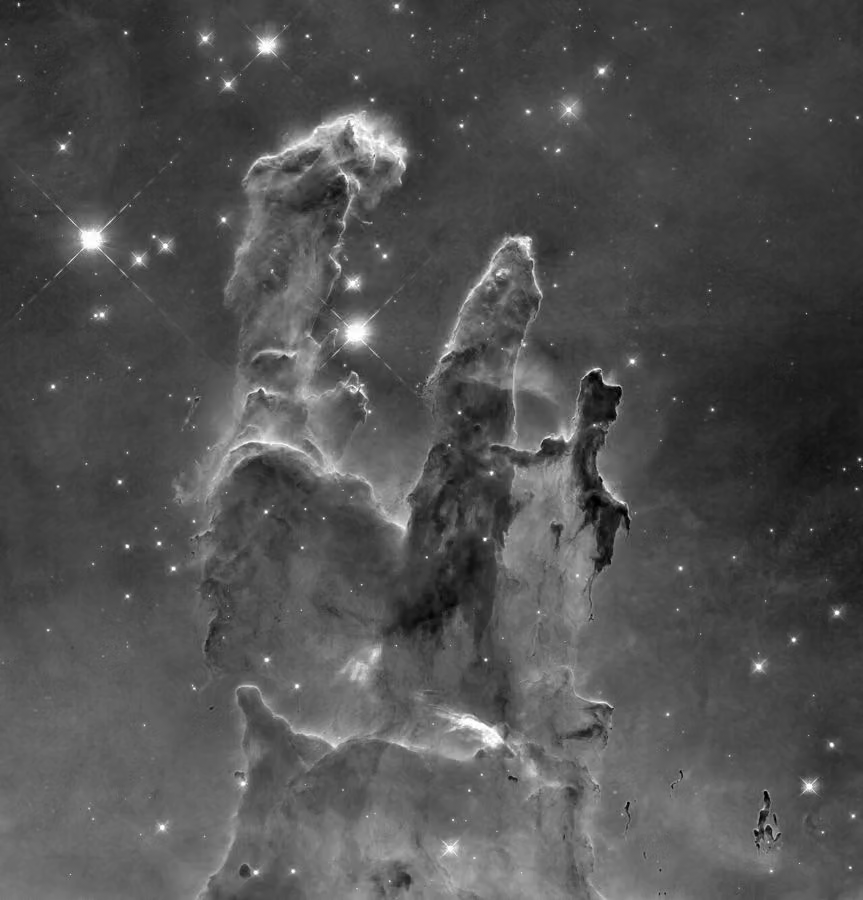
Four steps take a stack of gray frames to the picture on a poster or a phone screen, and the same steps sit behind all Hubble and Webb images. The example is the Pillars of Creation as Hubble photographed them again in 2014.
-
Expose through filters
In September 2014 Wide Field Camera 3 photographed the pillars again through three narrow filters, each passing the glow of one element: F502N for oxygen, F657N for hydrogen and F673N for sulfur. The detector counts light and records no color, so every frame is gray. One of the six pointings in the mosaic spent 50 minutes on oxygen, 30 on hydrogen and 45 on sulfur.
-
Remove what the camera added
Each filter is split into several exposures. In a single 10-minute frame, cosmic rays leave hundreds of bright specks and short streaks, and the gap between the camera's two detectors cuts a black band across the field. Three exposures taken at slightly shifted positions are compared, anything that appears in only one of them is rejected, and the shifts fill the gap. The sky itself is left alone.
-
Give each frame a color
An image processor gives each cleaned frame a hue in chromatic order: the longest wavelength red, the shortest blue. Here sulfur becomes red, hydrogen green and oxygen blue. Hydrogen and sulfur both shine deep red to the eye, so spreading them apart is what makes the structure of the pillars readable.
-
Stack them into one picture
Laid on top of each other, the three toned frames add up to the color picture released on 5 January 2015. Balance and contrast are adjusted so faint gas and bright rims both stay visible, but every structure in the result was already in the gray frames.




The archive
The Hubble Heritage archive
For years the Hubble Heritage project released a new picture almost every month, chosen as much for beauty as for science. Twenty-five of those objects have their own page here, each with the story of how its image was put together.
Eagle Nebula
Three columns of cold gas and dust, the tallest about five light-years high, photographed by Hubble twice, nineteen years apart.
Read the full story Image: NASA, ESA/Hubble and the Hubble Heritage Team- M16Eagle NebulaStar-forming region in Serpens~6,500 ly
- NGC 3372Carina NebulaPillars and young clusters in Carina~7,500 ly
- NGC 7635Bubble NebulaA shell blown by one massive star~7,100 ly
- M57Ring NebulaGas cast off by a dying star in Lyra~2,000 ly
- NGC 6543Cat's Eye NebulaNested shells around a hot central star~3,300 ly
- M1Crab NebulaDebris of a supernova seen in 1054~6,500 ly
- NGC 6960Veil NebulaFilaments of an ancient explosion in Cygnus~2,100 ly
- SN 1987ASupernova 1987ARings around a recent stellar explosion~168,000 ly
- M104Sombrero GalaxyAn edge-on spiral with a dark dust lane~28 million ly
- Hoag'sHoag's ObjectA near-perfect ring of young stars~600 million ly
- M106Messier 106A spiral with an active black hole at its core~23.5 million ly
- V838 MonV838 MonocerotisA light echo spreading through dust~20,000 ly
Lineage
From daguerreotype to Webb
Astronomical photography is younger than most people assume, and every new medium recorded more than the one before it. A plate builds up light for as long as the shutter stays open, so even the earliest showed detail no observer had seen. Long exposures through a filter are still how space telescope images are made.
-
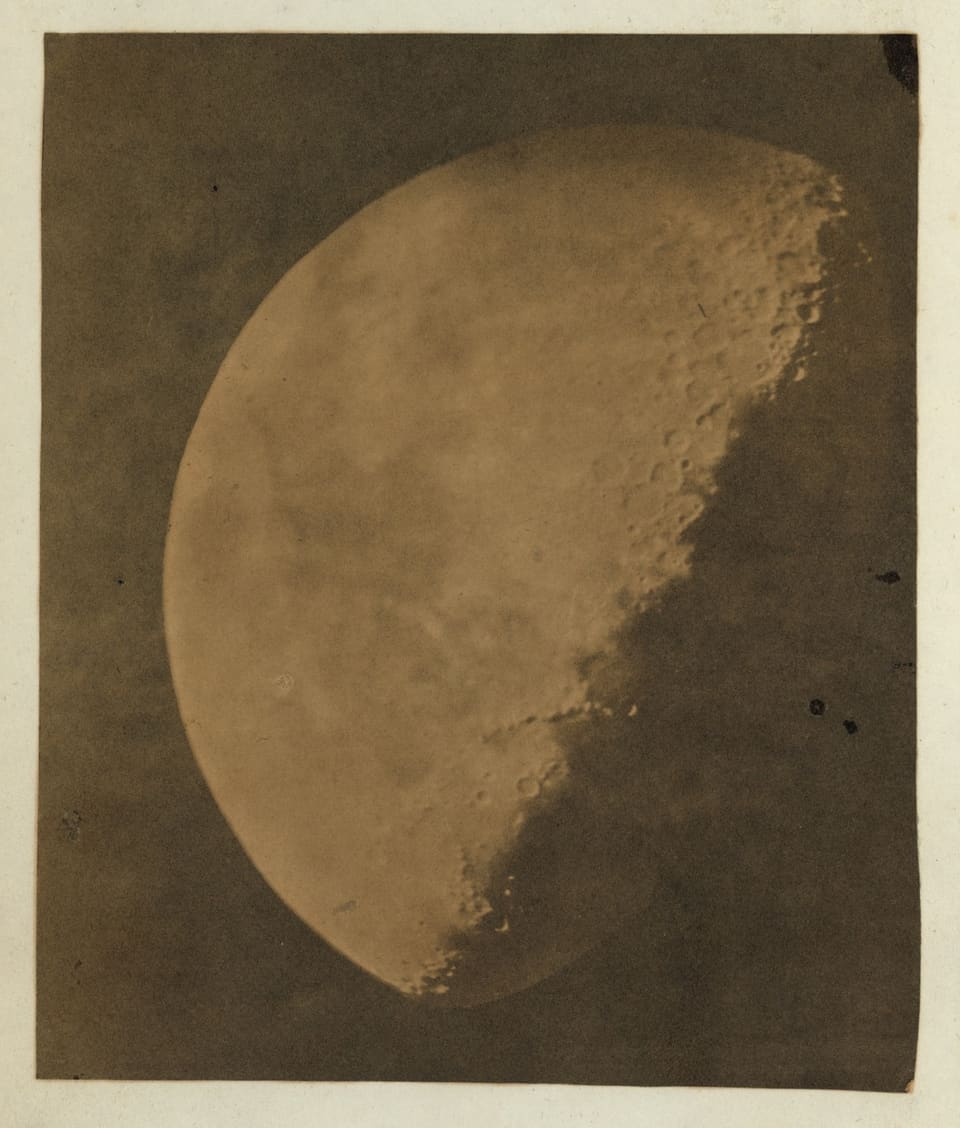
A plate collects light for as long as the shutter stays open. Draper caught the Moon in about twenty minutes in 1840; this print comes from a plate Whipple made at Harvard in March 1851. John Adams Whipple, 1851. Library of Congress (public domain) -
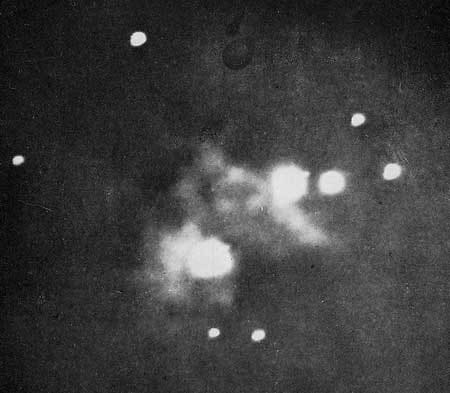
Henry Draper exposes a dry plate on the Orion Nebula for 51 minutes. Only the bright core registers, but it is the first photograph of any nebula. Henry Draper, 1880 (public domain) -
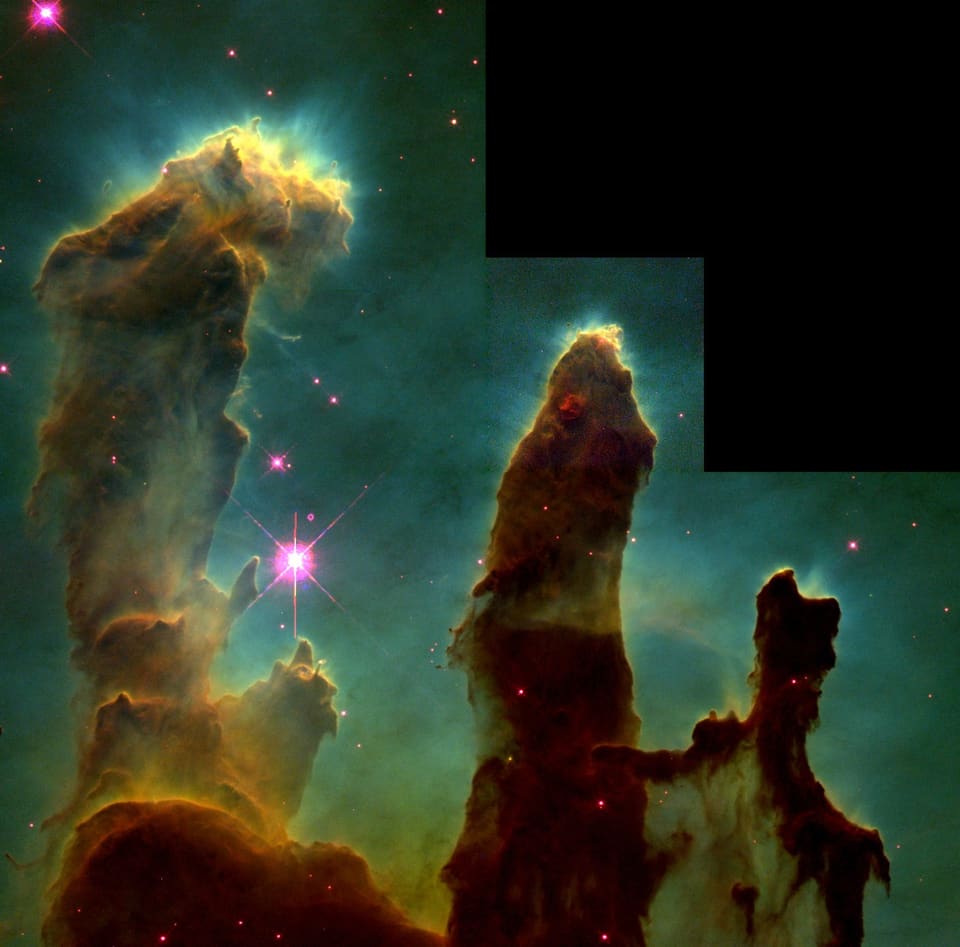
Above the atmosphere, Hubble resolves the pillars of the Eagle Nebula. The stepped notch in the corner is the layout of the camera's four detectors. Jeff Hester and Paul Scowen (Arizona State University), and NASA/ESA -
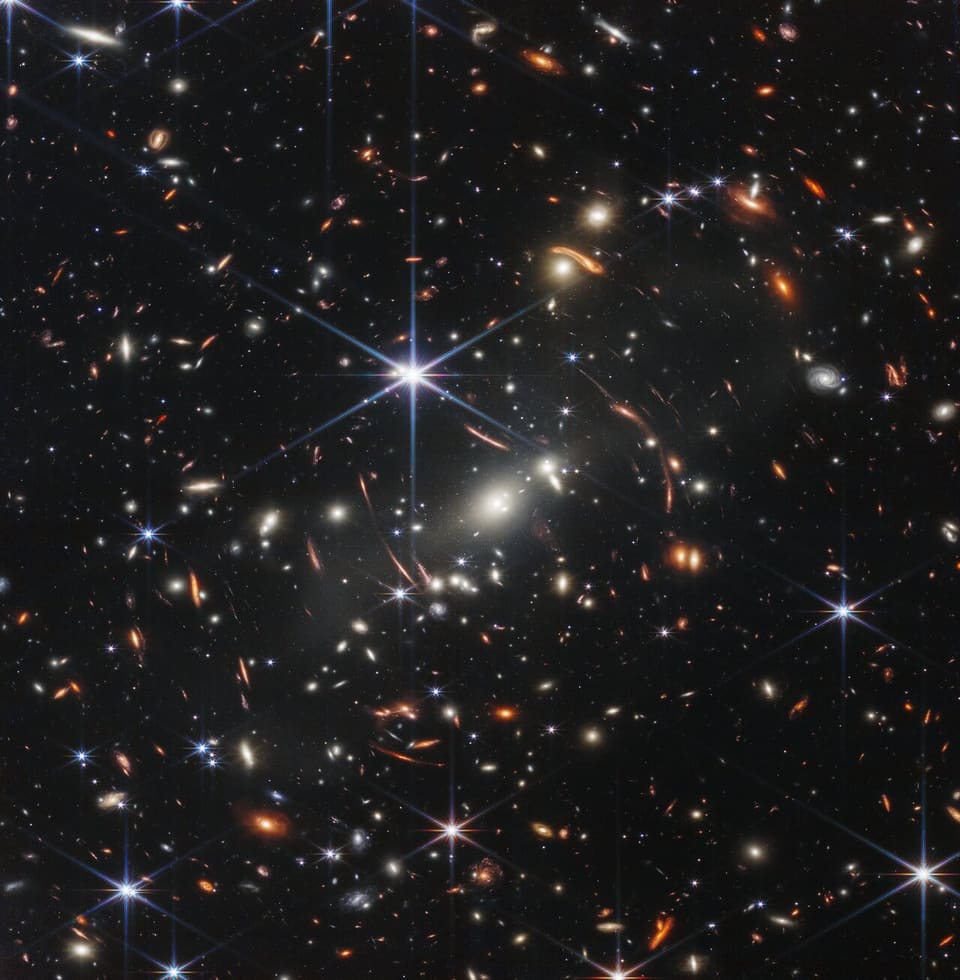
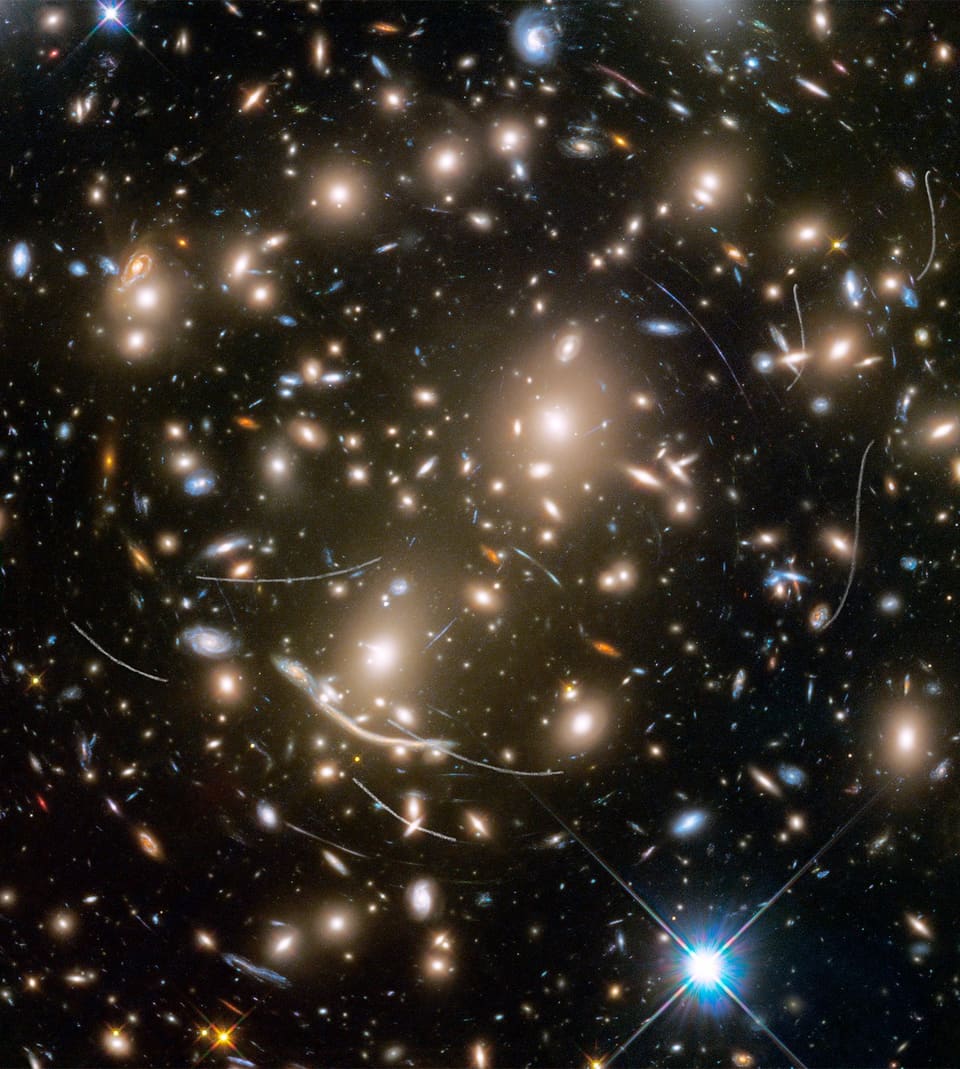
Webb's first deep field, released on 12 July 2022, records the cluster SMACS 0723 and the lensed galaxies behind it in infrared light. NASA, ESA, CSA, and STScI
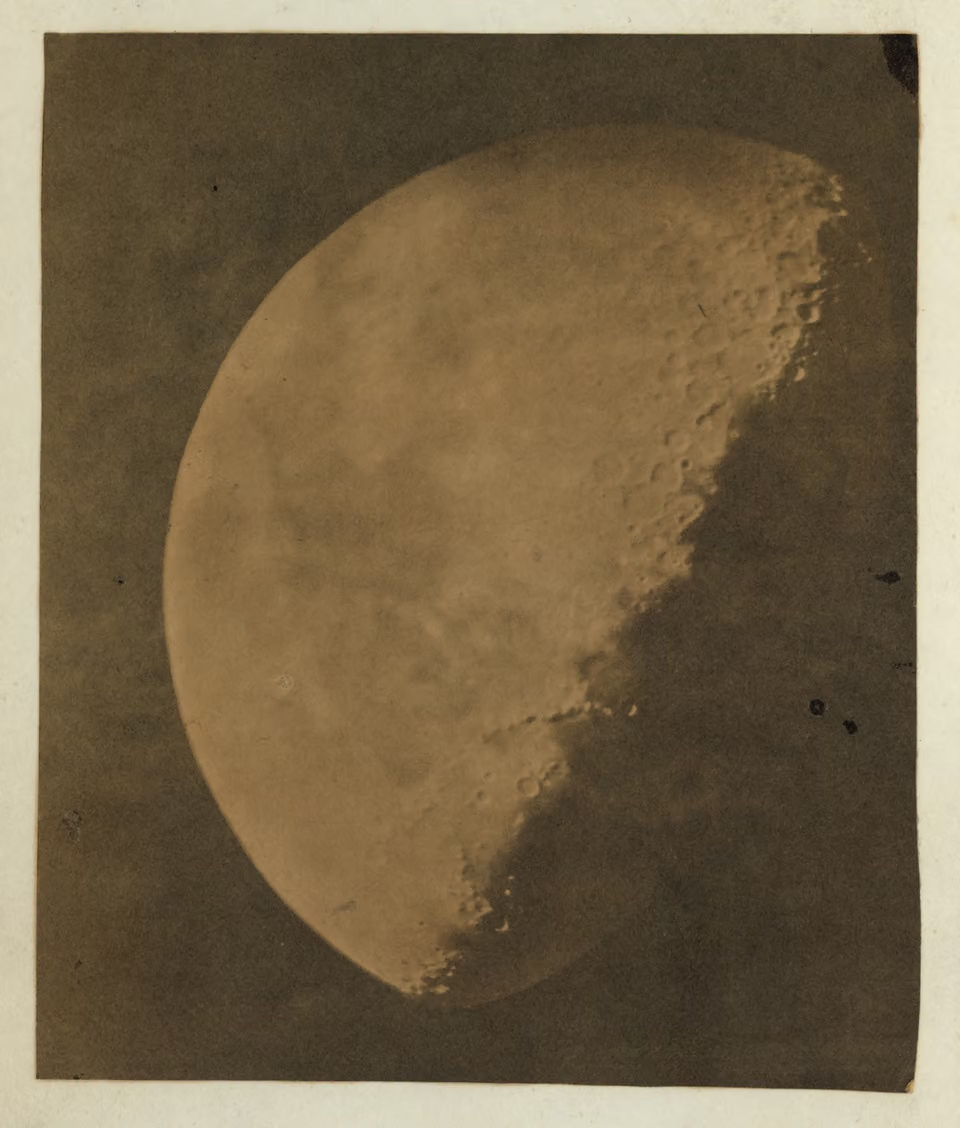


John William Draper exposes a daguerreotype of the Moon for about twenty minutes.
At Harvard, William Cranch Bond and John Adams Whipple record Vega, the first star on a plate.
Henry Draper photographs the Orion Nebula, the first nebula caught on a plate.
The Hubble Space Telescope reaches orbit, above the shimmer of the atmosphere.
Hubble's view of the Eagle Nebula's pillars becomes one of the most reproduced pictures in science.
Webb launches on 25 December to observe the universe in infrared light.
New on the bench
Latest articles
-
-
-
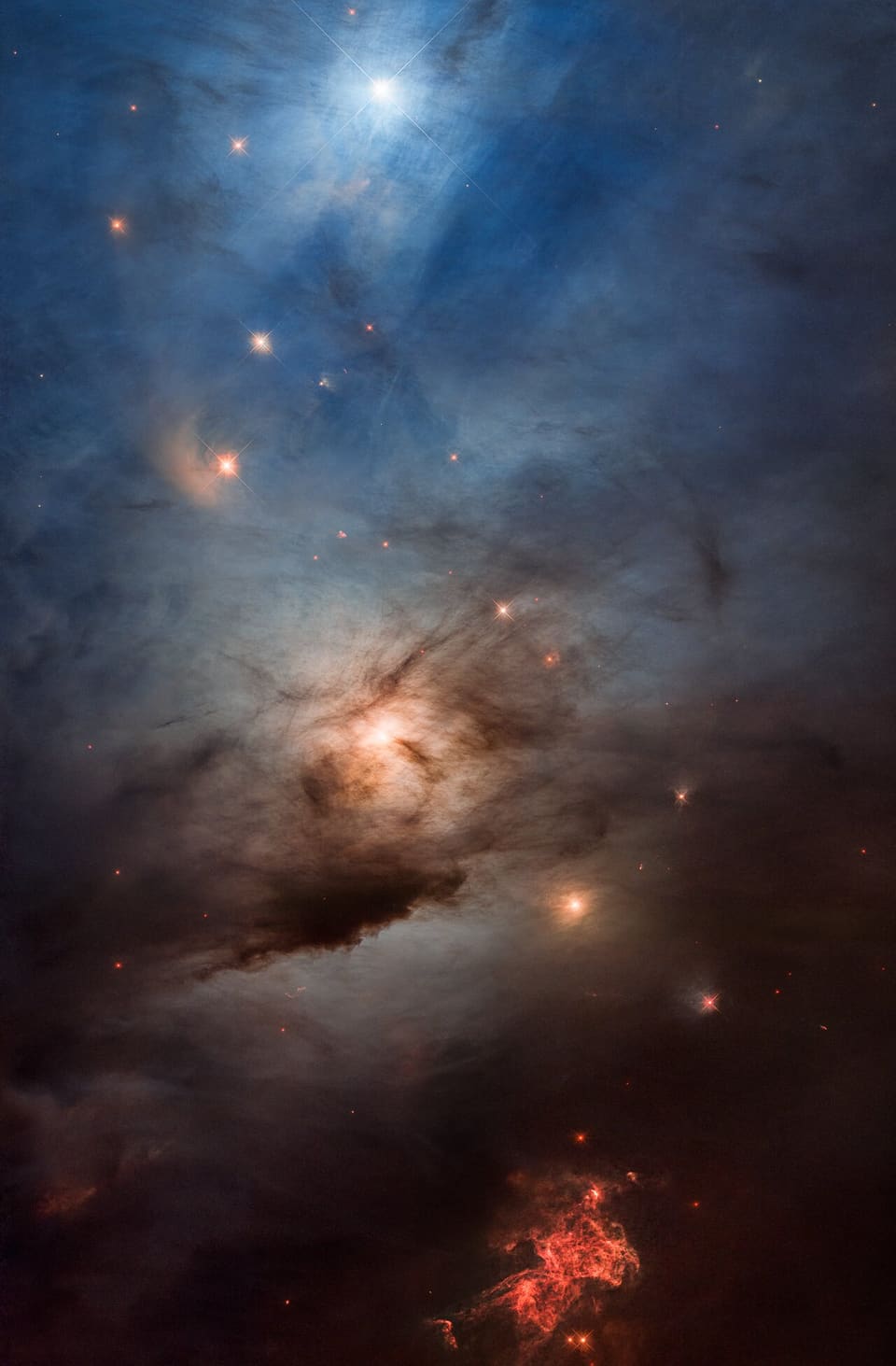
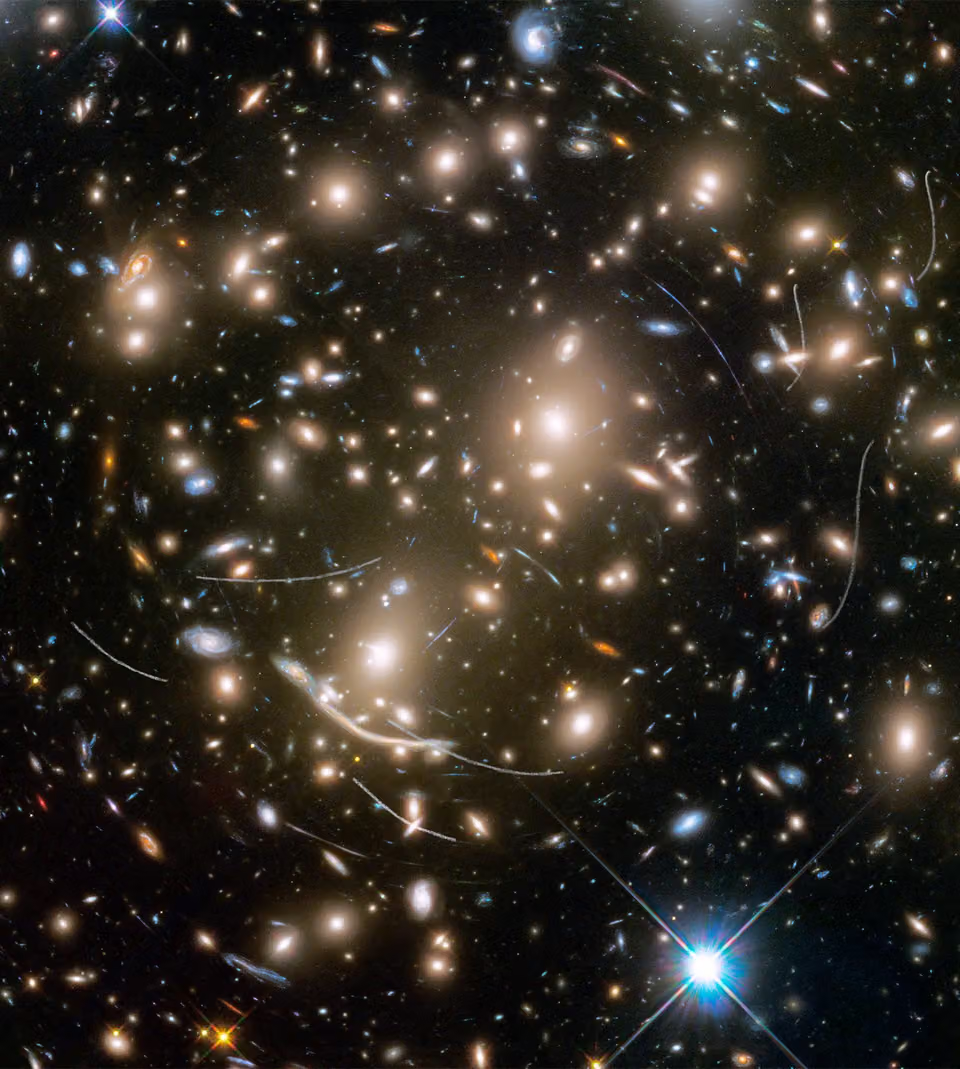
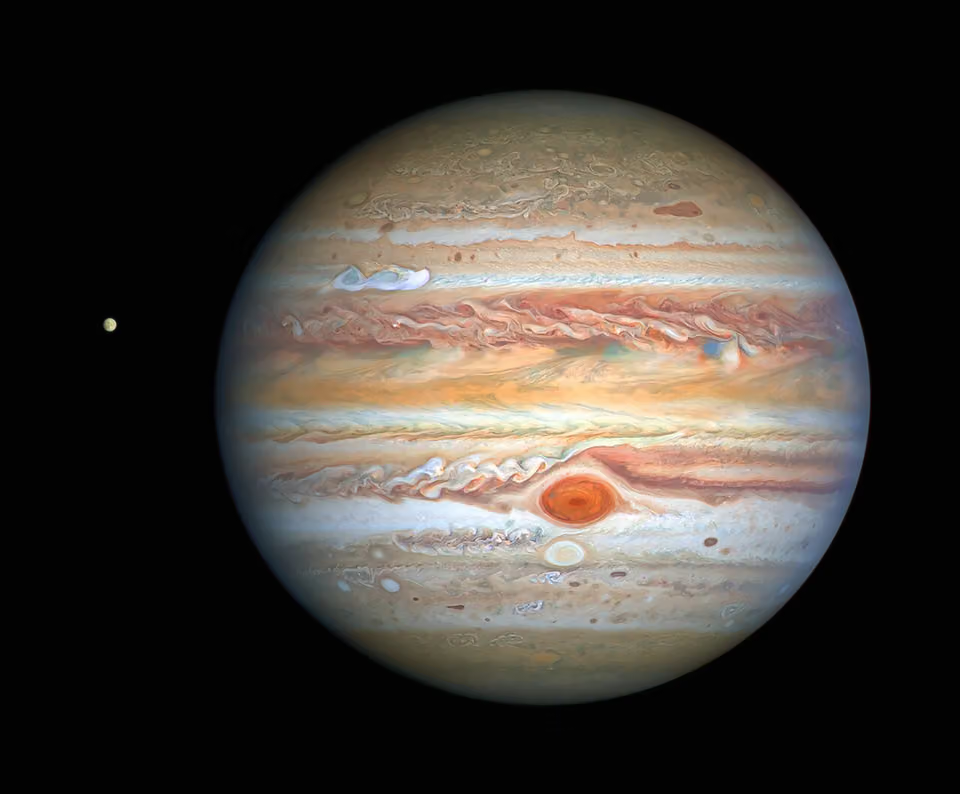
Questions
Questions readers ask
Short answers to what people most often want to know about space pictures.
Are Hubble images real photographs?
Yes. Every Hubble picture is built from measurements of light that the telescope collected from a real object. The data are calibrated, cleaned of camera artifacts and combined, but nothing is painted in. Only the color is added later, from separate black-and-white exposures.
Why do space telescopes take pictures in black and white?
A detector that records only brightness can be far more sensitive and precise than one with a color mask over its pixels. Putting the color selection in a filter in front of the camera lets astronomers choose exactly which wavelengths to measure, including light the eye cannot see.
Would the Eagle Nebula look like this through an eyepiece?
No. Through a telescope eyepiece most nebulae appear as faint gray haze, because the eye cannot build up light over time and sees little color in dim light. Long exposures collect light for hours and reveal what the eye cannot register.
Who decides the colors in a Hubble image?
Image processors, working with the astronomers who planned the observations. They follow conventions, mainly chromatic order, so that longer wavelengths look redder than shorter ones. Balance and contrast leave room for judgement, so two versions of one object can differ.
What does representative or false color mean?
It means the colors stand for wavelengths rather than reproducing what an eye would see. Infrared and ultraviolet light, or narrow emission lines from oxygen, hydrogen and sulfur, are each given a visible hue. The color is a code for real physical information.
What color is Mars really?
Closer to butterscotch or rusty tan than to a bright red. The color comes from iron oxide dust, and it shifts with lighting, dust in the air and the camera used. Daylight-balanced images and raw spacecraft frames differ, and both can be honest.
Why do stars in Hubble images have spikes?
The spikes come from light bending around the struts that hold the telescope's secondary mirror. Hubble's four supports produce four spikes. Webb's hexagonal segments and three struts give six points plus two fainter spikes.
How is color in Webb images different from Hubble?
Webb observes almost entirely in infrared, which no human eye can see. Its pictures therefore always use representative color: the infrared filters are spread across the visible range in chromatic order. Hubble covers ultraviolet, visible and near-infrared light, so some of its images sit closer to natural color.
Same light, same data. Only the toning changes.
Mix the colors again