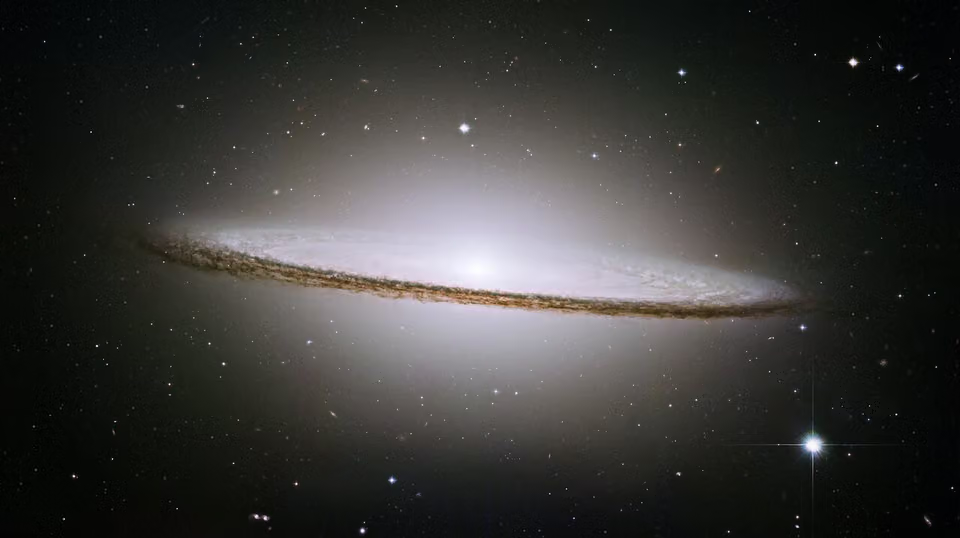


Light, and the absence of light
Everything known about a distant galaxy arrives as light: visible and invisible energy given off by stars and hot gas, or reflected by planets, moons and dust. On Earth the same holds for a canyon wall or a waterfall, lit by the one star close enough to warm it. Telescopes and cameras do the same job at different distances. Their mirrors and lenses gather that light, and the brightness, colors and patterns recorded tell what a scene is made of and how it formed.
The missing light matters as much. Shadows, silhouettes, eclipses and light absorbed or scattered along the way give a picture its depth. A dust lane in the Sombrero Galaxy is visible only because it blocks the stars behind it. A Joshua tree is a black shape against a sky full of star trails. And where gravity bends light, as it does around massive galaxy clusters, the distortion itself becomes a lens that magnifies galaxies too faint to see any other way.
Why the pictures are paired
The Celestial-Terrestrial Convergence gallery sets five Hubble images beside photographs from Yellowstone, Yosemite, Grand Teton, Great Sand Dunes and Joshua Tree. Some pairs share a physical process. Others share only a look, and the difference is the instructive part: the orange of a sunlit waterfall is reflected light, while the red of a nebula is gas giving off light of its own. The essay Celestial-Terrestrial Convergence: Hubble Views and Landscapes follows four further pairs, built around erosion, outflow and the view of a galaxy from inside and outside.
Color in the two kinds of picture also follows different rules. A landscape photograph records roughly what an eye would have seen. A Hubble image is assembled from black-and-white exposures taken through filters, and the colors are assigned afterward to show which element or wavelength produced each part of the scene, as explained in Are the Colors Real?
A camera above the atmosphere
Hubble was launched in 1990 and orbits about 350 miles (560 kilometers) above Earth's surface. From there, the blurring and glow of the atmosphere no longer stand between the telescope and its targets, so it can resolve fine detail in very faint objects. Its 94.5-inch (2.4-meter) mirror collects ultraviolet, visible and near-infrared light and feeds it to the scientific instruments. The data are sent to the ground, where they are calibrated, analyzed and combined into images, with light from objects as distant as 13.3 billion light-years.
Hubble cannot photograph a solar eclipse, because it must never point toward the Sun. It records other alignments instead. In April 2014 it caught the shadow of Ganymede, Jupiter's largest moon, falling on the Great Red Spot, where anyone standing in that shadow would have seen a total eclipse. In February 2009 it watched Titan and the much smaller Mimas cross Saturn with their shadows. With a coronagraph, Hubble can also block the light of a nearby star inside its own optics, an eclipse on demand that reveals faint rings of dust the star would otherwise drown out.
The landscape photographs work under the opposite conditions. They look up through the full depth of the atmosphere, which turns sunsets orange and the daytime sky blue, adds a faint airglow to night skies, and colors the Moon red during a lunar eclipse by bending sunlight into Earth's shadow. Those effects are part of what the landscapes show, and part of what Hubble was sent into orbit to escape.
Questions readers ask
What does celestial-terrestrial convergence mean?
It names the idea behind these pages: a picture of a place in space and a photograph of a landscape on Earth, placed side by side because they look alike. The pairs show shared shapes, and often shared processes such as erosion, outflow, or dust blocking light, at scales from meters to light-years.
Are the landscape photographs made with telescopes?
No. The landscapes were taken with ordinary digital cameras and lenses, usually on a tripod, in national parks and other public lands. The Hubble images come from the cameras on the telescope. The point of the pairing is that both kinds of picture record the same thing, light reaching a detector, at very different distances.
Why does Hubble avoid photographing the Sun?
Sunlight would damage the telescope and its instruments, so Hubble is never pointed at the Sun or close to it. It cannot record a solar eclipse. It can record smaller alignments, such as a moon of Jupiter or Saturn casting its shadow on the cloud tops, or block a star inside its own optics with a coronagraph.
Can the pictures in the gallery be reused?
The Hubble images carry their own credit lines, and ESA/Hubble releases its images under a Creative Commons Attribution license. The landscape photographs come from the National Park Service, whose work is in the public domain, or from photographers who chose a Creative Commons license. Each credit line names the source and the license that applies.