Exhibit
Celestial-Terrestrial Convergence: Five Hubble and Landscape Pairs
A hot spring and a stellar bubble, a lit waterfall and a pillar of gas: five pairs of pictures, and what light is doing in each one.
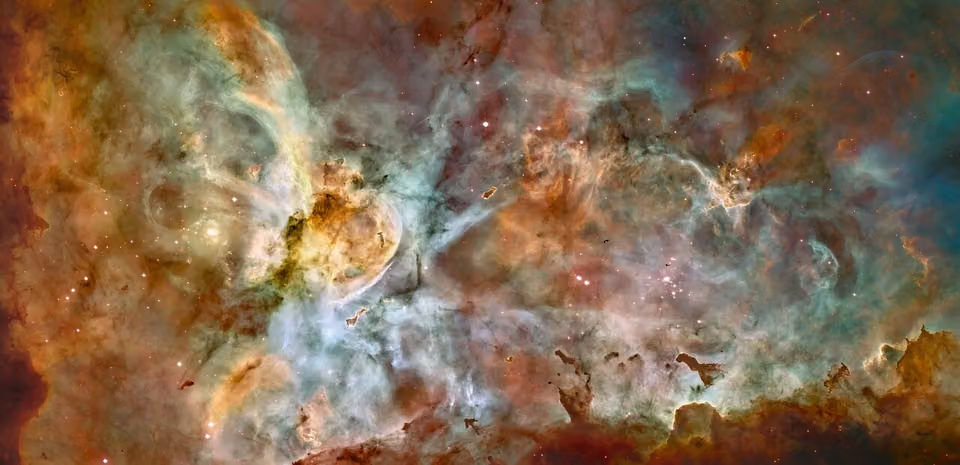
The picture above spans about 50 light-years of the Carina Nebula, assembled from 48 Hubble frames. Turn it on its side and squint, and it could pass for a mountain range at dusk. The gallery below puts five Hubble images next to five photographs taken in American parks, chosen because the two pictures in each pair look alike. Each pair also shows a different trick of light: color made by heat and life, light that is reflected and light that is emitted, dust that blocks starlight, time collected by a camera, and the gap between what is visible and what is out there.
The landscapes were made by park staff and by independent photographers who released their work under open licenses; the credit under each picture names them. A shorter essay on four other pairings, including the Pillars of Creation beside Delicate Arch, is in Celestial-Terrestrial Convergence: Hubble Views and Landscapes.
A ring of color: the Bubble Nebula and Grand Prismatic Spring

Seen from the air, Grand Prismatic Spring in Yellowstone is a blue eye roughly 75 by 91 meters (250 by 300 feet) across, rimmed in yellow and orange. The blue is the water itself: water absorbs red light, so a deep, clear pool returns mostly blue. The rings around it are mats of algae, bacteria and archaea. Their color depends on the balance of chlorophyll and carotenoid pigments in the microbes, so the mats look orange and red in summer and turn darker green in winter, when the organisms make more chlorophyll to cope with weaker sunlight.
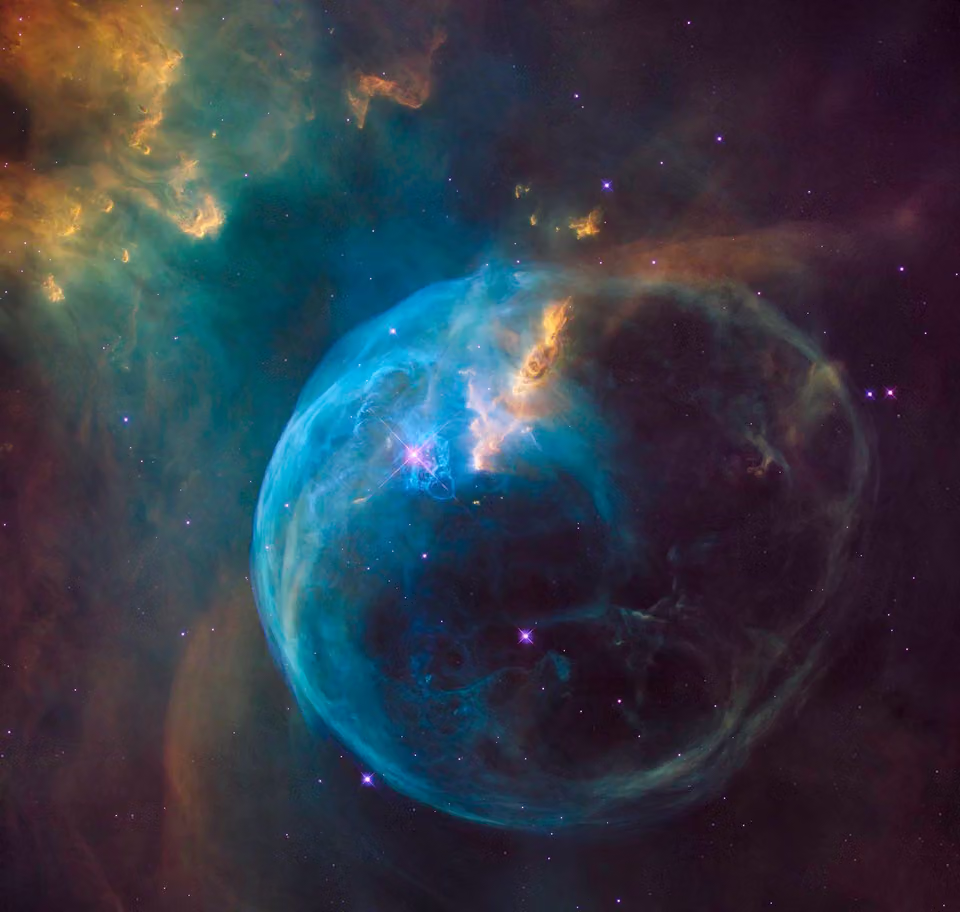
The Bubble Nebula in Cassiopeia has a ring structure for an unrelated reason. A single massive star is blowing a shell of gas outward with its wind, and the shell glows because the star's ultraviolet light energizes it. Hubble photographed it in February 2016, and the picture marked the telescope's 26th year in orbit. Its colors are assigned to filters: glowing oxygen is shown blue, hydrogen green and nitrogen red, a convention explained in Are the Colors Real? In the spring, the color is a pigment you could scoop up in a jar. In the nebula, it is a label for an element.
Reflected or emitted: the Eagle spire and Horsetail Fall


Horsetail Fall flows over the eastern edge of El Capitan, and on rare evenings in mid- to late February the setting Sun backlights it so that the thin stream turns orange, as if it were flowing lava. Nothing in the water is hot. The fall is catching sunlight that has passed through a long stretch of atmosphere near the horizon, and the effect lasts only while the angle of the Sun and the position of the fall agree.
The tower in the Eagle Nebula shows both kinds of light at once. It is a column of cold gas and dust about 9.5 light-years tall, photographed with the Advanced Camera for Surveys in November 2004. Ultraviolet light from a group of hot young stars beyond the top of the frame lights its rough surface and slowly erodes it, and streamers of gas boil off the edges as a haze. The blue at the top is oxygen glowing on its own; the red lower down is hydrogen doing the same. Telling reflected light from emitted light is a basic question for any astronomer reading such an image, and the waterfall is a reminder of how easily the eye mistakes one for the other. The full Eagle story, including the famous 1995 and 2014 views of the larger pillars, is on the Eagle Nebula page.
Dust across a disk: the Sombrero Galaxy and the Milky Way
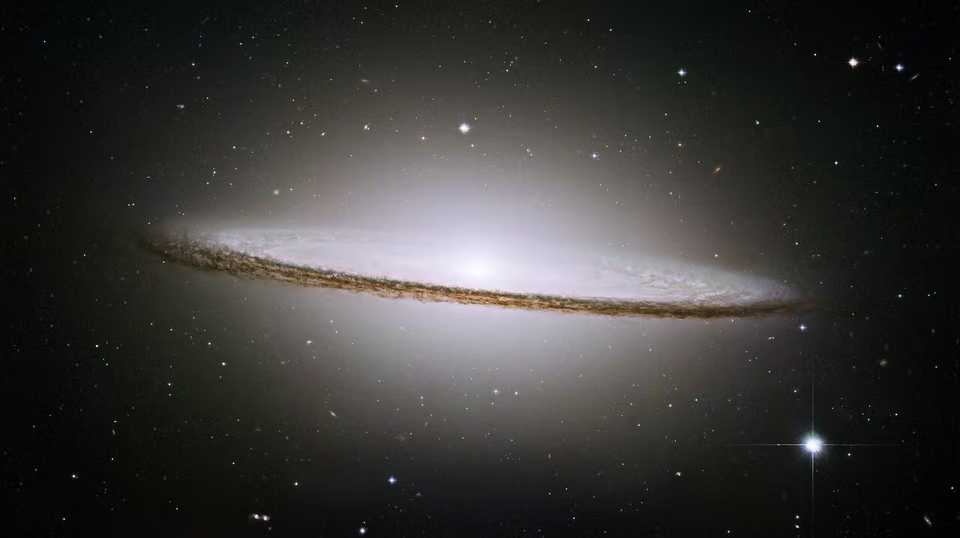

The Sombrero Galaxy, M104, lies about 30 million light-years away and measures about 50,000 light-years across. Earth sees it only six degrees above the plane of its disk, so the dust in that disk forms a dark band across the bright central bulge. The dust does not glow in visible light. It is visible only because it blocks and scatters the starlight behind it.
Over the barns of Mormon Row in Grand Teton National Park, the Milky Way shows the same effect from the inside. The Sun sits within the disk of its galaxy, so the disk appears as a band wrapped around the sky, and the dark rifts that split it are clouds of interstellar dust hiding the stars beyond. The structure that Hubble records in M104 at a single glance has to be pieced together for the Milky Way from a vantage point inside it.
Gathering time: the eXtreme Deep Field and star trails over Cyclops Rock


Both pictures are stacks of many exposures, built for opposite purposes. Above Cyclops Rock in Joshua Tree National Park, a camera on a tripod recorded frame after frame for about an hour while Earth turned, and the combined image draws each star as an arc around the celestial pole. The bright streak on the rock is the headlamps of climbers on a night ascent, stacked into one line the same way. The stacking is used to show motion.
The eXtreme Deep Field stacks a decade of Hubble observations of one small patch of sky in Fornax, more than two million seconds of exposure in total. Hubble held its pointing through every exposure, so the stars and galaxies stay fixed and their faint light piles up. The patch is less than a tenth of the width of the full Moon, about one 30-millionth of the whole sky, and it holds roughly 5,500 galaxies, some seen as they were when the universe was less than five percent of its present age. How small a field Hubble covers compared with a camera lens is the subject of Fields of View.
Counting the uncountable: Abell 370 and the Great Sand Dunes


On a moonless summer night at Great Sand Dunes in Colorado, the Milky Way stands above the dune field. Only a few thousand of its stars are bright enough for the naked eye, out of a total in the hundreds of billions, and scientists estimate that the universe holds more stars than Earth has grains of sand.
Abell 370 is one way to see why. The cluster lies almost five billion light-years away and is one of the first in which astronomers saw gravitational lensing: its mass bends the light of galaxies far behind it into arcs and streaks. Ground-based observations in the mid-1980s showed that the largest arc, at right in this view, is the stretched image of a galaxy about twice as distant as the cluster. Hubble took this picture on July 16, 2009, with the Advanced Camera for Surveys, which astronauts had repaired that May during the final servicing mission. Each smudge in the frame is a galaxy, and each galaxy holds billions of stars.
Questions readers ask
Are the landscape photographs edited to look like the Hubble images?
No. Each landscape was chosen because it already resembles its Hubble partner, and both are shown as their photographers released them, apart from cropping where the credit says so. The resemblance comes from shape, color and lighting in the original scenes. The pairs were made by matching existing pictures, not by altering one to fit the other.
Why are the stars sharp in the Hubble images but drawn as lines over Joshua Tree?
A camera on a tripod stays still while Earth rotates, so over a long series of exposures each star traces an arc around the celestial pole. Hubble locks onto guide stars and keeps its pointing steady for the length of every exposure, so stars and galaxies stay as points even when the total exposure time runs to weeks.
What makes the colors of Grand Prismatic Spring?
The deep blue center is the water itself, which absorbs red light and returns blue. The yellow, orange and red rings are mats of microbes, algae, bacteria and archaea, whose color depends on the mix of chlorophyll and carotenoid pigments they produce. In winter, with less sunlight, the mats make more chlorophyll and look darker green.
Is Horsetail Fall really glowing?
No. The orange color is sunlight caught by the falling water during a short window in mid- to late February, when the setting Sun backlights the fall at just the right angle. The light has crossed a long path through the atmosphere near the horizon, which leaves it orange. The parts of the Eagle Nebula that glow are different: that gas emits its own light after being energized by ultraviolet radiation from hot stars.
Can the dark lanes in the Milky Way be seen without a telescope?
Yes. Under a dark sky far from city lights, the band of the Milky Way shows dark rifts with the naked eye, and they stand out clearly in a long exposure like the one taken over Mormon Row. They are clouds of interstellar dust inside the galaxy, blocking the light of stars that lie behind them.