Solar System
Asteroid 6478 Gault: Two Ways to Process One Hubble Observation
One asteroid spinning itself apart, one set of exposures, and two published pictures that answer different questions about it.
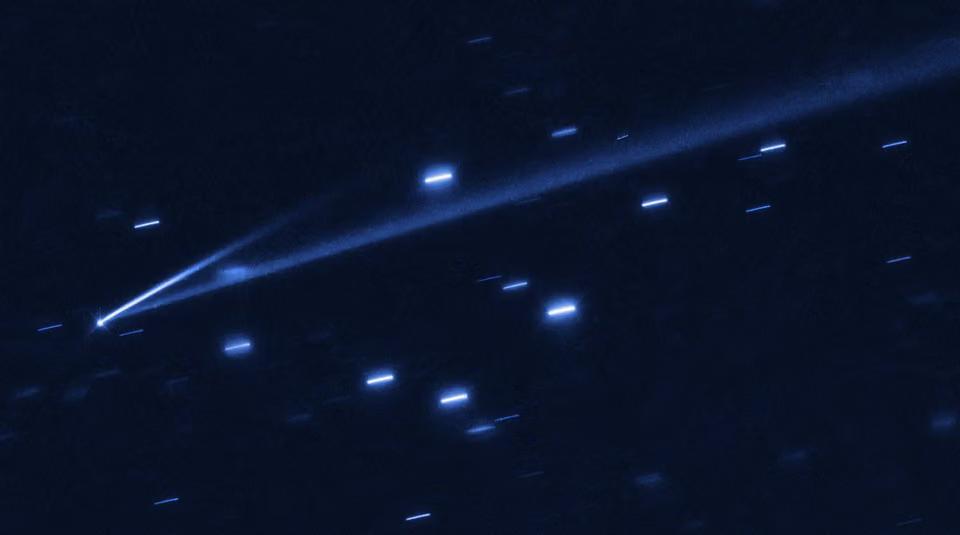
Asteroid 6478 Gault orbits the Sun in the main asteroid belt between Mars and Jupiter, and in early 2019 it started to look like a comet. Two thin tails of dust streamed away from it. The cause was not ice turning to gas but spin: Gault rotates about once every two hours, close to the speed at which loose material on its surface begins to slide off into space. Hubble photographed it in February 2019, and the same data ended up published as two quite different pictures.
An asteroid that is coming apart
Gault was discovered in 1988 and for three decades behaved like an ordinary main-belt rock, between about 4 and 9 kilometers across according to the ESA/Hubble release. The first sign of trouble came on January 5, 2019, when the ATLAS survey telescopes in Hawaii recorded a tail. A search of older survey data found the longer tail already present in December 2018, and a second, shorter one showed up in January. Working back from the dust, researchers dated the two events to around October 28 and December 30, 2018.
The process behind it is called the YORP effect. Sunlight warms an asteroid, and the infrared heat that escapes from its surface carries away a tiny amount of momentum. Over long periods that small push can spin an asteroid faster and faster. When the spin is quick enough, landslides on the surface throw rubble and dust into space, and the debris forms a tail. Gault's rotation, measured from ground-based follow-up, sits right at that two-hour limit. Such breakups are not common: among the roughly 800,000 known asteroids in the belt, astronomers estimate that a YORP disruption happens about once a year, and only a handful have been caught while it was under way.
Hubble's sharp view added detail. The tails are narrow, which suggests each release of dust lasted only a few hours to a couple of days, and there was no extra dust close around the asteroid itself. The ESA release on the findings is heic1906 on esahubble.org.
Why the stars become streaks
Pointing at an asteroid is not like pointing at a galaxy. A moving solar system target has to be tracked through the whole observation, so the telescope follows the asteroid and everything else in the field drifts. Stars that would be sharp points in a normal image are dragged into short lines, the way a photograph of a race car taken by panning with it leaves the background smeared.
Hubble's own motion adds to this. The telescope races around Earth at about five miles per second, so its viewpoint shifts during each exposure too. Over the roughly 42 minutes of the five exposures taken on February 5, 2019, from 15:08:42 to 15:51:06 UT, Hubble carried its camera about halfway around the planet.
Two images from the same data
The image released by NASA and STScI set out to give the cleanest possible view of the asteroid. Several exposures were available, and adding them together strengthens the signal from the asteroid while the noise and the star trails, which fall in different places in each frame, can be suppressed. The result is a smooth picture of Gault and its two tails against an almost empty background.
ESA/Hubble took a different route for the version shown at the top of this page. It was made from a single exposure and leaves the star trails in. That costs some quality, because one frame carries more noise than a stack, but it also shows the motion that every observation of a moving object involves. The asteroid looks like it is moving because, in the frame, it is.
The raw data show why the stack is cleaner. A single uncalibrated frame shows the asteroid and the trails, and also things that are not in the sky at all: the gap between two detectors, and a speckle of bright pixels and streaks across the whole field. That speckle is the signature of cosmic rays, energetic particles that pass through the telescope and strike the detector during an exposure. Taking several exposures is the standard way to identify and remove them, since a cosmic-ray hit lands in only one frame. They can be cleaned from a single exposure too, as the ESA image shows, but with some loss of quality. Other sources of such marks are described in Image Artifacts.
A movie of five frames
Because the observation was split into several exposures, the frames can also be played in sequence. There was some hope that the tails might change over a short time, so the five 6.5-minute exposures from February 5 were assembled into a short animation. The tails did not change visibly. The background did: the star trails slide past the asteroid, and the shift between frames reflects Hubble's own trip around Earth as much as the asteroid's motion.
Neither image is more truthful than the other. Both start from the same calibrated data, with nothing added and nothing invented, and differ only in choices made early in processing: stack or single frame, remove the trails or keep them. Each choice serves a different part of the science story, and that kind of editorial judgment is part of every published astronomical image. What Makes Them Real? looks at where those judgments start and stop. A much older chance sighting of an asteroid in Hubble data is the asteroid trail in Centaurus, recorded in 1998.
Questions readers ask
Why does asteroid Gault have tails?
It spins about once every two hours, close to the limit at which material on its surface starts to slide off. Landslides released dust in two short episodes, dated to around October 28 and December 30, 2018. The dust spread out behind the asteroid and formed two comet-like tails.
What is the YORP effect?
Sunlight heats an asteroid's surface, and the infrared radiation that leaves the warm surface carries away a little momentum. Acting over long periods, this small force can change how fast the asteroid spins. If the spin gets fast enough, the asteroid can begin to shed material, as Gault did.
Why are there two different Hubble images of Gault?
The NASA and STScI version stacked several exposures to give a clean view of the asteroid with the star trails removed. The ESA/Hubble version used one exposure and kept the star trails, giving a slightly noisier image with a strong sense of motion. Both come from the same observation.
What are the specks in raw Hubble images?
They are mostly cosmic rays, high-energy particles that pass through the telescope and hit the detector during an exposure. Each leaves bright pixels or short streaks. Because a hit appears in only one frame, comparing several exposures makes them easy to find and remove.