How images are made
Hubble on IMAX: The Short Film That Flew Through the GOODS Deep Field
A trailer-length film on the biggest screens there are, made almost entirely in-house from a deep Hubble survey of nearly 30,000 galaxies.
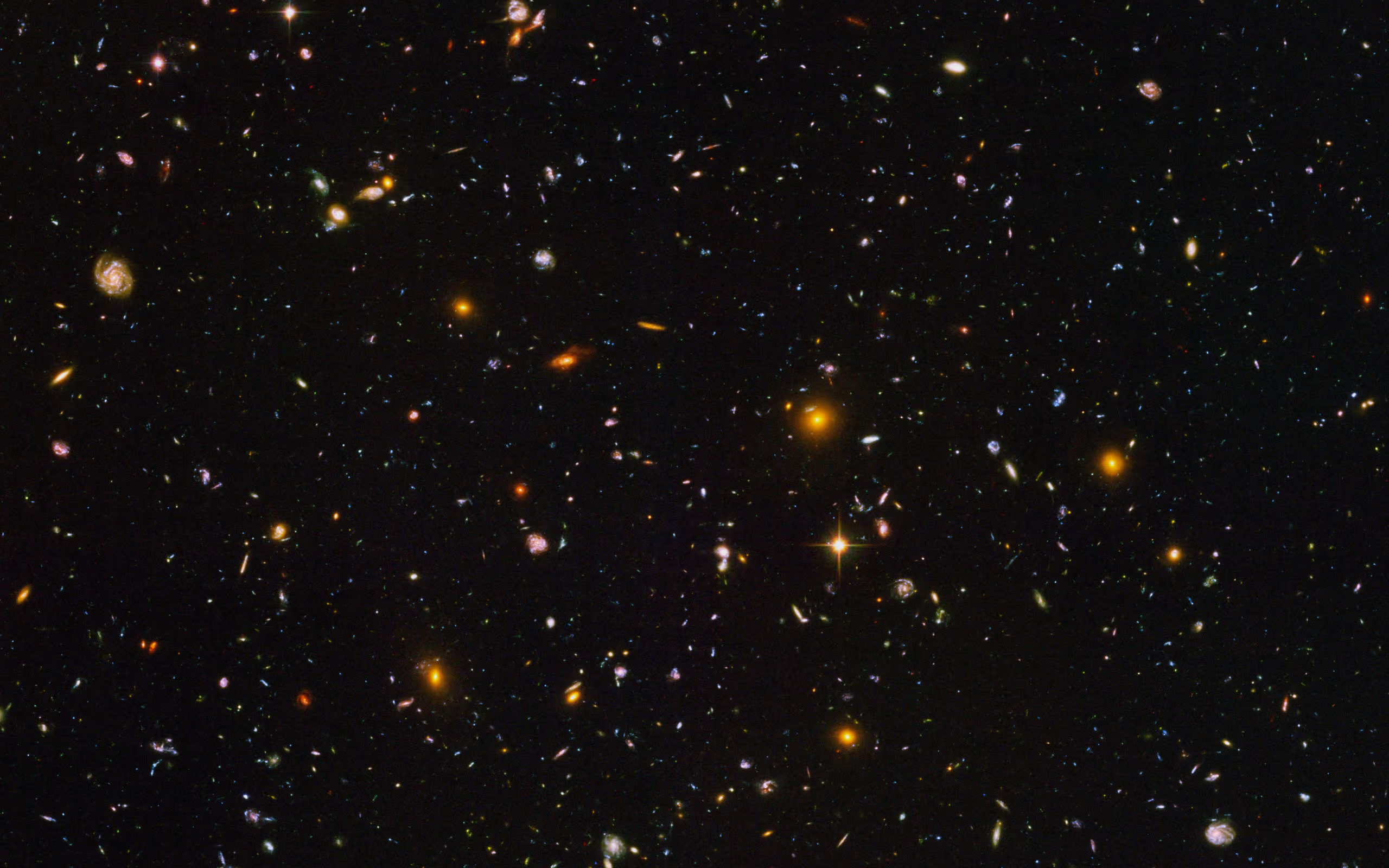
On March 9, 2002, the Hubble Space Telescope drifted away from the Space Shuttle Columbia with new solar arrays and a new camera on board. Exactly two years later, on March 9, 2004, data from that camera filled a large-format movie screen at the Maryland Science Center in Baltimore, in a film under three minutes long that flew the audience through a field of distant galaxies.

A camera with an IMAX screen's worth of pixels
The camera was the Advanced Camera for Surveys, installed by Columbia's astronauts during Servicing Mission 3B in early 2002. Its new detectors made Hubble about ten times more efficient at visible-light imaging and delivered frames of 4K by 4K pixels. A single exposure already held about as much detail as a frame of large-format film, and mosaics of many exposures would hold far more, since a single frame covers only a small patch of sky (see Hubble's field of view).
The large-format system in question runs 70 mm film through the projector, with 15 perforations per frame, at close to four feet per second. Its resolution outstrips high-definition television by a wide margin, and theaters equipped for it were common at science centers. What kept astronomy footage off those screens was cost: conventional production in the format ran to hundreds of thousands of dollars per minute.
A three-minute short, almost for free
The answer was to think small in running time. The idea was a series of trailer-length films, each under three minutes, produced digitally and almost entirely in-house, and offered to science-center theaters at very low cost as a bonus to run before a feature.
The pilot depended on a sponsor. DKP 70MM Productions, a subsidiary of IMAX Corporation, agreed to donate the services and materials needed to turn the digital frames into a film negative and a first print. Without that contribution the pilot could not have been made.
Why the GOODS field was chosen
For the subject, the producers settled on the Great Observatories Origins Deep Survey, known as GOODS, a joint program of Hubble with many other observatories in space and on the ground. Hubble's share included a huge, deep image covering a patch of sky comparable to a quarter Moon and containing almost 30,000 galaxies. The light of the faintest had been traveling for some ten billion years, so the field works as a core sample of the universe, showing galaxies as they were at many past epochs.
What made it suitable for a flight, as opposed to a slow pan across a flat picture, was distance information. The GOODS team had run a separate ground-based campaign to measure photometric redshifts, distance estimates based on how a galaxy's brightness changes across several color filters. With an estimated distance for many of the galaxies, each one could be placed at its own depth.
Building the flight
On paper the task had four steps. Convert the survey data into a picture fit for animation. Cut out the individual galaxies. Set each galaxy, as a flat sprite, at its estimated distance inside 3D animation software. Move a virtual camera through that field and save frames at 5.5K by 4K pixels.
In practice the source image held 627 million pixels in a specialized scientific data format, and the work took a team of image-processing and visualization specialists several months. The overall field and the largest galaxies were cleaned by hand before the cutouts were made.
Checking the result needed something close to a large-format screen. The tool was a visualization wall: a 4 by 4 grid of LCD panels, each driven by its own dual-processor Linux computer, all synchronized to play 24 frames per second. A viewer sitting about a foot from the panels got roughly the field of view, motion and resolution of a giant screen, though not its contrast, size or seamless surface.
After months of test renders, the finished flight was joined to opening pans and titles built from 2D animation. Actress Barbara Feldon recorded the narration, space-music composer Jonn Serrie wrote a surround-sound score, and the mix was made at ToyBox in Toronto.
Premiere and reception
The film opened on March 9, 2004, as the closing event of a workshop for science writers on the Hubble Ultra Deep Field, at the time the deepest view of the universe ever recorded. The print stayed in Baltimore through the summer of 2004, and early runs were planned at venues in San Diego and Detroit and at the visitor complex of the Kennedy Space Center. More than 25 large-format theaters asked about running it, and the film took the Best Short award at that year's Large Format Cinema Association festival.
Later visualizations followed the same basic recipe on single nebulae, cutting a Hubble image into layers and flying a camera between them; the Cosmic Reef fly-through of 2020 is one example.
Questions readers ask
What was the Hubble large-format film about?
It was a flight through the GOODS deep field, a Hubble image of almost 30,000 galaxies. Each galaxy was placed at a distance estimated from its colors, so the camera appeared to travel back through billions of years of cosmic history in under three minutes.
How were galaxy distances worked out for the film?
They came from photometric redshifts measured by the GOODS team in a separate ground-based campaign. The method estimates a galaxy's redshift, and so its distance, from its brightness measured through several filters.
What is the Advanced Camera for Surveys?
It is a visible-light camera installed on Hubble by astronauts from the Space Shuttle Columbia during Servicing Mission 3B in early 2002. Its detectors deliver 4K by 4K images and made the telescope about ten times more efficient at surveying the sky.
Where was the film first shown?
At the Maryland Science Center in Baltimore on March 9, 2004, at the end of a workshop for science writers on the Hubble Ultra Deep Field. It ran there through the summer of 2004 and won Best Short at the Large Format Cinema Association festival that year.