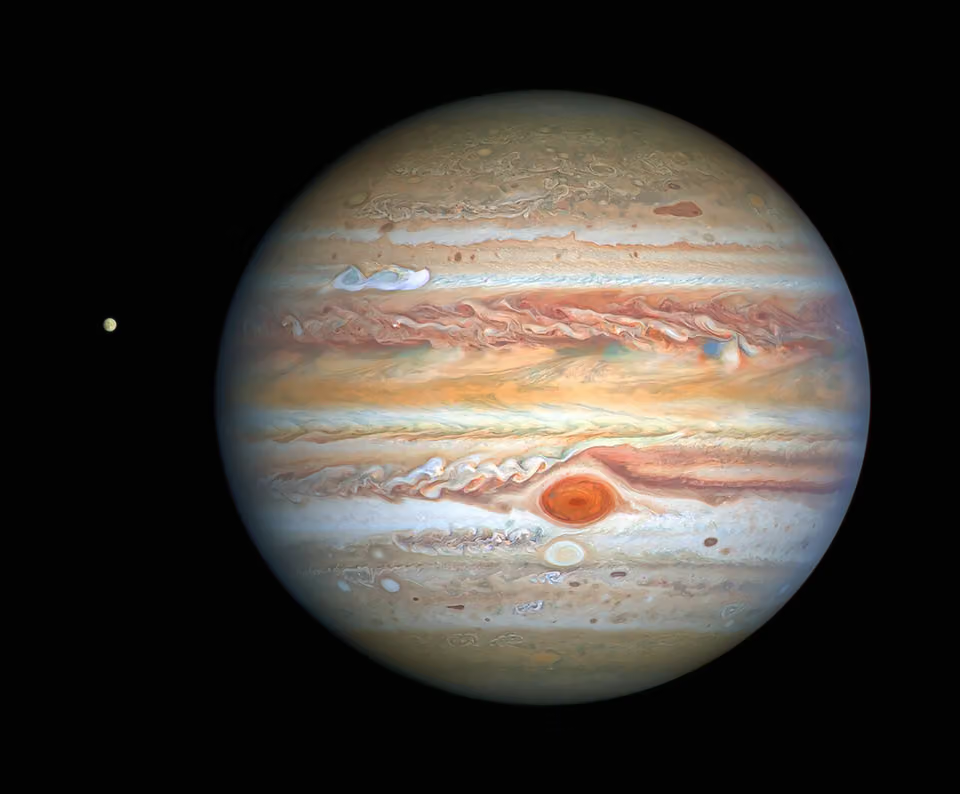


Why a deep-space telescope looks at the planets
From its orbit above the atmosphere, Hubble sees planets without the blurring that turbulent air adds to every view from the ground. Its cameras can resolve features on Jupiter a few hundred kilometers across and follow clouds on Neptune, a planet so distant that it shows only a tiny disk in most ground-based telescopes. For a planetary scientist that sharpness matters less than the time span: Hubble has been watching the same worlds since 1990, longer than any spacecraft has orbited one of them.
That record turns single portraits into a time series. The Great Red Spot on Jupiter has been measured shrinking across three decades of Hubble images. Seasonal changes on Saturn, dust storms that cover Mars, and dark storms that appear and vanish on Neptune all show up in the archive, because the telescope keeps coming back.
The OPAL program and the yearly portraits
Since 2014, Hubble has spent part of each year on the Outer Planet Atmospheres Legacy program, called OPAL. It observes Jupiter, Uranus and Neptune once a year, with Saturn added in 2018, and builds a full global map of each planet from images taken as the planet rotates. Because the filters and the timing are kept the same, any difference between two years is a change on the planet, not in the method.
The yearly portraits are some of the most widely shared Hubble pictures. The Jupiter and Saturn pages and the latest look at Jupiter use them to show how quickly the cloud bands change.
Where each planet sits on a given day is a separate question from what it looks like. The atlas of the planets and the sky on the home page computes the positions of all eight planets around the Sun for any date from 1900 to 2100, on a true linear scale of distance.
Mars follows a different schedule. Every 26 months or so Earth overtakes it on the inside track, and for a few weeks around that moment, called opposition, Mars is at its closest and brightest. Hubble's best views of the planet come from these windows, including the May 2016 opposition covered in the Mars near opposition page, when polar caps, dark volcanic plains and scattered clouds were all visible in one frame.
Color on other worlds
Planetary images are often closer to natural color than pictures of nebulae, because the planets are bright enough to photograph through broad red, green and blue filters. Even so, the result depends on choices. Mars can look orange, butterscotch or almost brown depending on dust in its atmosphere, the lighting and how the image was balanced, a question explored in what color Mars really is. Some images add ultraviolet or near-infrared light to bring out haze layers and high clouds that the eye would never see, and those colors are representative. The reasoning behind color choices is set out in Are the Colors Real?
Moons, shadows and rings
Moons show up in planetary images as small disks beside their planet, and sometimes as black dots on it. When one of Jupiter's large moons passes between the Sun and the planet, its shadow falls on the cloud tops as a sharp round spot. In January 2015 Hubble recorded Io, Europa and Callisto crossing Jupiter's face at the same time, with three shadows on the clouds. Smaller moons need patience: in May 2016 a series of thirteen exposures over 22 minutes caught Phobos moving along its orbit beside Mars, the subject of Phobos photobombing Mars.
Saturn changes in a slower rhythm. Its rings are tilted about 27 degrees to its orbit, so over a Saturn year of 29.5 Earth years they swing from wide open to edge-on and back. In the edge-on years the rings almost vanish in a telescope and their shadow becomes a thin line across the planet. Hubble's yearly images trace that tilt season by season, so the portraits double as a calendar for the planet.
Moving targets
Planets move against the stars, so Hubble tracks them during an exposure. Objects it does not track leave streaks. Asteroids crossing a long exposure of a distant galaxy cluster appear as curved trails, the curve coming from Hubble's own motion around Earth, which shifts the viewing angle during the exposure. Those accidental trails have turned up in deep fields many times and are used to find and measure small asteroids.
The fastest solar system event Hubble has recorded came in July 1994, when fragments of Comet Shoemaker-Levy 9 struck Jupiter. The impacts left dark scars larger than Earth in the planet's atmosphere, and Hubble followed them for weeks as the winds spread the debris around the planet.
Questions readers ask
Can Hubble take pictures of Earth or the Sun?
No. Hubble never points at the Sun, whose light would damage its instruments, and it avoids a wide region of sky around it. Earth moves past far too quickly for the telescope to track, and the planet is so bright that it would overwhelm the detectors. Images of Earth from orbit come from other spacecraft and from astronauts.
Why has Hubble never photographed Mercury?
Mercury never strays far from the Sun in the sky, and it always sits inside the zone that Hubble is not allowed to point toward. Every detailed picture of Mercury comes from spacecraft that flew to it, Mariner 10, MESSENGER and BepiColombo.
How often does Hubble photograph the giant planets?
Since 2014 the Outer Planet Atmospheres Legacy program, known as OPAL, has observed Jupiter, Uranus and Neptune about once a year, and Saturn was added in 2018. The repeated global maps let astronomers follow storms, cloud bands and color changes from one year to the next.
Are the colors in Hubble pictures of the planets natural?
Many planetary images are close to natural color, because they combine filters near the red, green and blue the eye sees. Others add ultraviolet or infrared light, or stretch the contrast to show faint cloud detail. The caption and the release page say which filters were used.