How images are made
Deep Field Images and Lookback Time: A Slow-Light View Down Broadway
If light crawled at a mile per century, a view from Times Square would show all of New York's history at once. A deep field works the same way.
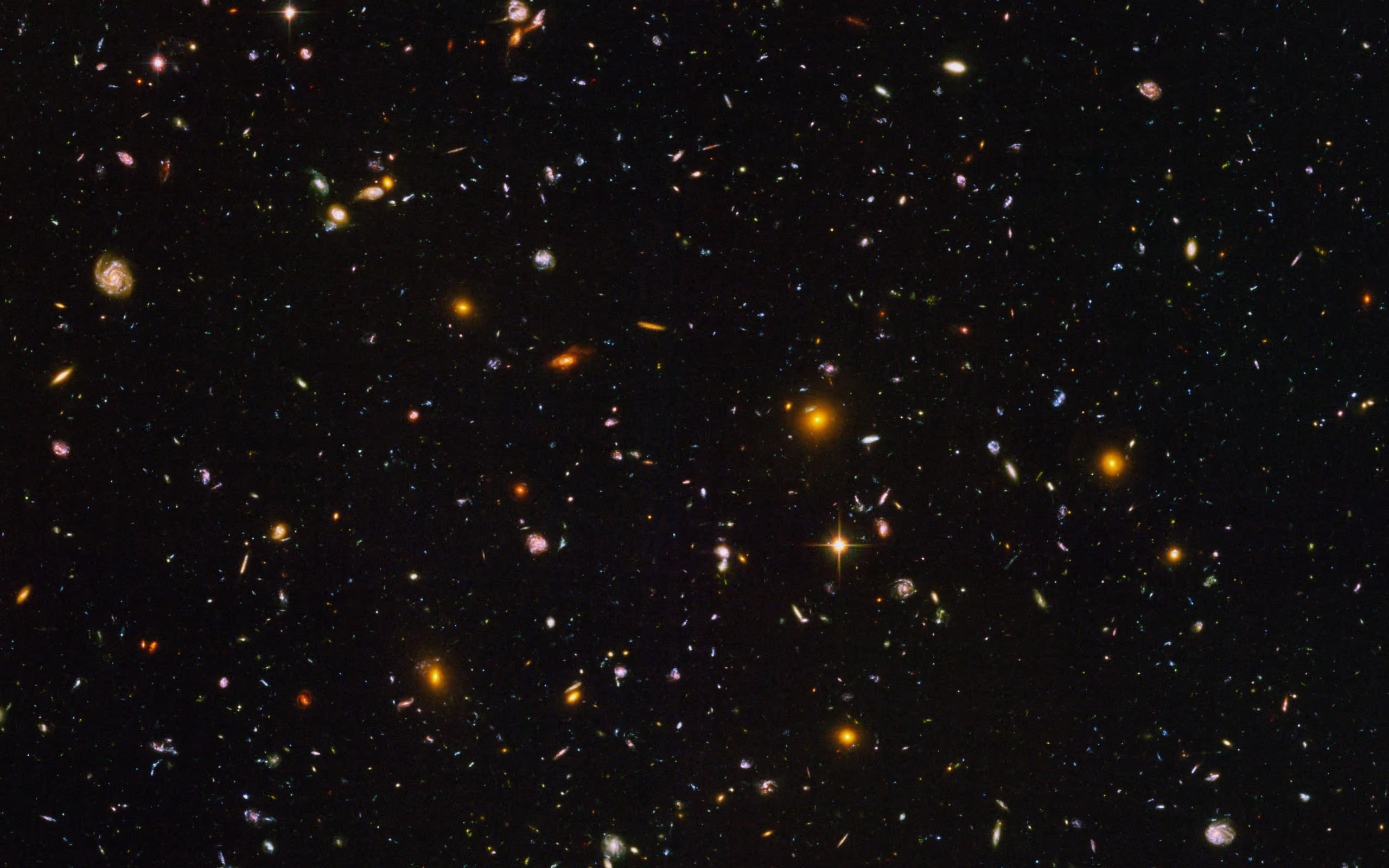
Light is fast but not infinitely fast. It takes time to cross the space between a star or galaxy and a telescope, so every object in the sky is seen as it was when its light set out. Looking out into space is also looking back in time. For a single nearby star the delay hardly matters. For a Hubble deep field, where objects at wildly different distances are crowded into one picture, it changes what the picture is.
Four dimensions on a flat page
A deep field such as the Hubble Ultra Deep Field at the top of this page is mostly galaxies, with a handful of stars. Each object has a position on the image, left-right and up-down. Each also lies at its own distance from Earth, a third dimension the picture does not show. And because light from each distance has traveled a different length of time, each object is also seen at a different moment in the past. A deep field is a map in four dimensions, space and time, squashed onto two.
Start with the stars, because they are simple. Every star in a deep field belongs to the Milky Way, typically hundreds to thousands of light-years away. Their light may have left them while the pyramids of Egypt were being built, but stars barely change over a few thousand years, so they look the way they would today.
Nearby galaxies are not much harder. The closest ones in a deep field lie millions of light-years away, and galaxies also change slowly on that timescale. The Sun needs more than 200 million years to complete a single orbit of the Milky Way. A galaxy whose light left it when dinosaurs walked the Earth would look much the same now.
Where the past becomes visible
Over billions of years, though, galaxies do change, and deep fields show it plainly. The most distant galaxies, more than ten billion light-years away, rarely have the tidy spiral and elliptical forms of galaxies nearby. They are smaller, often stretched or irregular, and dotted with bright knots of star formation. They are seen as they were before the Sun and Earth existed, and comparing them with closer galaxies is how astronomers piece together how galaxies grow.

The catch is that nothing in the image labels a galaxy's distance. A small faint smudge might be a small galaxy nearby or a large one very far away. Galaxies from every era are jumbled together across the frame, and sorting them into their proper layers of space and time is one of the central puzzles of cosmology.
A slow-light walk down Broadway
A thought experiment helps. Stand in Times Square in Manhattan and look south down Broadway toward the tip of the island, about four miles away. Now suppose light were extraordinarily slow, covering just one mile per century.
Every mile down the street would show a scene one hundred years earlier than the one before, and every city block would step back five to ten years. A quarter of a mile away, the southern end of the theater district would appear as it did in the early 1990s, when Miss Saigon was playing on Broadway. A few blocks farther, the 1960s would come into view, then the years of World War II and the Great Depression.
About a mile down, the Empire State Building would be missing altogether, because it was not finished until 1931. Close by, Madison Square Garden would still be in its original building, before it was torn down in the late 1920s.
Another mile, around Union Square, would reach back past the Civil War, the era of Tammany Hall politics and the commercial boom that followed the Erie Canal. The stretch toward Soho would pass through the years when New York served as the capital of the United States, the Revolutionary War and the founding of Columbia University, and further back to the era when the Dutch West India Company brought enslaved people to the colony. The last mile, down to Battery Park, would cross the colonial period of Dutch and English rule, the garrison of Fort Amsterdam, the island's Native American inhabitants and the first voyage of Henry Hudson.
From one street corner, the whole history of the city would be laid out in a single glance, each period at its own distance.
Reading a deep field the same way
That is the ordinary condition of a Hubble deep field. The view down Broadway would be a historian's dream; for an astronomer it is a routine observation. The one difference, and it is a big one, is that in Manhattan the distance of each building is obvious, while in a deep field it has to be measured, galaxy by galaxy. How another Hubble image stacks the solar system, the Milky Way and a distant cluster into one frame is the subject of Abell 370 and Its Asteroid Trails, and a deep field aimed at a neighboring galaxy is described in The M31 Deep Field.
Questions readers ask
What does "lookback time" mean?
It is the time light has spent traveling from an object to the observer. Because light speed is finite, an object is seen as it was when the light left it. For stars in the Milky Way that is hundreds to thousands of years; for the most distant galaxies in a deep field it is more than ten billion.
Are the stars in a deep field as old as the galaxies?
No. The few stars in a deep field are all in the Milky Way and comparatively close, so their light is only centuries or millennia old. The galaxies around them can be millions to billions of light-years away, so the image mixes very recent light with extremely old light.
Why do distant galaxies look so strange?
They are seen as they were billions of years ago, when galaxies were younger, smaller and still assembling. Many look elongated or irregular, with bright patches of star formation, and lack the orderly spiral or elliptical shapes typical of galaxies today.
How can astronomers tell how far away a galaxy in a deep field is?
The picture alone does not show it. Distance has to be measured separately for each galaxy, which is part of what makes deep fields a long-running research project instead of a single snapshot to interpret.