How images are made
Hubble's Field of View Compared With Camera Lenses and the Human Eye
A wide-angle lens takes in 84 degrees of sky. A single Hubble frame covers less than a tenth of the full Moon's width.
The Ultraviolet-Visible channel of Wide Field Camera 3, the camera behind most recent Hubble pictures, covers a patch of sky 160 arcseconds on a side. That is about 2.7 arcminutes, a little less than a tenth of the width of the full Moon. Divide the whole sky by an area that size and the answer comes out at roughly 21 million frames. The narrowness explains much of what Hubble pictures look like, from their fine detail to the mosaics needed whenever a target is larger than a postage stamp of sky.
Field of view in degrees and arcminutes
Field of view is simply how much of the scene a camera takes in, usually given as an angle across the frame. A degree is 1/360 of a full circle; an arcminute is 1/60 of a degree and an arcsecond 1/60 of an arcminute. The full Moon spans about half a degree, or 30 arcminutes.
Ordinary photography works in degrees. A 20 mm lens on a full-frame camera, a common choice for night landscapes with the Milky Way above the horizon, takes in about 84 by 62 degrees, wider than the part of a scene the eye attends to at a glance. Such a lens can hold a long stretch of the Milky Way in one exposure, along with the trees or rock arches in the foreground.
A moderate telephoto such as an 85 mm lens narrows that to about 24 by 16 degrees, enough to frame a single bright region of the Milky Way such as the North America Nebula in Cygnus. A 500 mm telephoto, about as long as most photographers ever carry, sees roughly 4.2 by 2.7 degrees.
How long a lens would match Hubble
Field of view shrinks in proportion to focal length. Carrying that relation down to Hubble's 2.7 arcminutes gives a lens of roughly 46,000 mm on a full-frame camera, nearly a hundred times longer than the 500 mm telephoto and about 0.05 degrees across the frame. Put another way, a single WFC3 frame covers about the same share of the sky as a postage stamp held about 30 meters away.
The other side of that narrow view is the scale of each pixel. The UVIS detector is 4,096 pixels square, so each pixel spans just 0.04 arcseconds. That is what allows Hubble to show filaments, knots and edges in a nebula that a camera lens would render as a smooth glow. How finely the telescope can actually separate two points is a separate question, covered in Angular Resolution and What Hubble Can't See.
Seeing the Whirlpool Galaxy at both scales
The Whirlpool Galaxy, M51, makes the difference easy to see. With an 85 mm lens and a full-frame camera the galaxy is a smudge a few pixels wide in a frame full of stars. Cropped to about a hundred pixels around it, the smudge resolves into two blobs, the large galaxy and its companion, and a hint of spiral structure in the larger one. A longer lens or a telescope with the same camera would show more, but always within a narrower frame.
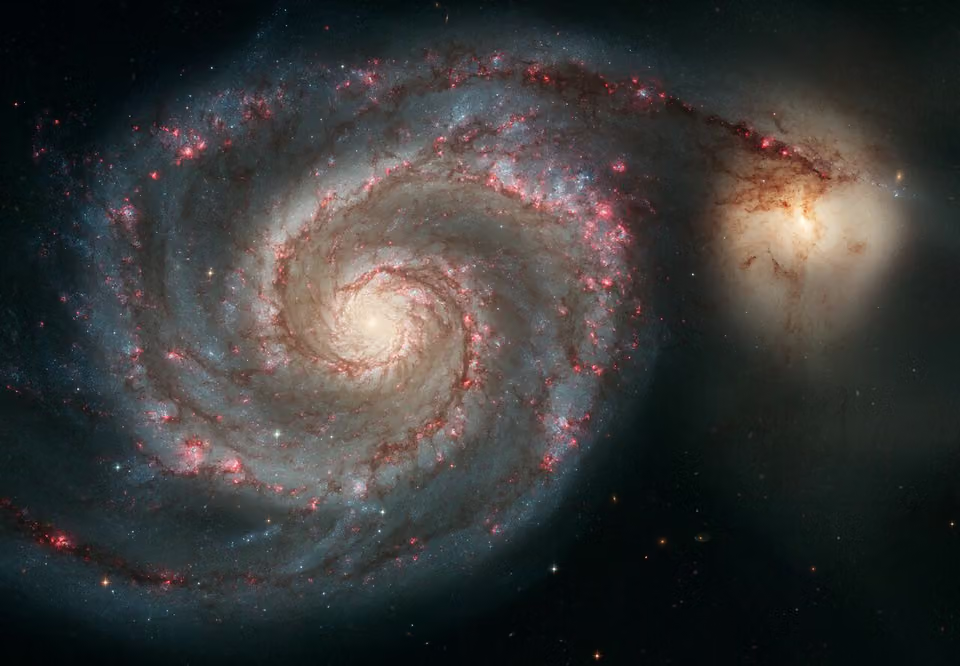
Hubble's 2005 portrait of M51 shows dust lanes along the inner edge of each arm, pink star-forming regions and blue clusters of young stars. Even this image, about 9.6 by 6.6 arcminutes, was built from six separate views stitched into a small panorama. Two things make the difference: a much longer focal length, with the magnification that brings, and a position above Earth's atmosphere, which blurs and absorbs light before it reaches any telescope on the ground.
Why big targets become mosaics
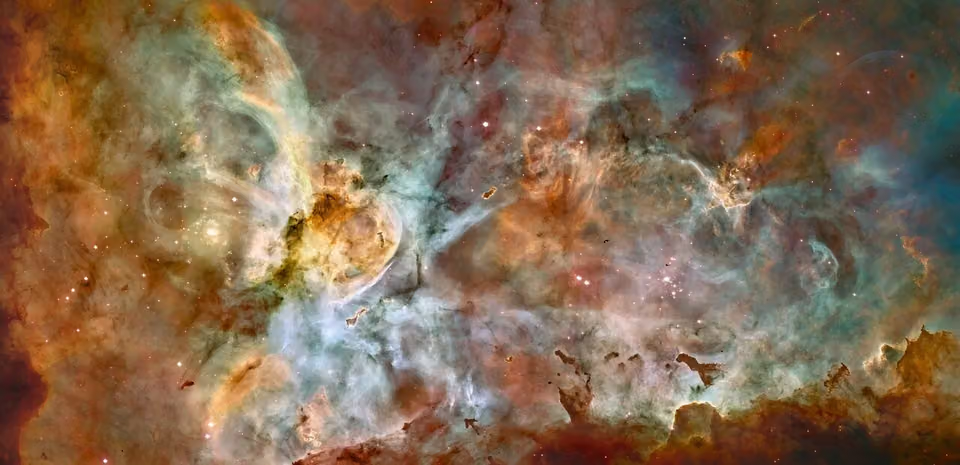
Many favorite targets are far larger than a single frame. The Carina Nebula, about 7,500 light-years away, spans some 50 light-years of gas and dust, which on the sky is close to half a degree. The panorama at the top of this page measures 24.6 by 11.9 arcminutes and was assembled from 48 Advanced Camera for Surveys frames, taken in the light of ionized hydrogen, with color added from a ground-based telescope in Chile. The object itself is covered in more depth on the Carina Nebula page.
A mosaic is planned as a grid of slightly overlapping pointings. Each tile is calibrated so that its background level matches its neighbors, then aligned on shared stars and blended. Every extra tile costs observing time, so the largest mosaics tend to be reserved for anniversary images and survey programs. The 33rd anniversary image of NGC 1333, for instance, was a grid of 2 by 3 tiles.
Questions readers ask
How much of the sky can Hubble see at once?
The UVIS channel of Wide Field Camera 3 sees 160 by 160 arcseconds, and the camera's infrared channel 123 by 137 arcseconds. The full Moon, at about 1,800 arcseconds across, would need roughly a dozen UVIS frames to cross from edge to edge.
Why are Hubble images so detailed if the view is so small?
The small field is spread over a 4,096 by 4,096 pixel detector, so each pixel covers only 0.04 arcseconds of sky. The telescope also works above the atmosphere, which on the ground smears fine detail regardless of how long the lens is.
How are wide Hubble pictures like the Carina Nebula made?
They are mosaics. Astronomers plan a grid of overlapping pointings, take each one through the same filters, then match the background brightness and align the frames on stars. The 2007 Carina panorama combined 48 frames from the Advanced Camera for Surveys.
Could a camera lens ever match Hubble's view?
Matching the field would take a lens of tens of thousands of millimeters. Even then, the atmosphere would limit the sharpness, so a ground-based camera would cover the same small patch of sky without recording the same detail.