Hubble Heritage Archive · Galaxy
NGC 4650A: How the Public-Vote Hubble Image of a Polar Ring Was Made
About 8,000 people voted on where Hubble should look next. The winner was a galaxy wearing a ring of stars around its poles.
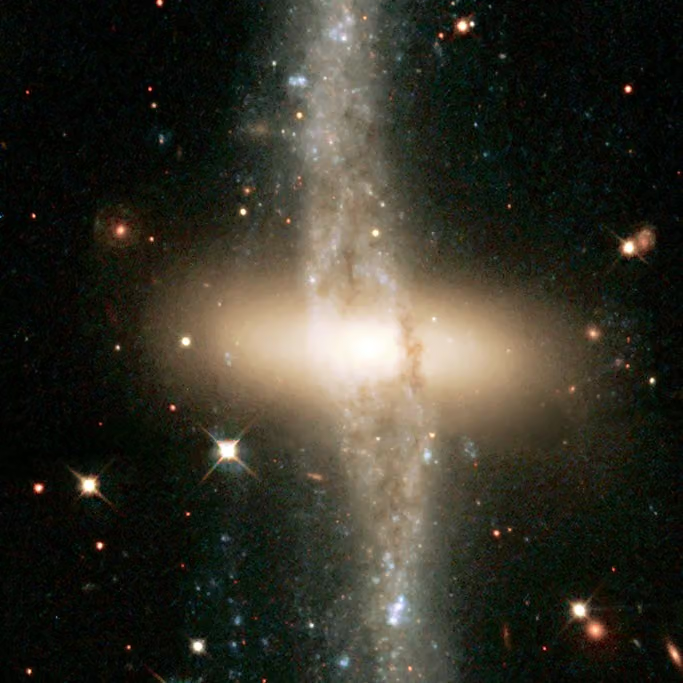
In the spring of 1999 the Space Telescope Science Institute let the public choose a Hubble target. A short list of candidates went online, about 8,000 people voted, and the clear favorite was NGC 4650A, a galaxy in Centaurus about 130 million light-years away with a ring of stars and gas wrapped around it almost at right angles to its main body. Hubble pointed at it from April 7 to 9, and the color picture appeared on May 6, 1999.
Choosing the target by vote
The vote ran during the first year of the Hubble Heritage project, which had begun releasing pictures in 1998. Polar-ring galaxies made a strong candidate. Only about a hundred of them were known, and their structure was still not fully explained. What the ring is and how such systems may have formed is the subject of a separate page on NGC 4650A as a polar-ring galaxy; this one follows the picture itself.
The science interest went beyond appearance. Because the ring reaches far out into the galaxy's halo and orbits over the poles of the inner disk, the motions of its stars and gas respond to the combined pull of that disk and of any dark matter around it. Because the ring sits along the rotation pole of the inner disk, it gives a way to separate those two pulls and so to probe how the dark matter is spread out. A science team of J. Gallagher and L. Sparke of the University of Wisconsin–Madison and L. Matthews of the National Radio Astronomy Observatory in Charlottesville worked on the data with the Heritage group.
Three filters, 5.6 hours
The observation used the Wide Field and Planetary Camera 2, then the main imaging camera on Hubble. Over three days the camera collected 5.6 hours of exposure through three broad filters.
| Filter | What it records | Shown as |
|---|---|---|
| F450W | Blue light (B band) | Blue |
| F606W | Broad visible light (V band) | Green |
| F814W | Near-infrared light (I band) | Red |
The colors follow the order of wavelength, an approach the release described as chromatically ordered: the shortest-wavelength filter, F450W, is shown blue, the middle one green, and the near-infrared F814W red. Because these are broad filters and the colors run in sequence, the result is close to what a very sensitive eye might register, with young hot stars looking blue and old cool stars looking yellow-orange. The same principle, and the cases where processors depart from it, are discussed in Are the Colors Real?
| Name | NGC 4650A |
|---|---|
| Type | Polar-ring galaxy |
| Constellation | Centaurus |
| Distance | About 130 million light-years (40 megaparsecs) |
| Ring diameter | About 60,000 light-years (18 kiloparsecs) |
| Brightness | Visual magnitude about 14 |
| Position (J2000) | R.A. 12h 44m 52s, Dec. −40° 42′ 52″ |
| Camera | Wide Field and Planetary Camera 2 |
|---|---|
| Observed | April 7 to 9, 1999 |
| Total exposure | 5.6 hours |
| Released | May 6, 1999 |
Splitting a long total exposure into many shorter frames was standard practice. It lets the processing reject cosmic-ray hits, which land on different pixels in each frame, and it keeps the bright central parts from saturating. The frames for each filter were combined first, and only then were the three filter images aligned and colored.
The released frame is unusually tall and narrow. The ring runs nearly top to bottom across it, with the smooth core as a short horizontal bar in the middle, and the frame follows its length. The version at the top of this page is a crop around the core, and the full frame appears further down.
What the finished image shows

Large ground-based telescopes had only recently revealed the structure of NGC 4650A, and the Hubble image confirmed it in finer detail while adding features nobody had seen. The central concentration, slightly orange in this palette, looks completely smooth. That is the mark of a dense system of older stars with little gas or dust left, probably once an ordinary medium-sized galaxy before the events that built the ring changed it.
The dark lanes across the center come from dust in the ring, on the near side of the inner galaxy, blocking the light behind it. That dust and gas are where new stars form, and the bright bluish clumps, which stand out most toward the ends of the band, are regions full of luminous young stars.
The ring is not flat. No regular spiral pattern shows in its main body, and young stars appear below the main band on one side and above it on the other, which means the band is bent and twisted out of any single plane. Measuring the ages of the stars in it was one of the first goals of the science team, since the ages help date the event that made the ring.
The 1999 picture sits among the early releases collected in the Hubble Heritage archive. The galaxy shines at about visual magnitude 14, and its ring spans some 60,000 light-years.
Questions readers ask
How was NGC 4650A chosen as a Hubble target?
The Space Telescope Science Institute posted a list of candidate objects online and invited the public to vote. About 8,000 people took part, and the polar-ring galaxy NGC 4650A received the most votes. Hubble observed it in April 1999 and the image was released that May.
Which camera and filters were used?
The image comes from the Wide Field and Planetary Camera 2. It combines 5.6 hours of exposures through three broad filters: F450W for blue light, F606W for visible light and F814W for near-infrared light. They are shown blue, green and red in order of wavelength.
Are the colors in the NGC 4650A image natural?
They are close to natural. The three broad filters cover blue, visible and near-infrared light and are colored in the same order as their wavelengths, so young stars in the ring appear blue and the old stars of the central body appear yellow-orange.
Why is the ring of NGC 4650A useful for studying dark matter?
The ring extends far into the galaxy's halo and orbits over the poles of the inner disk. The way its stars and gas move depends on the gravity of both the disk and the dark matter around them, so measuring the ring helps map where that unseen mass sits.