Hubble Heritage Archive · Supernova remnant
Crab Nebula (M1): Hubble's Time-Lapse View of the Pulsar at Its Heart
A city-sized star spinning 30 times a second, and a picture whose rainbow edges show how far the gas around it moved between exposures.
In the year 1054, Chinese astronomers recorded a new star in the sky in what is now the constellation Taurus. The explosion they saw left behind the Crab Nebula, an expanding cloud of debris about 6,500 light-years away, and at its center a collapsed stellar core that still drives the whole nebula. Hubble's July 2016 release zoomed in on that core.
The engine in the middle
What remains of the star's center is a neutron star: about as massive as the Sun, packed into a sphere only a few miles wide. It spins 30 times every second and sweeps two beams of radiation around with it, so from Earth it appears to flash on and off like a lighthouse. In the close-up below it is the right-hand member of the pair of bright stars near the middle of the frame.

Those regular pulses were first detected in 1968, and astronomers soon realized they had found a new kind of object. The Crab pulsar became the archetype of the class: a rapidly rotating neutron star whose spin sets the clock. Pulsars keep time so steadily that they serve as natural laboratories for a range of measurements, among them the search for gravitational waves.
Reading the colors as time
Most Hubble color images assign one hue per filter. This one does something else. The data came from the Wide Field Channel of the Advanced Camera for Surveys and use only two filters: F550M, a medium-width visible band, and F606W combined with a polarizing filter. Those filters were used on different dates. The F606W polarized frames include data from August 2003, and the F550M frames come from September 15, 2005 and January 10, 2013.
| Names | Crab Nebula, M1, NGC 1952 |
|---|---|
| Type | Supernova remnant with a central pulsar |
| Constellation | Taurus |
| Distance | About 6,500 light-years (2,000 parsecs) |
| Position (J2000) | R.A. 05h 34m 32s, Dec. +22° 00′ 52″ |
| Explosion seen | 1054 A.D., recorded by Chinese astronomers |
| Camera | Advanced Camera for Surveys, Wide Field Channel |
|---|---|
| Filters | F550M, and F606W with the POLV60 polarizer |
| Epochs | F606W+POLV60 from August 8, 2003; F550M from September 15, 2005 and January 10, 2013 |
| Programs | HST proposals 9787, 10526 and 13109 |
| Released | July 7, 2016 |
The processors gave separate colors to different filters, and also to the same filter observed at different times. Material that held still between the epochs lines up in every layer. Material that moved appears in a slightly different place in each colored layer, so it ends up outlined in a thin rainbow. The colored ripples around the neutron star are exactly that: material that shifted during the years between exposures. More on the usual rules, and on why departures like this one are legitimate, is in Are the Colors Real?
Filaments, glow and wisps
Three kinds of structure share the frame. The red filaments are glowing gas from the shattered star, forming a tangle of cavities and threads. Inside them sits a ghostly blue haze. That light is not from hot gas at all: it is synchrotron radiation, emitted by electrons that whirl at close to light speed around the strong magnetic field wrapped about the neutron star.
Closest to the center are the wisps. These bright arcs move away from the neutron star at about half the speed of light and spread into an expanding ring. They are thought to mark a shock wave where the high-speed wind blowing off the neutron star is converted into extremely energetic particles.
Two views of one remnant
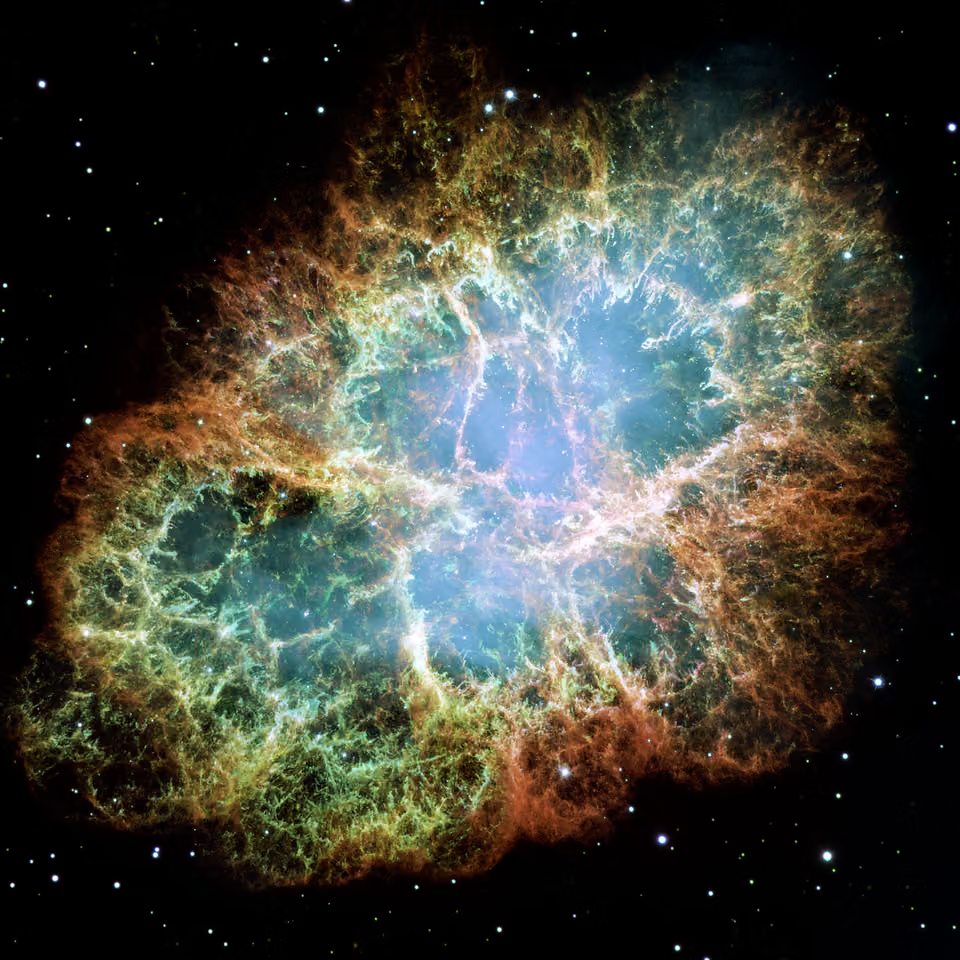
The image at the top of this page shows the whole nebula, built from 24 separate Wide Field and Planetary Camera 2 exposures and released in December 2005. It was the largest image ever made with that camera, and at its release it was the sharpest picture of the complete nebula ever produced, fine enough to trace individual filaments across the full width of the remnant. The 2016 picture covers a small patch near its center, about 1.8 arcminutes on a side, which at the Crab's distance is a little over three light-years. Seen together they show the scale of the system: the filaments at the outer edge are the debris of the explosion, and the tiny star in the middle is still powering the blue glow that fills them.
The data for the 2016 image came from three programs: proposals 9787 and 10526, led by J. Hester and J. Foy of Arizona State University with J. Morse of Rensselaer Polytechnic Institute, and proposal 13109, led by M. Weisskopf of NASA's Marshall Space Flight Center with a large international team. A five-observatory composite of the same object, from radio to X-rays, is described in The Kaleidoscopic Crab, and an older remnant is shown in the entry on the Veil Nebula.
Questions readers ask
Where is the neutron star in the Hubble image?
In the 2016 close-up it is the right-hand star of the pair of bright stars close to the middle of the frame. It looks like an ordinary star in a single picture. Its true nature shows in its pulses, which repeat 30 times a second as its beams sweep past Earth.
Why does the image have rainbow-colored edges?
The colors mark time as well as wavelength. Data from the same filters, taken on different dates years apart, were given different hues. Material that moved between the dates lands in a different spot in each layer, so it appears fringed with color.
What makes the blue glow in the Crab Nebula?
Electrons moving at nearly the speed of light spiral around the strong magnetic field near the neutron star and emit light as they do. This synchrotron radiation fills the inside of the nebula with a pale blue haze, separate from the red light of the gas filaments.
Can the Crab Nebula be seen with a small telescope?
Yes. Amateur telescopes show the nebula in Taurus as a faint glow,, well placed in winter evening skies for northern observers. The filaments and the pulsar need large instruments or long exposures, and the motions in the core need a telescope with Hubble's sharpness.