How images are made
AG Carinae in 3D: How a Hubble Image Became a Fly-Through Animation
Spectra showed the nebula was two overlapping bubbles with a cape behind them. That shape, nicknamed a super space peanut, set the whole visualization.
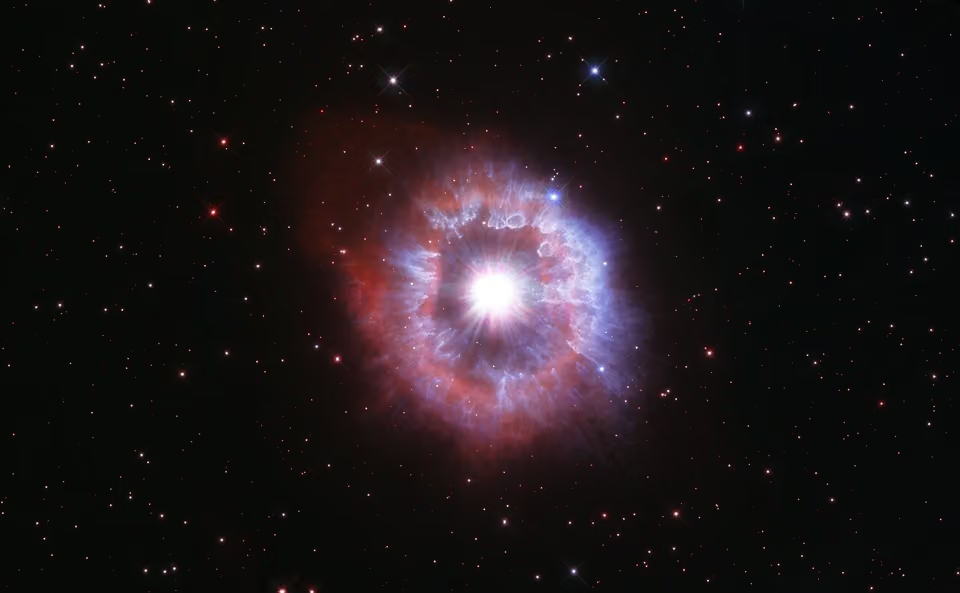
AG Carinae is about 20,000 light-years away, and in a single Hubble picture its nebula is a flat ring. The visualization made for the telescope's 31st anniversary in 2021 lets a camera fly in past the star and look back at the shell from the side. Getting there took a reading of the research literature, a peanut-shaped model and a stack of 21 semi-transparent layers. How the still image was processed is covered separately in Hubble at Thirty-one Trips Around the Sun; this page follows its conversion to 3D.
A luminous blue variable
Every visualization starts with the astronomy. AG Carinae is a luminous blue variable. Luminous: it shines with the light of about a million Suns and is one of the brightest stars in the Milky Way. Blue: that is its dominant color in visible light. Variable: its brightness changes, by about a factor of 60 over the last four decades of monitoring, as the star swells and shrinks and throws off material.
Stars of this class have occasional giant outbursts. One or more such eruptions several thousand years ago blew off roughly ten times the mass of the Sun, and that material forms the bulk of the nebula. Since then a fast stellar wind, moving at up to a million kilometers per hour, has been clearing a cavity around the star and plowing the ejected gas outward into a shell. Dust clumps in the shell have been sculpted into fingers and tadpole shapes that point back toward the star. The key idea for the visualization followed: a shell of material moving away from AG Car in every direction.
Shape from motion: the super space peanut
On the sky the nebula is almost circular. Long exposures through a nitrogen emission-line filter show an extension on one side, which one researcher had called the cone. That is a 2D projection; the 3D shape comes from motion.
Gas moving away from the observer has its light shifted to longer wavelengths, a redshift, and gas moving toward the observer is blueshifted. Spectra taken across the nebula in that nitrogen line show which parts are approaching and which are receding. A single expanding sphere would trace one ellipse in such a spectrum. AG Car traces two: one blueshifted, one redshifted. The nebula is bipolar, two lobes joined at the star, and the view from Earth looks almost straight down the axis connecting them, so the two bubbles overlap into a roughly round outline.
The cone turned out to be faster still than the receding lobe, a blowout from an old eruption that trails behind the nebula like a cape. Two lobes plus a cape: the artists' notes called it the super space peanut, a deliberately silly name that helped scientists and visualizers agree on the shape. Astronomers who study the star, Antonella Nota and Kerstin Weis among them, advised on the interpretation.
Taking the image apart
The method chosen was a form of decoupage: many 2D images layered and sculpted to give a 3D effect. Its great advantage is that the first frame of the animation can match the published Hubble image almost exactly.
The first step removed every star, so that only the nebula was left, then split it further. The central star went into an image of its own. The nebula was divided into a gas image, the red emission, and a dust image, the blue reflected light. Black sky caused trouble, because a nebula needs to be transparent where nothing glows, so as much black as possible was stripped out without losing faint structure.


Each of the gas and dust images was then cut along hand-drawn lines into about ten layers, a slow puzzle of deciding which wisp lies in front of which. The layers were saved with varying opacity, to be used as textures. Recombining them relies on the screen blending mode: screening a color over black leaves it unchanged, screening over white gives white, and stacking layers this way always lightens the result, which suits laying gas over dust, or nebula over black space.
Building and flying the model
The 3D model began as a toy: two slightly overlapping spheres, tilted a little, checked by laying them over the Hubble image with the approaching and receding lobes marked. Gas and dust got separate models, to be merged later.
Each model is a pyramid of flat planes facing the camera, scripted so that a plane can change size while its texture stays aligned with the image. The center of the star, found in the press image by following its diffraction spikes back to a single pixel, was placed at the origin of the scene, and every other plane was aligned to it. Textures went onto the planes from nearest to farthest. Science dictated the placement: the dust only appears in the near lobe, so the dust planes sit only inside the sphere closest to the camera.
The camera path was chosen to show off the cone at the back and the parallax of the dust. Planes were then sculpted, divided into smaller pieces wherever the texture held detail and pushed toward or away from the camera, never sideways, which would have broken the match with the first frame. Because the final path drifts sideways and twists, the camera sees the edges of the layers, so every texture had to be painted over its gaps to read as one object. In the finished flight, the nebula and star are 21 planes, rendered as three sets of frames.
Gaia stars and Tiny Tim
Stars carry the sense of depth in a fly-through. All the stars in a region around AG Car were extracted from the Gaia catalog, which lists each star's position, its brightness in a few colors and a parallax-based distance, then rotated and aligned to the Hubble field. Each star image was generated with Tiny Tim, a program that models Hubble's optics and produces a star nearly identical to one in a real exposure; thousands were processed this way.
Distances were used only partly. Flying the true distance of thousands of light-years would make the video far too long, so stars were spread with a statistical, roughly logarithmic distribution tuned by eye, and Gaia distances decided only which stars sit in front of AG Car and which behind. Gaia misses many faint stars that Hubble records, and its colors never match Hubble's filters exactly, so each color channel was adjusted separately. Four streams of star processing came out of this, rendered as foreground and background layers.
Compositing, zoom and music
Five renders were stacked in compositing: the central star, the gas, the dust, and the stars behind and in front of the nebula, with screen blending where needed and repeated drafts until the opening frame matched the release image. A zoom-in sets the scene first. It starts from a ground-based photograph of the sky by Akira Fujii, passes through the Digitized Sky Survey and ends on the first frame of the visualization, with the images scaled exponentially so the zoom feels steady.

The score, titled Luminous Beings, opens with heavy strings for the lift-off from Earth, moves to airy guitar and muted piano as the camera nears the star, and adds an arpeggiated synthesizer at the moment the image turns three-dimensional. A similar flat-layer approach was used a year later for the 32nd anniversary galaxy group.
Questions readers ask
What kind of star is AG Carinae?
A luminous blue variable: a very massive, very bright star in an unstable phase, prone to large changes in brightness and occasional giant eruptions. It shines with the light of about a million Suns and lies roughly 20,000 light-years away in the constellation Carina.
How do astronomers know the 3D shape of AG Carinae's nebula?
From the Doppler shift of its gas. Spectra in a nitrogen emission line show one part of the shell approaching and another receding, tracing two lobes seen nearly end-on, plus a faster-moving region at the back known as the cone.
Is the AG Carinae fly-through accurate?
The opening frame matches the Hubble image, and the overall shape follows published spectroscopy. The fine placement of each wisp in depth is an informed artistic choice, made within the constraints of the science, and star distances were compressed so the flight would be short.
How big is the nebula around AG Carinae?
About five light-years across, roughly the distance from the Sun to Alpha Centauri. It was created from material thrown off in one or more eruptions several thousand years ago and has been shaped since by the star's fast wind.