Webb
Webb Mirror Selfie: How NIRCam's Pupil Imaging Lens Saw the Mirror
A lens that swings into the light path, one bright hexagon among eighteen, and a star seen eighteen times before the mirror was aligned.
The first pictures released from the James Webb Space Telescope in February 2022 were not of galaxies or nebulae. They were engineering images, made to help the team bring the 18 segments of the primary mirror into line and switch on the instruments. One of them surprised almost everyone outside the engineering teams: a portrait of the mirror itself, taken from inside the telescope by the Near Infrared Camera, NIRCam.
What a pupil imaging lens does
The selfie was possible because of a part few people had heard of, a pupil imaging lens inside NIRCam. In optics, the pupil is the opening through which light enters a system. In a telescope like Webb, that opening is effectively the primary mirror. A pupil imaging lens is a lens designed for one job: to form a clear image of that opening, so that engineers can see exactly how light is arriving at the instrument.
The lens was added to NIRCam's design so that the alignment of Webb's mirrors could be checked optically at every stage, during testing on the ground, during commissioning in space, and over the course of the mission. Its design and fabrication were set out in detail in a 2005 conference paper published by SPIE, the Society of Photo-optical Instrumentation Engineers.
Mechanically it is a small, clever device. A combination of weights and magnets swings the lens into the light path when it is needed and back out again afterward. A fail-safe spring makes sure it can never stay stuck in the beam. If it did, it would block the camera's normal view of the sky and leave the rest of the instrument close to useless.
Reading the mirror selfie
The selfie shows the hexagonal segments of the primary mirror as a honeycomb, and one of them is far brighter than the other seventeen. That segment was the only one sending light from the alignment target, a bright star cataloged as HD 84406 in the area of the Big Dipper, through NIRCam's optics at that moment. Because the lens is focused on the mirror and not on the sky, the star's light is spread out into the shape of the segment that reflects it.
The other segments are faintly visible by ambient light and reflections. Vertical and diagonal lines cross the center of the array: these are the struts that hold the secondary mirror in front of the primary. A few small glints near the center and the corners come from internal reflections inside NIRCam. For the engineers, the whole picture is a check that each segment sits where it should before the fine adjustments begin.
Eighteen copies of one star
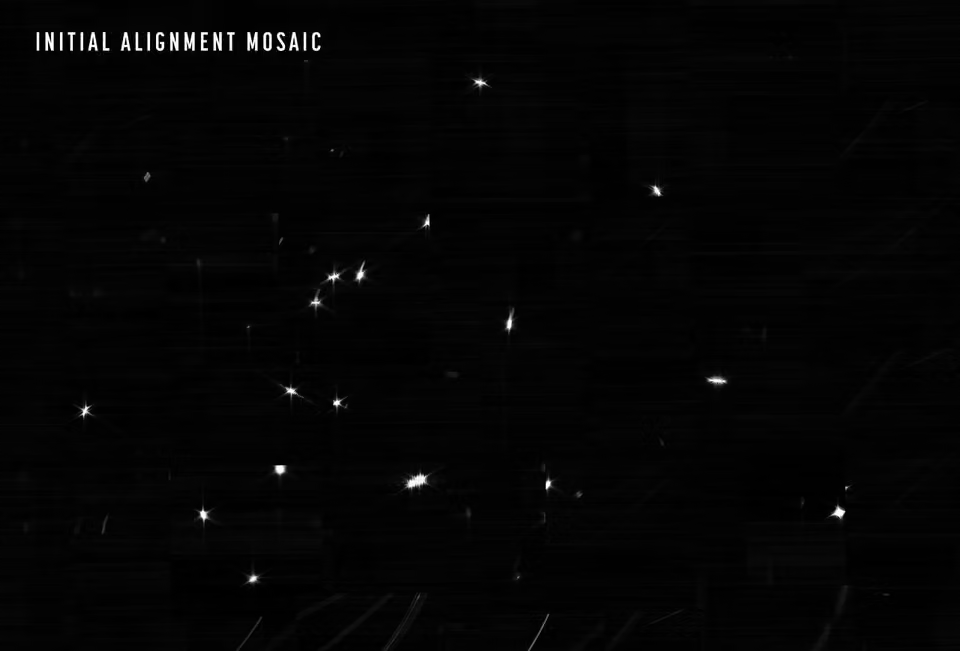
The same release included the image at the top of this page. To find the star at all, the team imaged a large area of sky around it, roughly the size of the full Moon. Nobody knew how far the mirror segments had drifted after the stresses of launch and the unfolding of the mirror in space, and in the worst case each segment might have thrown its own image of the star far across the field.
The process began on February 2, 2022. Webb was pointed at 156 positions around the predicted location of the star and recorded 1,560 images with NIRCam's 10 detectors, 54 gigabytes of raw data, over nearly 25 hours. In fact the star was found in every segment within the first six hours and 16 exposures. Stitched together, the frames made a mosaic of more than two billion pixels, and the released picture is only its central part.
The result shows 18 blurry dots scattered in no obvious order, each one the same star as reflected by a different segment. The segments had held their alignment far better than feared, and all 18 images landed close to the center of the search area. The next step was to work out which dot belonged to which segment, a little like matching faces to names in a group photo, and to label each one with its segment's identifier.
From scattered dots to one star
Once every dot was identified, the segments were tilted so that the 18 images formed an ordered hexagonal pattern matching the layout of the mirror, including the two wings of three segments each, which had swung into place when the mirror deployed. Then each segment was adjusted again until all 18 images were stacked into one. Further refinements were planned for the months that followed, as the observatory cooled to its operating temperature and the other instruments came online.
The way telescope design limits what any picture can show is discussed in Angular Resolution and What Hubble Can't See, and the marks that instruments leave on their own images are the subject of Image Artifacts. Webb's later science images, made once all this was done, include the Tarantula Nebula.
Questions readers ask
How did Webb take a picture of its own mirror?
NIRCam, Webb's main near-infrared camera, contains a pupil imaging lens. When swung into the light path, it focuses on the primary mirror instead of on the sky, so the camera records an image of the mirror segments. It is an engineering tool for checking the mirror alignment.
Why is one mirror segment much brighter than the others?
At the moment of the image, only that segment was sending light from the alignment star HD 84406 into NIRCam. The other seventeen were not yet aligned to send the star's light the same way, so they appear only faintly, lit by ambient light and reflections.
What are the 18 dots in Webb's first alignment image?
Each dot is the same star, HD 84406, as reflected by one of the 18 primary mirror segments. Before alignment the segments pointed in slightly different directions, so the star appeared 18 times. Engineers then identified each dot and moved the segments until the images stacked into one.
How much data went into the first alignment mosaic?
Webb pointed at 156 positions over nearly 25 hours and took 1,560 images with NIRCam's 10 detectors, producing 54 gigabytes of raw data. The full mosaic has more than two billion pixels, and the published image shows only its center.