How images are made
Tarantula Nebula in Webb's NIRCam: How the 30 Doradus Image Was Made
The first science observation of Webb's early release program, a mosaic 340 light-years wide, and the alignment problems that came with it.
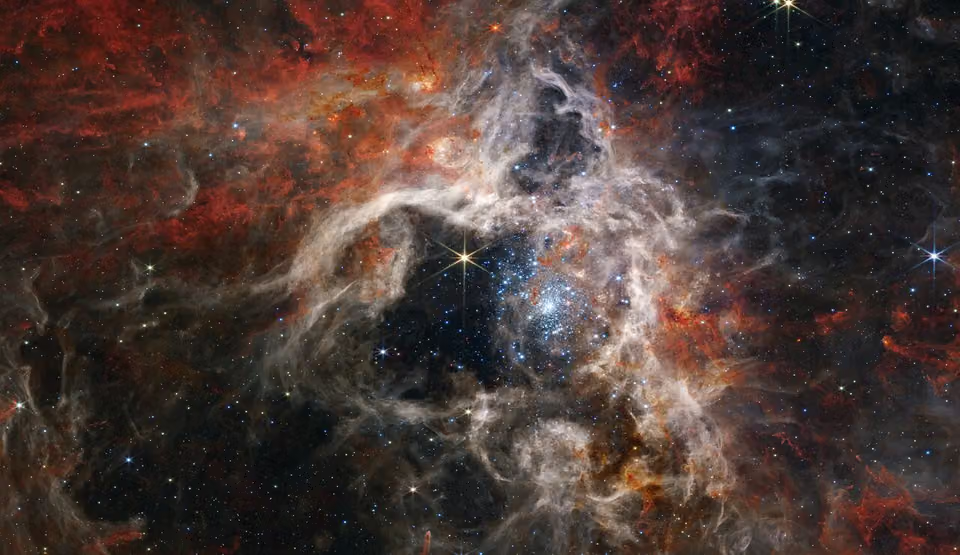
The first observation carried out in the James Webb Space Telescope's Early Release Observations program was not one of the images unveiled on July 12, 2022. It was 30 Doradus, the Tarantula Nebula, a star-forming region in the Large Magellanic Cloud about 161,000 light-years away. Its NIRCam mosaic, stretching 340 light-years across, was held back as one of the extra targets and released on September 6, 2022. Making it was a test of how far the processing methods developed for Hubble would carry over to an infrared telescope still fresh from commissioning.
From launch to a backlog of first images
Webb launched on an Ariane 5 rocket on December 25, 2021. Over the following months it went through a long series of milestones: its five-layer sunshield was deployed and tensioned, the secondary mirror deployed, the segmented primary mirror unfolded, and the telescope was brought into focus. Webb's own view of its mirror segments during that phase is described in Webb Takes a Selfie.
The Early Release Observations were planned and run by a production team of roughly 30 people (scientists, engineers and writers, plus two specialists in image processing), who met nearly every morning from late May, when the first observations began, until the release in July. The team deliberately observed more targets than it would publish at the end of commissioning. That gave backup options in case any observation failed to cover the observatory's main science goals. None failed, so the spare targets, the Tarantula among them, could be released later.
A mosaic that would not line up
Among the early release programs, the 30 Doradus mosaic was second in size only to Stephan's Quintet. The raw frames went through Webb's processing and calibration pipeline, with settings adjusted where needed, and every frame was aligned to reference stars from the Gaia catalog. Alignment between the frames of the mosaic was the hardest part of these first steps. After three rounds of processing, the raw images were as clean as the pipeline could make them, with small offsets still visible near the core of the nebula in the shortest-wavelength filter.
The schedule left no room for more iterations, so the remaining misalignment was fixed at the image-processing stage. The tool was Photoshop's Puppet Warp, which can distort an image locally in small regions. Used carefully, it brings individual stars into register across the color channels, in effect removing geometric distortion by hand. Other leftover artifacts were also handled at that stage, in the same spirit as the cleanup described in Are Hubble Images Real? Image Artifacts Explained.
Choosing filters from 0.9 to 4.4 microns
Webb is an infrared observatory: all the light it collects lies beyond the range of human vision. Coloring its images still works like coloring Hubble's. The eye has three kinds of color receptors, roughly for red, green and blue, and any screen image can be split into those three channels. Infrared data can be mapped into them, much as a recording of a dog whistle can be shifted down a few octaves until a human can hear it.
30 Doradus was observed in several NIRCam filters between 0.9 and 4.4 microns. Some narrowband images added nothing to the final composite and were left out. The picture uses three broadband filters at 0.9, 2.0 and 4.4 microns, plus a medium-band filter at 3.35 microns with continuum subtraction applied.
Continuum subtraction isolates one narrow feature by removing the broad background light underneath it. At 3.35 microns the target was polycyclic aromatic hydrocarbons, PAHs: extremely small dust grains built from rings of carbon and hydrogen that glow when warmed. Subtracting the continuum leaves a map of where that hydrocarbon glow is concentrated in the nebula.
Stretch, color and balance
The data were first stretched in FITS Liberator, free software built for the purpose. Stretching rescales the enormous range of brightness values in raw data with a mathematical function that lifts the darkest pixels while keeping detail in the brightest, so that faint structure becomes visible on a screen.
Color was then applied chromatically. The shortest wavelength, 0.9 microns, went to blue, 2.0 microns to green and 4.4 microns to red. The continuum-subtracted 3.35-micron layer was added later in the process, in a reddish-orange tone. This initial composite is only a starting point, usually flat and dull. Color balance, contrast and the treatment of faint detail follow the visual principles of photography, and that is where the work becomes more subjective, always within the limits of the data. The color rules themselves are explained in Are the Colors Real?.
What the finished image shows
In the NIRCam view the nebula's central cavity was emptied by the fierce radiation of a cluster of massive young stars, the pale blue points at its heart. Denser parts of the cloud resist the stellar winds and form pillars pointing back toward the cluster, with forming stars inside them. Tens of thousands of young stars appear that had been hidden by dust. To the upper left of the cluster, an older star shows NIRCam's distinctive eight diffraction spikes, an artifact of the telescope's structure. Cooler gas farther from the core takes on a rust color, a sign that the nebula is rich in complex hydrocarbons.


At longer wavelengths, the Mid-Infrared Instrument sees a different nebula: the hottest stars recede and the cool gas and dust take over the frame, with points of light marking protostars still gaining mass. Hubble's visible-light views show yet another layer, the glowing gas and the stars in front of the dust. A useful comparison is medical imaging: X-rays show bones, an MRI uses a different kind of signal to show soft tissue, and doctors need both. Webb and Hubble play those roles for star-forming regions.
Questions readers ask
Where is the Tarantula Nebula?
It lies in the Large Magellanic Cloud, a satellite galaxy of the Milky Way, about 161,000 light-years from Earth. Also called 30 Doradus, no star-forming region in the Local Group of galaxies is larger or brighter, and it holds the hottest, most massive stars known.
Which filters did Webb use for the Tarantula Nebula image?
The NIRCam composite combines three broadband filters at 0.9, 2.0 and 4.4 microns, colored blue, green and red, with a continuum-subtracted medium-band image at 3.35 microns that traces the glow of polycyclic aromatic hydrocarbons, added in a reddish-orange tone.
Why do stars in Webb images have eight spikes?
The spikes are an artifact of the telescope's structure, which bends the light of bright stars into a fixed pattern, much as the struts inside Hubble produce its four spikes. In the Tarantula image an older star to the upper left of the central cluster shows the pattern clearly.
Why is the Tarantula Nebula interesting to astronomers?
Its chemical makeup resembles that of the giant star-forming regions seen at cosmic noon, when the cosmos was only a few billion years old and forming stars at its fastest rate. That makes it the closest place to study, in detail, the kind of star birth that dominated that era.