Hubble anniversaries
Hickson Compact Group 40: Hubble's 32nd Anniversary Galaxy Group
Three spirals, an elliptical and a lenticular galaxy, falling toward one another in an isolated corner of the sky in Hydra.
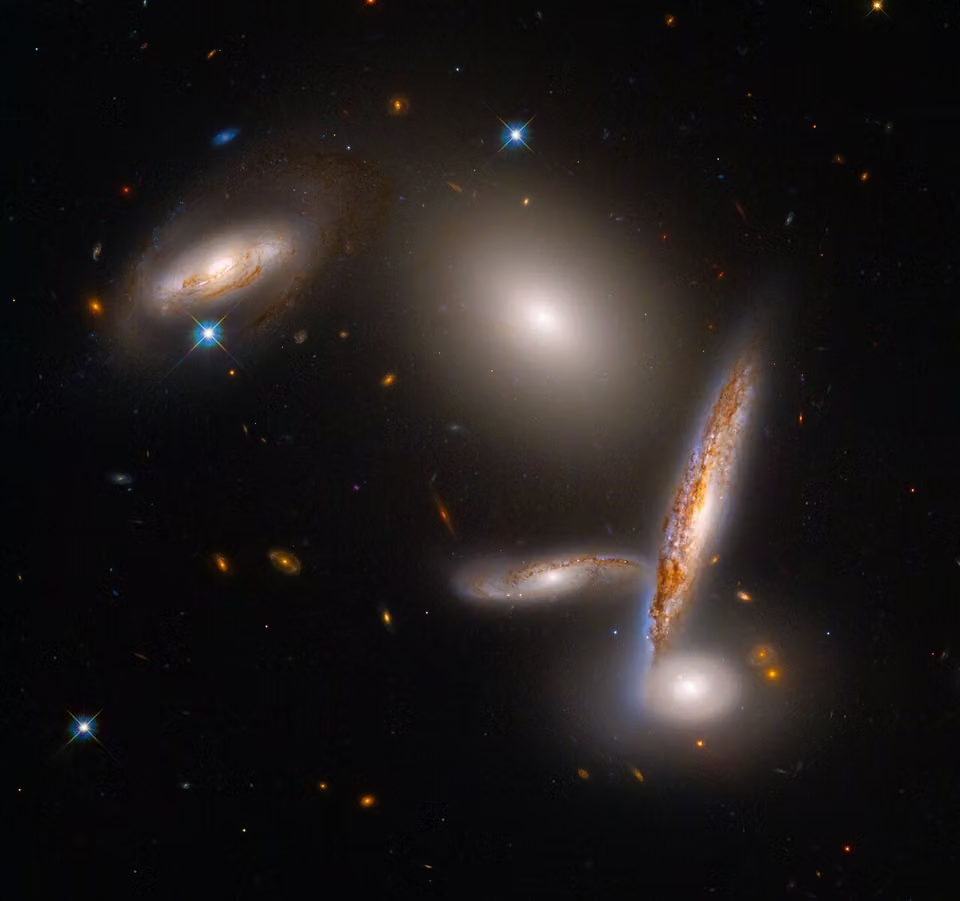
Five galaxies, close enough together that the whole group would fit inside a region less than twice the diameter of the Milky Way's disk of stars: that is Hickson Compact Group 40, the target Hubble photographed for its 32nd anniversary. The image was released on April 19, 2022. HCG 40 had never been observed by Hubble before, and the group promised the kind of crowded, varied scene that shows off the telescope's sharpness.
Number 40 in Hickson's catalog
The name comes from a catalog of compact galaxy groups compiled by the astronomer Paul Hickson. Over a hundred such groups have been cataloged in sky surveys going back several decades, and few are as tightly packed as HCG 40. Groupings this tight are usually found deep inside large galaxy clusters. HCG 40 is different: it lies alone, far from any big cluster, in the direction of the constellation Hydra.
The membership is a sampler. Three of the galaxies are spirals, one is an elliptical and one is a lenticular, a lens-shaped disk galaxy with little ongoing star formation. In the anniversary image the large, smooth elliptical sits near the center, an edge-on spiral with a ragged dust lane stands to its lower right, and a tilted spiral at upper left shows a bright core wrapped in dust.

Falling together
The galaxies are caught in a slow gravitational dance. One explanation for how such a group stays so compact involves dark matter, the invisible form of matter detected only through its gravity. If the galaxies share a large cloud of it, they feel a kind of friction as they move through it, lose energy and fall toward one another. In about a billion years they are expected to collide and merge into a single giant elliptical galaxy.
There are signs that the members already interact. Tidal stretching is clearest in the warped dust lanes of the upper-left spiral, at about the eleven o'clock position in the frame. Observations at other wavelengths add more: nearly all of the members have a small, bright radio source in their centers, possible evidence of a supermassive black hole; X-ray data show a lot of hot gas between the galaxies, a product of their gravitational interactions; and infrared data trace how fast they are forming new stars.
Groups like this may have been more common in the early universe, where they could have fed gas to black holes and powered quasars. Studying nearby examples helps astronomers work out when and where galaxies assembled, and from what.
Four filters and a natural-color result
Hubble took the data with Wide Field Camera 3 through four filters: broadband filters near 475, 606 and 814 nanometers, and a narrowband filter isolating hydrogen-alpha and nitrogen. The broadband filters roughly match the blue, green and red sensitivity of human vision, so the combination gives what processors call a natural-color image. Colors were assigned in chromatic order, the shortest filter blue, the middle one green and the longest red. The narrowband image was also added in red, the color hydrogen actually glows, to bring out star-forming regions.
After the first combination came the usual adjustments to color, contrast and detail, noise reduction, and removal of artifacts not belonging to the galaxies. The aim was to bring out the structure of the spirals, their dark dust lanes, bright cores and faint star-forming regions, and to set them against the smooth, featureless look of the elliptical. The rich scatter of background galaxies, captured in a tiny fraction of the sky, was emphasized too. The general color rules are in Are the Colors Real?.
Taking the group apart for a flight
The release came with a visualization that flies a camera through the group. It is pseudo-3D: there are no volumetric models, and every element is a flat image. Building it meant taking the picture apart into a sky background, a layer of distant background galaxies and a separate layer for each of the five members, with the background filled in wherever a galaxy had been cut out. Disentangling overlapping galaxies cleanly takes skill and knowledge of how such objects are structured.
The layers were then placed in 3D space with enough separation to produce parallax as the camera moves. To check that the arrangement was plausible given what is known of the galaxies' motions within the group, the team consulted astronomers, Paul Hickson among them. The result is an informed best guess of the group's 3D layout, similar to the layered approach used a year earlier for AG Carinae. A soundtrack built with a generative sequencer changes key as the Hubble image comes into focus and ends on a close view of the large elliptical overhead.
Questions readers ask
What was Hubble's 32nd anniversary image?
Hickson Compact Group 40, a tight group of five galaxies in the direction of Hydra, released on April 19, 2022. It had never been observed by Hubble before. The image shows three spirals, an elliptical and a lenticular galaxy close together.
Will the galaxies in HCG 40 merge?
That is the expected outcome. The galaxies appear to be losing energy as they move through a shared cloud of dark matter, so they are falling toward one another. In about a billion years they should merge into a single giant elliptical galaxy.
What is a compact galaxy group?
A small group of galaxies packed unusually close together on the sky and in space. More than a hundred have been cataloged. Many sit inside large galaxy clusters, but HCG 40 is notably isolated, and it ranks among the tightest groups known.
Is the HCG 40 fly-through a real 3D model?
No. It is pseudo-3D, built from flat layers cut out of the Hubble image and placed at different distances. The arrangement was checked with astronomers against what is known about the galaxies' motions, but it remains a scientifically informed best guess.