Hubble Heritage Archive · Galaxy
NGC 4889: A Giant Elliptical Galaxy and Its 21-Billion-Sun Black Hole
A smooth, featureless glow 300 million light-years away, wrapped around a black hole whose edge would swallow Neptune's orbit fifteen times over.
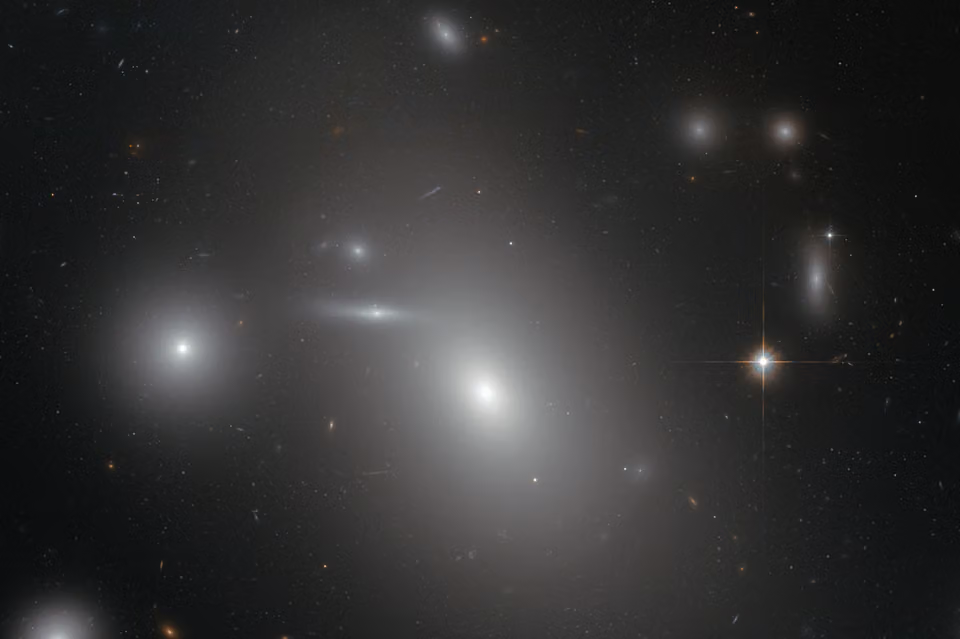
Nothing in this picture looks violent. NGC 4889 is a vast, smooth ball of old stars, glowing evenly from center to edge, with no spiral arms, no dust lanes and no bright knots of star formation. Yet its center holds a black hole that ranks with the heaviest ever weighed, about 21 billion times the mass of the Sun. Hubble's image of the galaxy and its neighbors was released on February 8, 2016.
A giant at the heart of Coma
NGC 4889 belongs to the Coma Cluster, roughly 300 million light-years from Earth, a dense collection of galaxies in the constellation Coma Berenices. It is the biggest and brightest galaxy in the Hubble frame and one of the two dominant galaxies of the whole cluster. Within the cluster only NGC 4874, outside this field, outshines it, and only by a small margin.

NGC 4889 carries signs of its own history. Faint shells of starlight can be traced around it, a pattern that points to a merger with a smaller galaxy in the comparatively recent past.
The size of the black hole
The numbers attached to the central black hole are hard to picture. Its event horizon, the boundary inside which not even light can escape, is about 80 billion miles across. Neptune's orbit could be lined up across it about 15 times, and a beam of light would need roughly five days to cross from one side to the other. For comparison, the black hole at the center of the Milky Way weighs about four million Suns, and its event horizon is only about one fifth the size of Mercury's orbit. The black hole in NGC 4889 is some five thousand times heavier. The two are covered side by side in the entry on the center of the Milky Way.
A black hole that large is not visible in a picture like this one. Its presence is inferred from the way it governs the motion of stars and gas near the center of the galaxy, and the Hubble image shows only the starlight of the galaxy around it.
A quasar gone quiet
NGC 4889 was not always calm. In the past its black hole was pulling in gas, dust and other material at a high rate. That material collected into an accretion disk, a spinning platter of matter orbiting the black hole, and the disk was accelerated by the black hole's gravity and heated to millions of degrees. It also launched powerful, energetic jets.
At that stage the galaxy would have been classified as a quasar. Its disk could have outshone the entire Milky Way by as much as a factor of a thousand. The process that drove it is known as hot accretion, in which infalling matter heats up as it spirals inward.
The disk kept feeding the black hole until the supply of nearby material ran out. Since then the black hole has been dormant. The environment inside the galaxy is now quiet enough that stars are forming from the remaining gas and orbiting the black hole without being disturbed. For astronomers, a sleeping giant like this is a way to learn how and where quasars, still mysterious objects, formed in the early universe and how they fall silent.
Building the image
| Filter | What it records | Shown as |
|---|---|---|
| F475W | Blue-green light (SDSS g band) | Blue |
| F475W + F814W | The two filters combined | Green |
| F814W | Near-infrared light (I band) | Red |
The data were taken on March 1 and 2, 2013, with the Wide Field Channel of the Advanced Camera for Surveys, for a program led by J. Blakeslee of the Dominion Astrophysical Observatory with P. Côté and L. Ferrarese, J. Jensen, A. Jordán, S. Mei, E. Peng and J. Tonry. Only two filters were used: F475W, close to the Sloan g band, and F814W in the near-infrared. With only two filters a third color channel has to be created, so the processors made a synthetic green channel by combining the two. Blue, the synthetic green and red then follow the order of wavelength. The broader question of how and why colors are assigned is covered in Are the Colors Real?
| Name | NGC 4889 |
|---|---|
| Type | Giant elliptical galaxy in the Coma Cluster |
| Constellation | Coma Berenices |
| Distance | About 300 million light-years (92 million parsecs) |
| Central black hole | About 21 billion times the mass of the Sun |
| Position (J2000) | R.A. 13h 00m 08.13s, Dec. +27° 58′ 37.20″ |
| Camera | Advanced Camera for Surveys, Wide Field Channel |
|---|---|
| Observed | March 1 and 2, 2013 |
| Program | HST proposal 11711 (J. Blakeslee and collaborators) |
| Released | February 8, 2016 |
The frame is richer than it first looks. Stars with four-pointed diffraction spikes are foreground stars inside the Milky Way, and there are few of them. The hundreds of tiny, faint points of light scattered around NGC 4889 are globular clusters, many of them probably in orbit around the giant galaxy. Some faint, ghostly ellipticals in the field belong to the class of ultra-diffuse galaxies, whose formation is still debated. A few background galaxies seem to share an alignment, which may be a sign of weak gravitational lensing: such lensing slightly squashes the images of distant galaxies in a common direction. The smaller elliptical NGC 4886, just above NGC 4889 in the frame, has a nucleus that is actually brighter at its very center, a reminder that the cores of elliptical galaxies vary widely in how concentrated they are.
The release came almost three years after the observations. Like most pictures of this kind, it reused data that had been collected for research, so the frame is laid out the way the science program needed it. That is why NGC 4889 sits right of center, with a crowd of smaller cluster galaxies and distant background galaxies filling the rest of the view.
Questions readers ask
How massive is the black hole in NGC 4889?
About 21 billion times the mass of the Sun, which places it among the most massive black holes ever discovered. Its event horizon is roughly 80 billion miles across, around fifteen times the width of the orbit of Neptune. The Milky Way's central black hole has about four million solar masses.
Is the black hole in NGC 4889 active?
No. It has stopped feeding and is dormant. In the past it was powered by an accretion disk that made the galaxy a quasar, shining up to a thousand times brighter than the Milky Way. Once the nearby gas and dust were used up, the disk faded and the activity stopped.
Where is NGC 4889?
It is a member of the Coma Cluster in the constellation Coma Berenices, at a distance of roughly 300 million light-years. It is one of the two brightest galaxies in the cluster. Only NGC 4874 is brighter, and only slightly.
What are the small dots around the galaxy in the Hubble image?
Most of the hundreds of faint, point-like objects are globular clusters, dense balls of old stars, and many are probably orbiting NGC 4889. The few objects with four-pointed spikes are foreground stars in the Milky Way, and the fuzzy patches are other galaxies, hundreds of them lying far in the background.
Why does the image use a synthetic green channel?
The observations used only two filters, F475W and F814W. A color image needs three channels, so the green channel was made by combining the two filters. Blue, green and red then follow wavelength order, from F475W through the mix to F814W.