How images are made
The M31 Deep Field: Hubble's Quiet View into the Halo of Andromeda
A plain-looking field of dots that holds nearby stars, stars in another galaxy and galaxies billions of light-years beyond, all side by side.
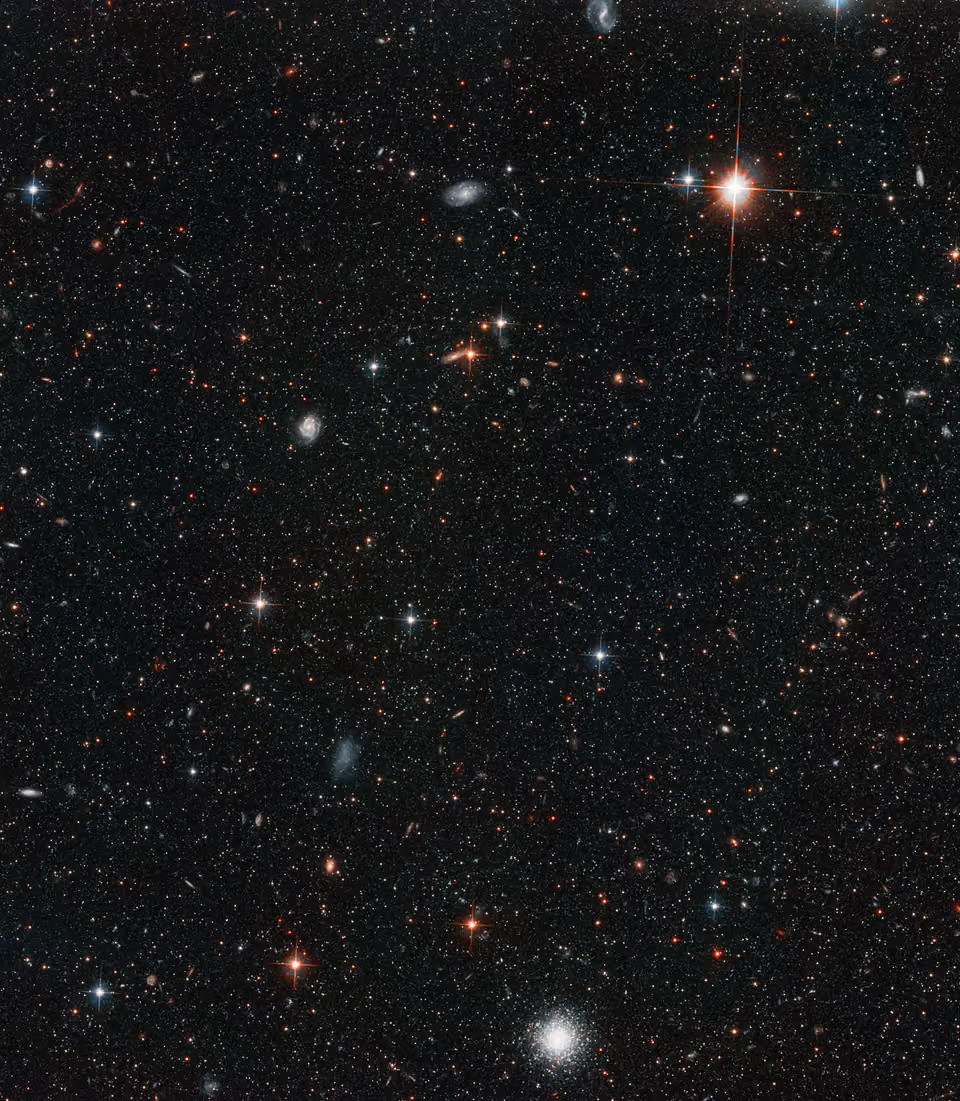
At first glance the M31 Deep Field is a sheet of black paper sprinkled with salt. No glowing gas, no bold color, no obvious subject. It is still one of the most instructive pictures Hubble has made, because a single frame reaches from stars a few thousand light-years away to galaxies so distant their light set out billions of years ago.
A deep field pointed at a neighbor
Hubble's best-known deep fields, starting with the original in 1995, were aimed at patches of sky chosen for being empty, so that nothing nearby would get in the way of the faintest, most remote galaxies. This one breaks the pattern. The telescope was pointed just off the Andromeda Galaxy, Messier 31, a large spiral about 2.5 million light-years away and close in size and type to the Milky Way.
The target was the galaxy's halo. Photographs of Andromeda from the ground, such as the wide-field plates made at Palomar Observatory, are dominated by the tilted bright disk and a couple of small companion galaxies. Around that disk lies a vast, sparse sphere of faint stars that barely registers in a ground-based image. Astronomers wanted to measure the brightness and color of those halo stars, one by one, in order to work out how old they are. Hubble's patch covers a tiny fraction of the galaxy's outskirts, a speck on any wide photograph of M31.
The Advanced Camera for Surveys collected the light over many long exposures, and the release in May 2003 described it as the deepest visible-light image of the sky taken up to then, with roughly 300,000 stars resolved in Andromeda's halo.
Two filters instead of three
Most color pictures from Hubble combine three filters. This one uses two, the standard V band in visible light and the I band in the near infrared. That pairing was chosen for the science: comparing a star's brightness in V and in I gives its color, and plotting thousands of stars by color and brightness is how their age is estimated.
Seen separately, the V and I frames look almost identical. A color composite can be built from two frames, usually by giving the shorter wavelength a cooler hue and the longer a warmer one, but the range of colors is narrower than with three. After the brightness and contrast are adjusted, differences in star color still come through clearly: hot stars look blue-white and cool giants orange. The general rules for picking those hues are covered in Are the Colors Real?.
Reading the layers in one patch of sky
Zooming into smaller sections turns the scattered dots into a cross-section of the universe.

The few bright stars with spikes are foreground objects inside the Milky Way, perhaps a few thousand light-years from Earth. The far more numerous faint points belong to Andromeda, about a thousand times farther away. Scattered among them are small smudges with shape: spirals seen face on, elongated disks and compact blobs. Those are other galaxies, many roughly the size of Andromeda itself, appearing small only because they lie tens of millions to billions of light-years beyond it. One detail shows a neat spiral much like the Milky Way; another shows a small bluish dwarf with no visible arms, dust or gas, only a loose spread of stars.
The same mix of distances in a single field is the subject of A Deep View Down Broadway, which compares a deep field to looking down a street lined with buildings from different centuries.
A globular cluster 2.5 million light-years away
The most striking detail sits near the bottom edge of the full image: a globular cluster, a ball of hundreds of thousands of stars that formed together long ago and are still held together by their own gravity.

It looks like the globular clusters around the Milky Way that astronomers have studied for many years. The difference is distance. This cluster belongs to Andromeda, roughly 100 times farther away than most similar clusters in the Milky Way, and Hubble still separates it into individual stars at its edges. Not long before Hubble, photographs of nearby globular clusters showed about this level of detail.
The study behind the image produced a surprise of its own. About a third of the halo stars measured turned out to be 6 to 8 billion years old, much younger than the 11 to 13 billion years typical of stars in the Milky Way's halo.
Questions readers ask
What is a galactic halo?
It is the roughly spherical region of thin, old stars that surrounds a spiral galaxy's disk and reaches far beyond it. The halo is faint because its stars are spread out, so ground-based photographs of Andromeda mostly show the bright disk. Hubble's sharp view picks out halo stars individually.
Why does the image use only two filters?
The observing program needed to measure star colors, and two bands, V and I, are enough for that. A color picture can still be made from the pair, with the in-between color built from a blend of both frames, though the result shows a smaller range of hues than a three-filter image.
How far away are the galaxies in the background?
They range widely. Some are tens of millions of light-years away and others billions. Many are similar in size to Andromeda, which lies 2.5 million light-years from Earth, so their small apparent size is a direct measure of how much more distant they are.
Can Andromeda be seen without a telescope?
The bright disk, yes: from a dark site it shows as a faint, elongated glow in the constellation Andromeda. The halo stars in the Hubble image are another matter. They are individually far too faint for the eye or a backyard telescope, and recording them took long exposures from orbit.