How images are made
Abell 370 and Its Asteroid Trails: Four Distances in One Hubble Frame
Curved asteroid trails cross a galaxy cluster four billion light-years away, and behind the cluster stretched images of galaxies farther still.
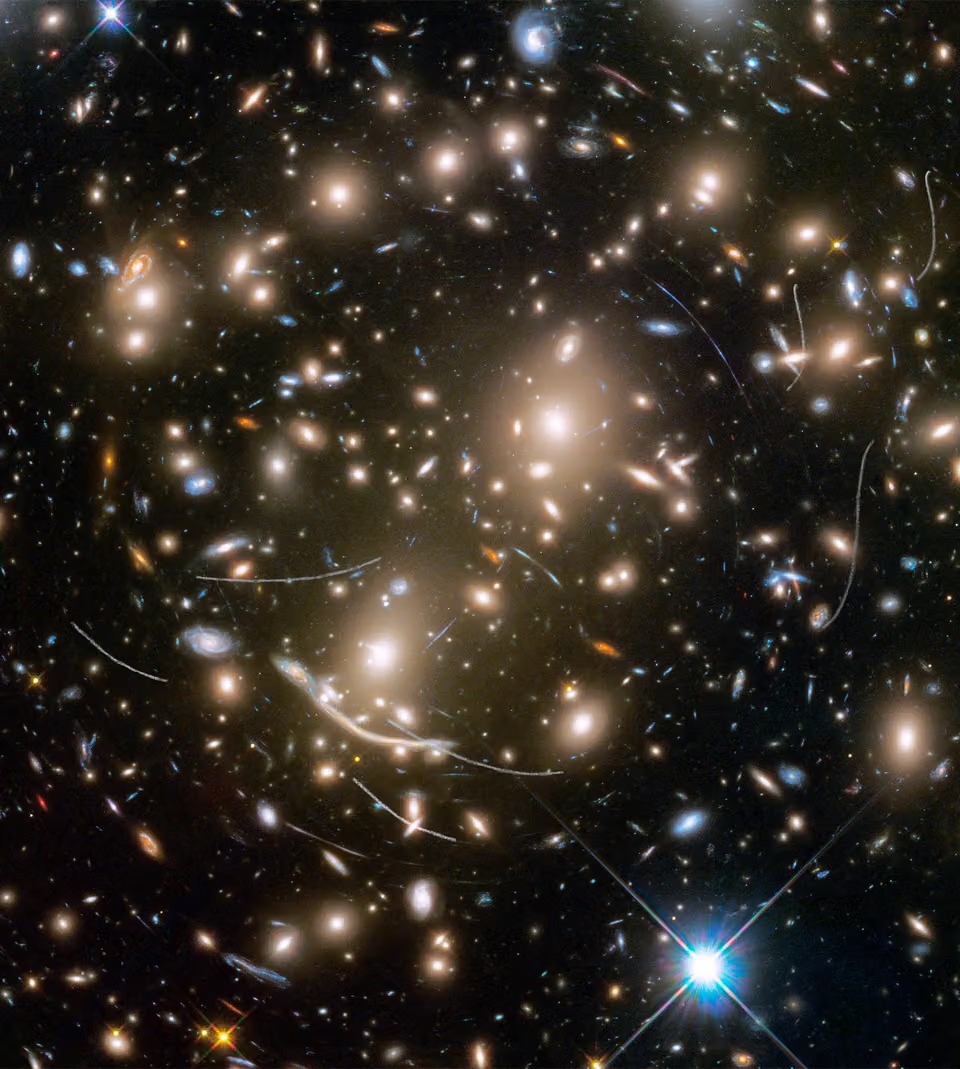
In November 2017 Hubble's image team released a picture of the galaxy cluster Abell 370 with an unusual detail: thin, curved white streaks laid across the galaxies. They were asteroids that had drifted through the field while the exposures were being collected. Put out with a light headline about asteroids photobombing distant galaxies, the image rewards a second look, because it stacks objects at wildly different distances in a single frame.
What sits in the frame, near to far
The nearest things in the picture are the asteroids. According to the release they lie on average about 260 million kilometers from Earth, close by astronomical standards. They are so faint that none had been identified before. Across the exposures there were 22 asteroid sightings, made by five separate objects.
Next out is a bright star with diffraction spikes near the lower right. It belongs to the Milky Way, hundreds of millions of times farther than the asteroids.
Then the main subject: Abell 370 itself, about 4 billion light-years away in the constellation Cetus. Several hundred galaxies are bound into the cluster by their mutual gravity, a mix of large yellowish ellipticals and spirals. Together they hold an estimated 100 trillion stars or more.
The farthest objects are the oddest-looking ones: faint blue arcs and smears that do not resemble ordinary galaxies. They are distorted images of galaxies far behind the cluster, many of them too faint for Hubble to record without help. Nothing in the picture marks these four layers apart; a streak, a spiked star, a yellow elliptical and a blue arc all sit on the same flat page, and only knowing what each one is restores the depth.
Why the asteroid trails curve
An asteroid crossing a long exposure leaves a line. These lines bend into arcs and S-shapes, and the reason is the telescope's own motion. Hubble orbits Earth about every 96 minutes, so its point of view swings back and forth while it stares at the cluster. Against the far more distant galaxies, a nearby asteroid appears to shift with each swing, the same parallax effect that makes a nearby fence post jump against distant hills when a passenger moves their head. Earth's own path around the Sun and the asteroid's orbit add further skew.
The trail shapes are in effect a record of Hubble's orbit. Sixteenth-century astronomers argued over whether Earth moves at all; here the movement of an observing platform is written across a picture of the deep universe.
None of the trails were found automatically. They were spotted by eye, mostly by blinking between consecutive exposures and watching for something that moved. On average one new asteroid turned up for every 10 to 20 hours of exposure time.
A cluster that works as a lens
The galaxies in Abell 370 are pulling on one another, and over hundreds of millions of years they move around the cluster like a swarm. What holds the swarm together is mostly invisible. Dark matter makes up the bulk of the cluster's mass, and its gravity bends the light of galaxies behind it, stretching and brightening their images. Astronomers call this gravitational lensing. It turns the cluster into a natural telescope that reveals galaxies too faint to be seen any other way, and the pattern of distortion is used to map where the dark matter sits.
Abell 370 was one of the first clusters in which a lensed arc was recognized. Ground-based observations in the mid-1980s showed that the most prominent arc was not a structure in the cluster but the stretched image of an object about twice as far away.

Images from 2009 also showed a long, segmented feature that looks like a serpent winding between the cluster galaxies. It earned the nickname "the dragon." It is a single background galaxy, imaged several times over and stretched by the lens into one sinuous shape.
The Frontier Fields behind the picture
The 2017 data came from the Frontier Fields program, in which Hubble and other observatories studied six massive galaxy clusters and their lensing in great depth. While one camera stared at each cluster, a second camera pointed slightly to the side and recorded a "parallel field" at the same time, adding a second deep field for no extra observing time. The asteroids were a side benefit of all those long exposures; similar strays turn up in other deep Hubble fields, as in Asteroids Photobomb the Universe.
Read from front to back, the Abell 370 frame spans the solar system, the Milky Way and the remote universe at once, a theme it shares with Hubble's M31 Deep Field.
Questions readers ask
Are the asteroids a problem for the science?
Mostly not. Astronomers combine many exposures, and anything that moves between them can be identified and handled. The trails do have to be told apart from the blue lensed arcs, which they sometimes resemble. Found by eye in the 2017 data, the trails also became a small asteroid survey in their own right.
What is gravitational lensing?
Mass bends the path of light passing near it. A galaxy cluster contains so much mass, much of it dark matter, that it acts like a large imperfect lens. Light from galaxies behind it is stretched into arcs and often magnified, making very distant galaxies visible.
How far away is Abell 370?
About 4 billion light-years, in the constellation Cetus. The light now reaching Hubble has been traveling for billions of years, while the asteroids in the same picture are only a few hundred million kilometers away.
What is "the dragon" in Abell 370?
It is the nickname for a long, winding lensed image in the cluster. The shape belongs to one background galaxy whose light has been split and stretched by the cluster's gravity into several overlapping copies.