Hubble anniversaries
Lagoon Nebula: Hubble's 28th Anniversary Image in Visible and Infrared
One patch of the Lagoon, four light-years across, photographed twice in February 2018: once for its glowing gas, once to look through the dust.
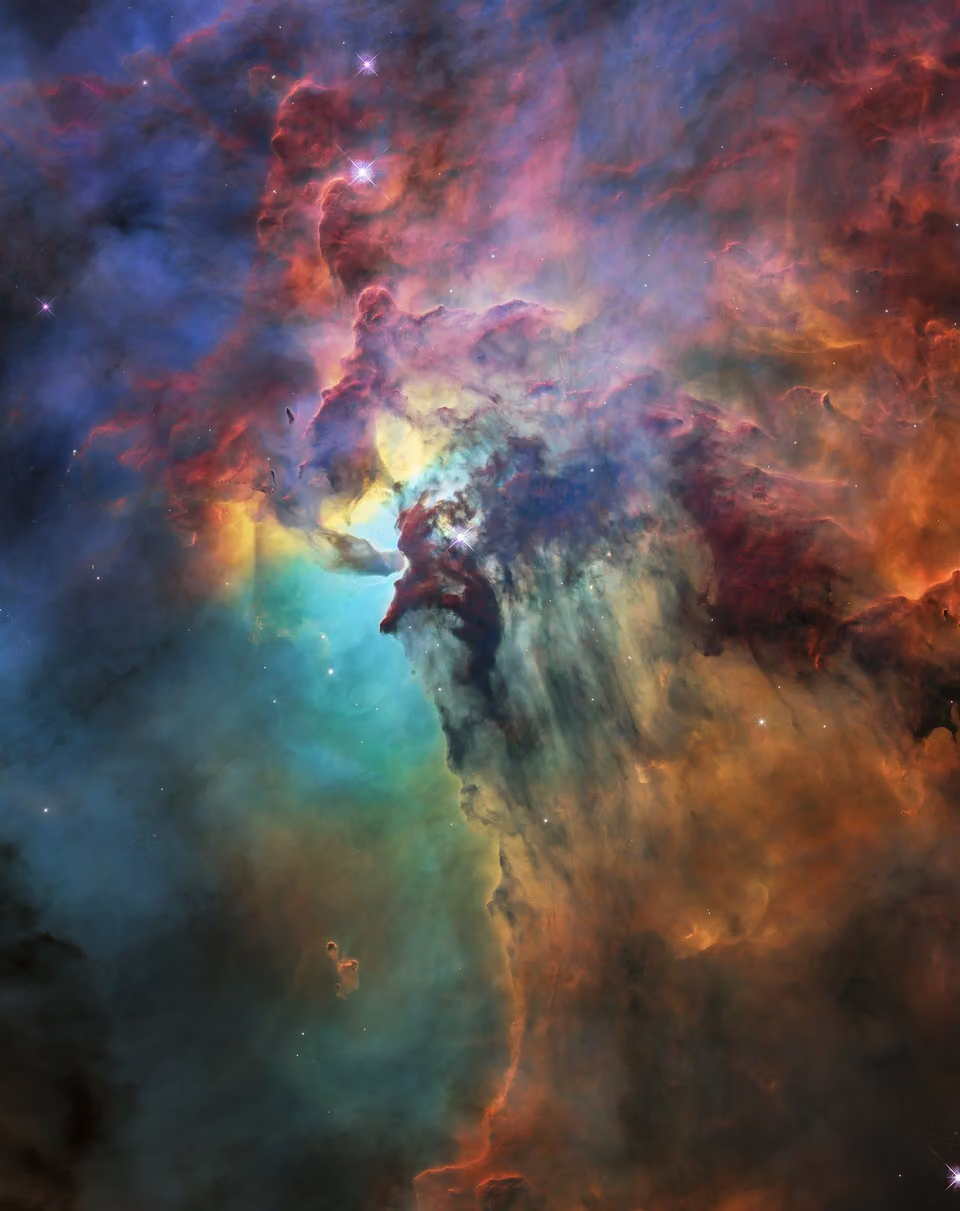
Hubble was launched on April 24, 1990, and every year since its anniversary has been marked with a new picture. For the 28th, released on April 19, 2018, the target was the Lagoon Nebula, Messier 8, a stellar nursery about 4,000 light-years away. The whole nebula is some 55 light-years wide and 20 light-years tall, three times the apparent size of the full Moon and visible to the naked eye from a dark site. Hubble's view takes in only a region about four light-years across at its very center, photographed between February 12 and 18, 2018 with Wide Field Camera 3, once in visible light and once in the near-infrared.
What the visible-light image shows
The bright star embedded in dark clouds near the middle is Herschel 36, one of the hot, massive stars that light the nebula. Stars like it are young, a few million years old at most, and pour out ultraviolet radiation and fast winds of charged particles. The radiation ionizes the surrounding gas and makes it glow. The winds carve cavities in the parent cloud and sculpt it into ridges, pillars and chimneys.
Two of the most striking shapes are a pair of interstellar twisters, rope-like funnels each about half a light-year long, probably wound into shape by the temperature difference between their hot surfaces and cold interiors. Where enough dense material survives, the pressure from the first stars can push it into collapse and start the next generation. The name Lagoon makes more sense in wide views of the whole nebula, where a broad, lagoon-shaped lane of dust crosses the glowing gas. The nebula was first cataloged in 1654 by Giovanni Battista Hodierna.
Four filters and a small mosaic
Wide Field Camera 3's UVIS channel sees only about 2.7 arcminutes of sky in one frame, so the bright center of the Lagoon was covered with a mosaic of 2 by 2 overlapping tiles. Each filter was stitched into its own seamless gray mosaic before any color was added.
Three filters are narrowband, only a few nanometers wide: F502N for oxygen, F656N for hydrogen-alpha and F658N for nitrogen. Because stars emit over a wide range of wavelengths while the gas emits mostly in sharp lines, these filters dim the stars relative to the nebula. The fourth, F547M, is a medium-band filter about 75 nanometers wide centered on 547 nanometers, so stars look much brighter in it compared with the gas.
The F547M frames also showed artifacts more clearly. A broad vertical streak in one corner came from a bright star outside the field scattering light inside the camera, and a few figure-eight shapes were out-of-focus reflections of bright stars off the filter or other optical surfaces. Both kinds of artifact, and how they are removed, are described in Are Hubble Images Real? Image Artifacts Explained.
Colors for hydrogen and nitrogen
Color followed wavelength: oxygen at 502 nanometers became blue and nitrogen at 658 nanometers red. Hydrogen-alpha at 656 nanometers is almost the same color as nitrogen, only two nanometers away, and both would look identical red to the eye. Giving hydrogen green instead separates the two gases in the picture and stretches the palette to show more of the information in the data, at the price of colors that are not what an eye would see. Are the Colors Real? explains that convention.
The first composite gave most stars an odd magenta cast, a side effect of the narrow filters and the colors chosen for them. The F547M exposures fixed it. The nebula light in that frame was suppressed further, and the result was layered over the composite in Lighten blend mode, which brought the stars to more neutral, natural colors. A final round of brightness and contrast adjustments restored structure across an enormous dynamic range.
The same field in infrared light

Wide Field Camera 3's infrared channel recorded nearly the same field through two broadband filters, F125W and F160W, at about 1.25 and 1.6 micrometers. With only two filters there are not enough channels for a full red, green and blue composite, so complementary colors were used: cyan for F125W and red for F160W. Since the light is invisible to begin with, the final hue shift that gives the stars more pleasing, realistic-looking colors is a matter of judgment.
The first thing that stands out is how many more stars there are and how much less nebula. Infrared light passes through the dust that absorbs and scatters visible starlight, so stars behind the cloud, and young ones inside it, come into view. The gas, which shines brightly in visible emission lines, is much fainter in the infrared. The comparison is a preview of what the James Webb Space Telescope does on a larger scale, with cameras and spectrographs reaching from the near-infrared to about 25 microns in the mid-infrared. More on that kind of comparison is in Peering Through the Dust.
Questions readers ask
What was Hubble's 28th anniversary image?
The Lagoon Nebula, Messier 8, released on April 19, 2018. Hubble's Wide Field Camera 3 photographed the center of the nebula in February 2018 in visible light and in near-infrared light, and both images were published together.
How far away is the Lagoon Nebula?
About 4,000 light-years. The whole nebula is roughly 55 light-years wide and 20 light-years tall, and it appears three times larger in the sky than the full Moon. The Hubble image covers only about four light-years at the center.
Why is hydrogen shown green in the Lagoon image?
Hydrogen-alpha (656 nanometers) and nitrogen (658 nanometers) glow almost the same red. To tell them apart in the composite, nitrogen was shown red and hydrogen green, with oxygen blue. The colors keep their wavelength order but are not what the eye would see.
Why does the infrared Lagoon image show more stars?
Infrared light passes through dust far more easily than visible light. Stars hidden behind or inside the nebula become visible, while the glowing gas, which emits mostly at visible wavelengths, fades.