How images are made
Lagoon Nebula in 2.5D: How a Flat Hubble Image Became a Fly-Through
No 3D model existed, so the depth had to come from the picture itself: stars removed, clouds cut into layers, and a camera sent drifting through.
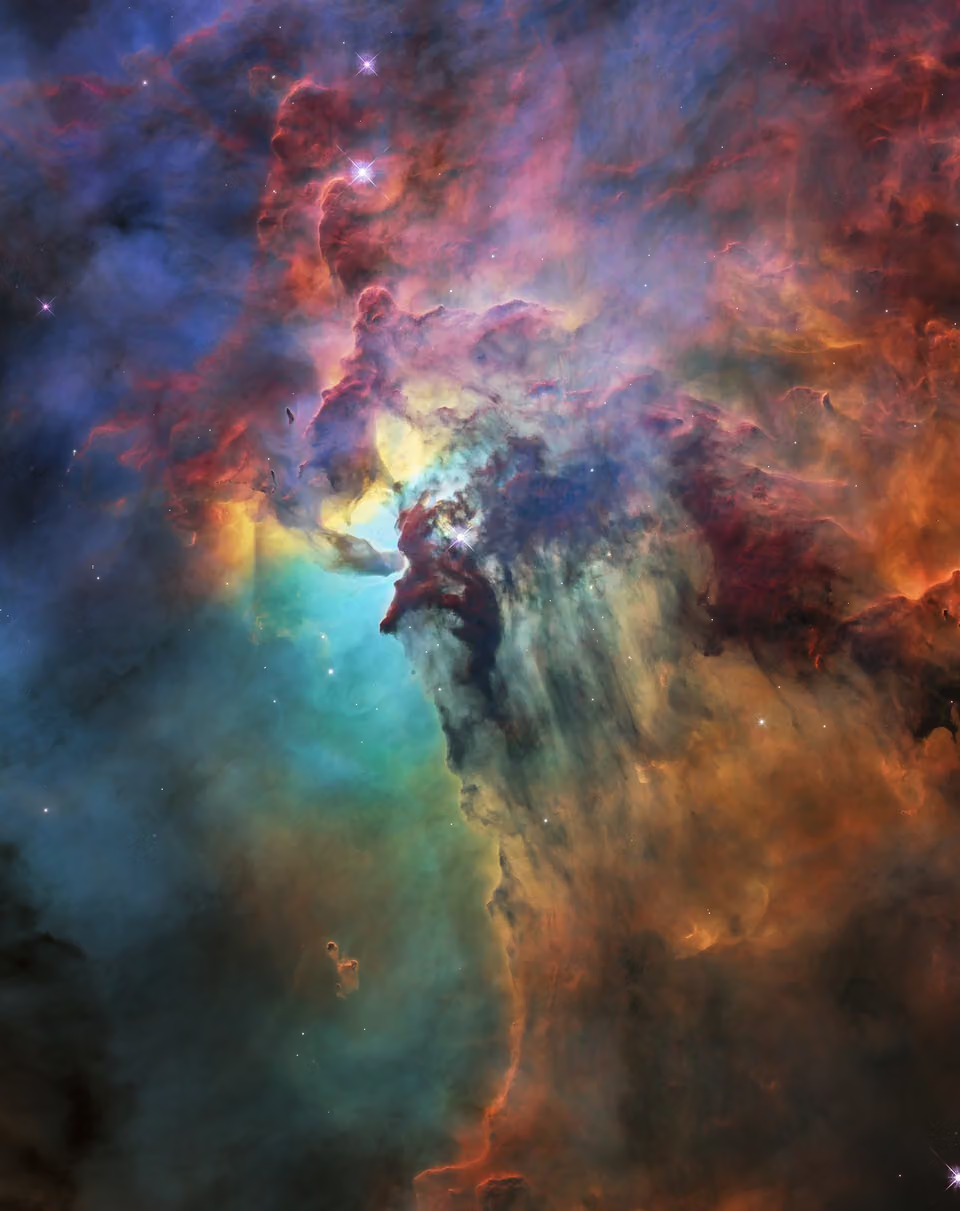
Hubble's 28th anniversary picture, released on April 19, 2018, shows the bright core of the Lagoon Nebula, Messier 8, about 4,000 light-years away in Sagittarius. Ultraviolet light and stellar winds from young, hot stars are carving the gas and dust there into ridges, cliffs and twisted funnels. Alongside the still image, the visualization team at the Space Telescope Science Institute produced a short flight across the scene. It was built without a 3D model of the nebula, using only the picture itself, and the result sits somewhere between flat and solid. The makers called it 2.5D.
A small window on a large cloud
The whole Lagoon Nebula is about 55 light-years wide and 20 light-years tall. Hubble's frame covers roughly four light-years of it, a small window on the turbulent center. Ground-based photographs show the full extent: a long glowing cloud split by a dark lane of dust, with the bright core near one end.

A true three-dimensional reconstruction would need data on the shape of the entire cloud, and Hubble had imaged only a sliver of it. So the team set itself a narrower target: give the viewer a convincing sense of depth inside that sliver, while staying faithful to what the data show.
The object has a long history of attention. The Italian astronomer Giovanni Battista Hodierna listed it in 1654, part of an effort to record fuzzy objects so they would not be confused with comets. The 2018 data were collected with Wide Field Camera 3 between February 12 and 18.
Deciding what is in front of what
A photograph holds no depth information, so every depth decision is an interpretation. Before cutting anything, the team marked up a draft of the image with the regions it planned to separate and talked the layout through with researchers who study star-forming regions. Which ridge of dust is likely closer to the viewer? Which glowing wall lies behind it? Is the dark lane in front of the bright cavity or carved into it?
The answers produced a working map of the nebula's topography. That map, more than any software step, is what keeps a visualization like this tied to science. The depth is still a reasonable reading of the image, not a measurement, and the distances in the final scene are deliberately exaggerated so that the motion is perceptible.
Taking the stars out
A powerful cue the brain uses to judge depth in motion is parallax: near objects slide across the view faster than distant ones. In a scene of clouds alone that cue is weak, because soft gas has few sharp edges to track. Stars are ideal markers.
The visible-light image of the Lagoon contains relatively few stars, because the narrowband filters used for the nebula pass little starlight and the dust hides many stars behind it. There are enough, though. The first step was to make a version of the picture with every star removed and the gap behind each one painted in with nebula. The stars themselves were saved as a separate set of elements, each free to be placed at its own distance.
Cutting the nebula into layers
Next came the clouds. Following the map, individual features were cut out of the starless image and lifted onto their own layers: a foreground ridge here, a pillar there, the glowing back wall at the rear. Every time a feature was removed, the area behind it had to be filled with a plausible guess at what lay hidden. Get that fill wrong and the illusion breaks the moment the camera moves and the "hole" comes into view.
With the layers prepared, they were placed in the three-dimensional workspace of a motion-graphics program, each one pushed forward or back along the depth axis according to the interpretation. The stars were scattered through the same space. Each layer is still a flat cutout, two-dimensional in itself, and arranging such cutouts in depth is what earns the method its half dimension.
Flying the camera
The last stage is camera work. A virtual camera drifts across the arranged layers, and because each sits at a different depth, they shift against one another as it moves. Foreground stars glide past quickly, the nearer dust ridges move a little slower, and the back wall barely moves at all. The eye reads that layered motion as volume.
Small choices matter. A camera that moves too far reveals the edges of the cutouts; one that moves too little gives no depth at all. The final flight was a slow pan across the core, set to a soundtrack of layered guitars with long delays and reverb.
The technique is a cousin of the one used for other Hubble targets, including the supernova remnant described in The Red Bubble, where thousands of stars were cut out and placed on floating panels around a modeled sphere. How the Lagoon data themselves were planned and collected is covered in Imaging the Lagoon Nebula with Hubble, and the precise alignment of the mosaic tiles in Lining Up the Lagoon.
What the fly-through can and cannot show
A 2.5D visualization is a teaching device. It makes clear that the Lagoon is a volume with depth, that the bright cavity is a hollow being blown open, and that the dark ridges stand in front of the glowing gas behind them. It does not show true distances between features, and no viewer should take the relative spacing of the layers as measured. The colors are those of the published still: oxygen shown blue, hydrogen green and nitrogen red, chosen by wavelength order as described in Are the Colors Real?
Questions readers ask
Is the Lagoon Nebula fly-through a real 3D model?
No. It is built from the flat Hubble image, cut into separate layers that were placed at different depths. The arrangement follows an informed reading of which features are in front, but the distances are interpretation and are exaggerated so the motion shows.
Why remove the stars before building the layers?
Stars are the sharpest reference points in the picture, and moving them separately from the clouds gives the strongest sense of parallax. Taking them out first also leaves a clean nebula image that can be cut into layers without slicing through stars.
How big is the area in the Hubble image?
About four light-years across. The full Lagoon Nebula measures roughly 55 by 20 light-years, so Hubble's frame shows only its central core, where young, hot stars are shaping the surrounding gas.
When was the Lagoon Nebula image released?
On April 19, 2018, to mark Hubble's 28th year in orbit. The observations behind it were made with Wide Field Camera 3 over one week in February 2018.