How images are made
GW170817 Kilonova: How Hubble Pictured a Neutron Star Merger
Two neutron stars collided 130 million light-years away. Hubble watched the afterglow fade for six days, and one color panel nearly told the wrong story.
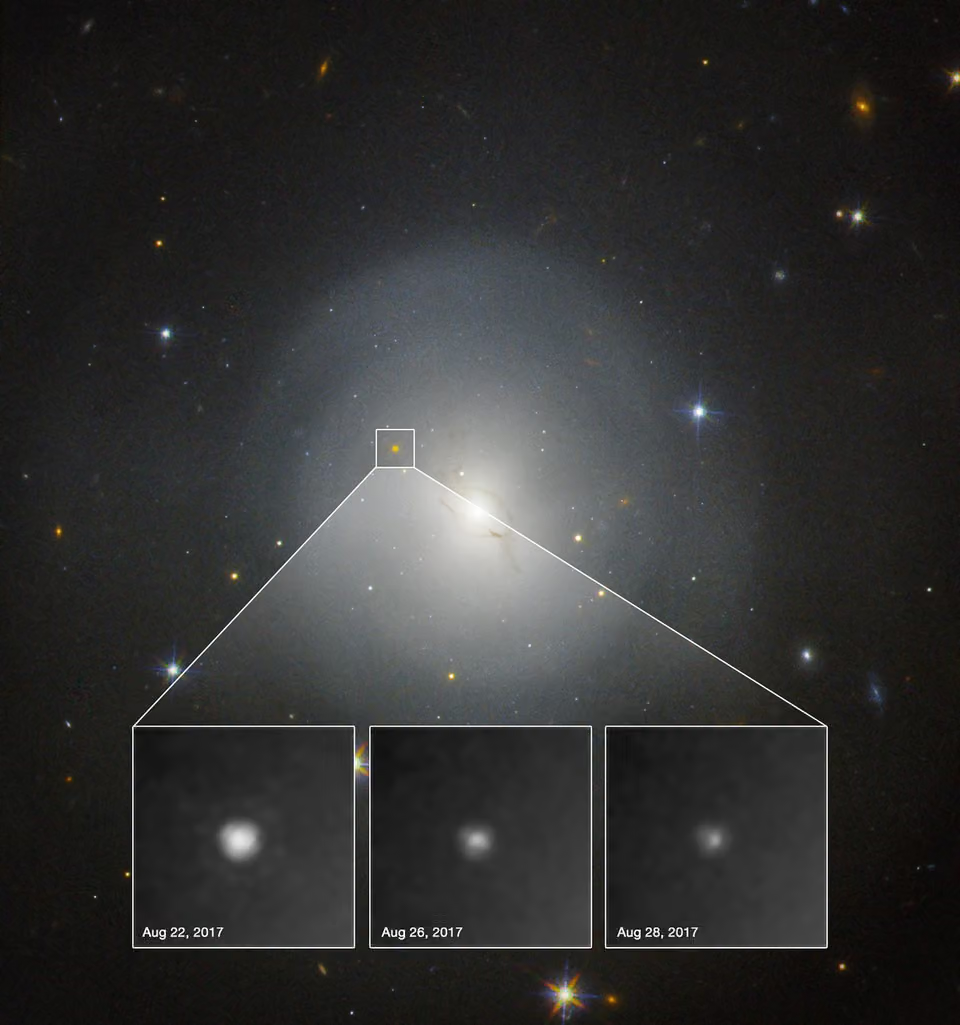
On August 17, 2017, the LIGO and Virgo detectors registered a ripple in space-time from the direction of the constellation Hydra. The signal, named GW170817, was followed shortly afterward by a faint pulse of gamma rays picked up by NASA's Fermi satellite from the same region. Within 12 hours telescopes had found a new point of light in the galaxy NGC 4993, about 130 million light-years away. For the first time, an event detected through gravitational waves had also been seen in light.
A collision heard and seen
The source was the merger of two neutron stars, the collapsed cores left behind by massive stars. When such a pair spirals together and collides, it throws out debris that glows intensely for days, an event called a kilonova. The collision also forges heavy elements, including gold and platinum, and scatters them into space, so the metals people prize are made in some of the most violent events the universe produces.
The gravitational-wave signal can even be played as sound. LIGO converted its record of the merger into an audio track, so the collision of two dead stars, which no ear could ever have heard across space, can be listened to.
Hubble's part in the campaign
Once the location was known, Hubble was pointed at NGC 4993 under a target-of-opportunity program, which lets astronomers interrupt the planned schedule for an unpredictable event. Over about a week the telescope photographed the galaxy with the infrared channel of Wide Field Camera 3. Hubble also took a spectrum of the source in near-infrared light, and that spectrum matched theoretical predictions for a neutron star merger so closely that it removed remaining doubt about what the object was.
The kilonova was visible across almost the entire spectrum, from radio waves to X-rays. Its light peaked first in the ultraviolet and then shifted toward the infrared as the debris expanded and cooled, before fading away.

Making the main picture
For the release image, the new infrared frames were combined with an older visible-light image of the galaxy taken with the Advanced Camera for Surveys. In that composite the kilonova shows as a small yellow dot to the upper left of the galaxy's center, yellow because most of its light was in the near infrared, at the red end of the color mapping.
A single still could not convey the most remarkable thing about the source, which was that it changed in days. Enough data had been collected at each visit to make a picture for every stage, so the release included three small insets showing the dot dimming over six days. Those insets are black and white, and the reason is a lesson in how a color image can mislead.
Two filters and a scheduling gap
At each visit Hubble observed with just two infrared filters, F110W near 1.1 micrometers and F160W near 1.6 micrometers. Three-color pictures can still be made from two filters. The shorter wavelength, F110W, is assigned blue and the longer, F160W, red, following the order of the spectrum, and the green channel is synthesized from an equal blend of the two. The method is often called pseudo-green. It gives fewer distinct hues than three real filters, but it works well for most targets. The reasons behind ordering colors by wavelength are set out in Are the Colors Real?
Built this way, the three panels showed two problems. First, without the visible-light data used in the main image, the kilonova came out white instead of yellow, so the insets and the main picture disagreed. Second, and more troubling, the middle panel showed the source turning bluer. Fading was expected; a color change in the near infrared was not, and would have implied some additional physical process.
The cause turned out to be the calendar. Because of scheduling constraints, the F160W exposure for that visit had been taken two days after the F110W exposure. During those two days the kilonova faded noticeably, so the red channel recorded a dimmer source than the blue channel, and the combination tipped toward blue. The color shift was produced by the timing of the exposures, not by the object.
Choosing clarity over color
The decision was to show the insets in grayscale. The point of the panels was the drop in brightness over time, and color would only have added a distraction, and in the middle frame a false one. Color was kept for the main image, where it was reliable.
Choices like this one are a normal part of preparing a news image. Processing has to balance accuracy and appearance, and so does the graphic that tells the story. Other cases where an image feature comes from the instrument or the schedule, and not from the sky, are collected in Image Artifacts.
Questions readers ask
What is a kilonova?
It is the glow from debris thrown out when two neutron stars merge. The event is extremely energetic, and the debris is rich in newly made heavy elements such as gold and platinum. It shines for days while it expands and cools. GW170817 produced the first kilonova linked to a gravitational-wave signal.
Where did GW170817 happen?
In NGC 4993, a lenticular galaxy about 130 million light-years away in the constellation Hydra. The kilonova appeared a short distance from the galaxy's center, and observatories had pinpointed it within 12 hours of the gravitational-wave detection.
Why are the Hubble insets black and white?
The two infrared filters for one visit were observed two days apart, and the kilonova faded in between. In color, that made the source look as if it turned blue, which it did not. Grayscale panels show the fading honestly without suggesting a false color change.
What does pseudo-green mean?
It is a way to make a full-color image from only two filters. The shorter wavelength becomes blue, the longer becomes red, and green is created by blending the two. The result has fewer distinct hues than a three-filter image but follows the same wavelength order.