Solar System
Phobos Photobombs Mars: How Hubble's 2016 Frames Revealed the Moon
Forty minutes of Mars exposures, four filters, a rotating planet, and a small moon that only appears once the planet is blown out to white.
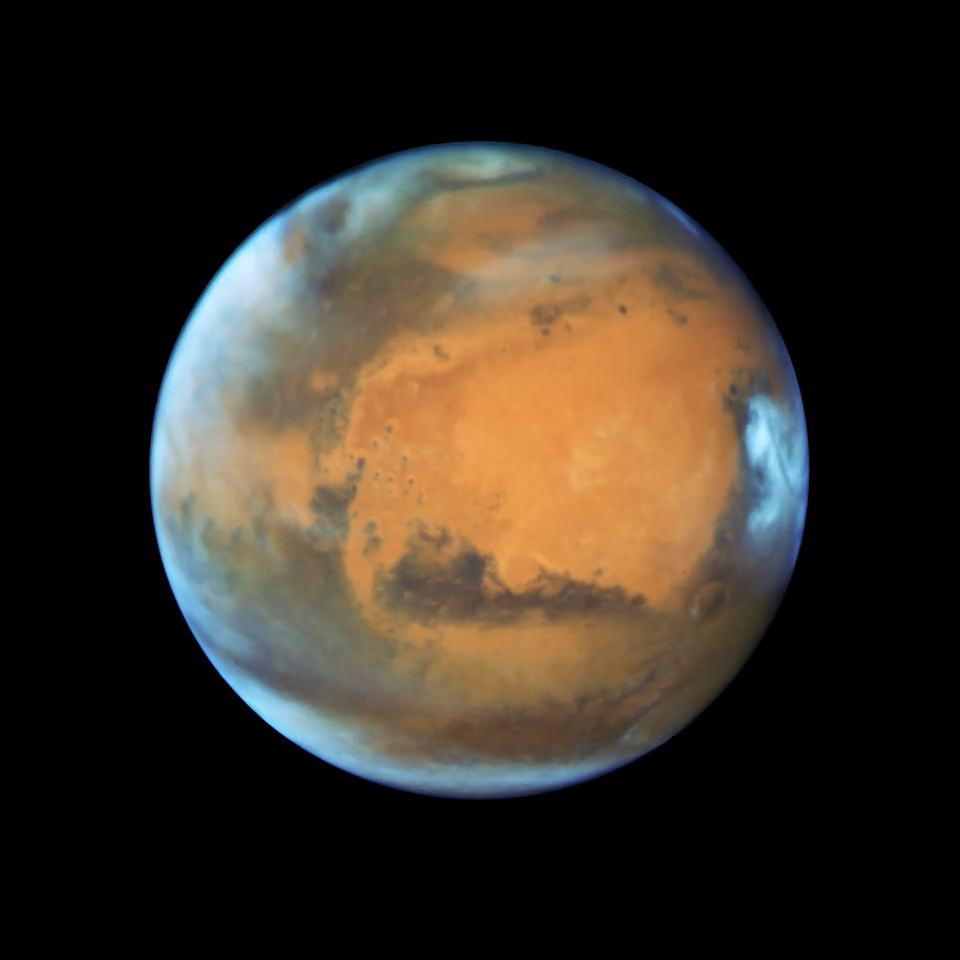
Roughly every two years Earth overtakes Mars on the inside track of their orbits, and for a few weeks the planet looks larger and brighter than at any other time. On May 12, 2016, close to one of those approaches, Hubble spent about 40 minutes photographing Mars. The pictures produced a sharp color portrait of the planet and, once they were pushed far past their normal brightness, an unplanned bonus: the small moon Phobos, caught in the act of moving.
Forty minutes of Mars
At the time of the observations Mars was about 80 million kilometers (50 million miles) from Earth, or 0.53 astronomical units, and its disk spanned 18 arcseconds on the sky. The Heritage team used the UVIS channel of Wide Field Camera 3 and took 25 exposures through four filters, running the same filter sequence three times over. The whole set fit into about 40 minutes, a little under half of one of Hubble's orbits around Earth, which take roughly 90 minutes each.
Hubble filter names carry their own key. In F410M, for example, the number gives the central wavelength in nanometers and the M marks a medium-width filter. Exposure times ranged from half a second to 20 seconds, because the filters pass different amounts of light and the detector is more sensitive at some wavelengths than others. The processors then evened out the brightness so that each filter's frames had a consistent tonal range. Some of the longer exposures were bright enough to be partly overexposed.
Turning four filters into color
For the color version, the processors picked the best frame per filter from every one of the three cycles and given a color according to its wavelength: blue, cyan, green and red, from shortest to longest. Combining the four layers produced a color composite for each cycle. The same convention of ordering colors by wavelength runs through most Hubble images, and its rationale is explained in Are the Colors Real?
A planet adds a complication that a nebula does not. Mars turns once in a little more than 24 and a half hours, slightly longer than Earth does, and even in the few minutes between one filter and the next the globe rotates enough for surface features to shift. Stacking the layers directly would blur them a little. Here the effect is small and can be reduced further by nudging each layer into place. A more thorough method maps each image onto a flat projection of the planet, aligns and combines all the frames for each filter on that map, builds the color image, and then wraps the result back onto a globe. It is more accurate and much more work.
The finished 2016 portrait, with its named features and the seasonal state of the polar caps, is described in Mars Near Opposition 2016, and what the processing means for the planet's apparent color is the subject of What Color Is Mars?
The moon in the glare
Mars has two moons, and one of them, Phobos, appears in about half of the frames. It circles the planet once every 7 hours and 39 minutes, far faster than Mars spins. When the observations began it was hidden behind the planet, and over the following minutes it came out from behind the limb.
In the images processed to show surface detail, Phobos does not appear at all. It is small and faint, many times fainter than the sunlit planet. It only shows when the frames are brightened so far that the whole disk of Mars burns out to white. In that version the different filters and exposure lengths were again balanced, this time so that Phobos looks consistent from frame to frame while Mars is completely saturated. The overexposed disk was masked and drawn as an outline.

Once the moon's positions were known, they could be combined with the color views of the planet to make a realistic visualization of the system in motion. With careful interpolation between frames the result can be smoothed into a short movie in which Phobos glides out from behind Mars. The labeled version of the portrait above marks the regions of Mars that were facing Hubble while Phobos made its exit.
The next close approach
The next opposition falls on July 27, 2018, when Mars will be even closer to Earth and brighter than in 2016. Close approaches like these are the best chances to photograph the planet from Earth orbit, since the disk is larger and fully lit.
Questions readers ask
Why does Phobos not appear in normal Hubble images of Mars?
Phobos is small and far fainter than the sunlit disk of Mars. When images are processed to show surface features on the planet, the moon is too dim to register. It only becomes visible when the frames are brightened so much that Mars itself is completely overexposed.
How fast does Phobos orbit Mars?
It completes one orbit in 7 hours and 39 minutes, much faster than Mars rotates. That speed is why it moved noticeably during the roughly 40 minutes of Hubble observations in May 2016, emerging from behind the planet as the sequence went on.
Why does Mars rotation blur color images?
Hubble takes each filter separately, one after another. Mars keeps turning between exposures, so features land in slightly different places in each color layer. Shifting the layers reduces the blur, and a fuller fix projects every frame onto a flat map, combines them there and wraps the result back onto a globe.
What do filter names like F410M mean?
The F stands for filter and the number is the central wavelength in nanometers, so F410M is centered on 410 nanometers. The final letter gives the width of the band: W for wide, M for medium and N for narrow.