How images are made
Mars in a Global Dust Storm: How Hubble's 2018 Images Were Made
A planet wrapped in dust, a 43-minute filter sequence and a red filter that could see a little deeper than the rest.
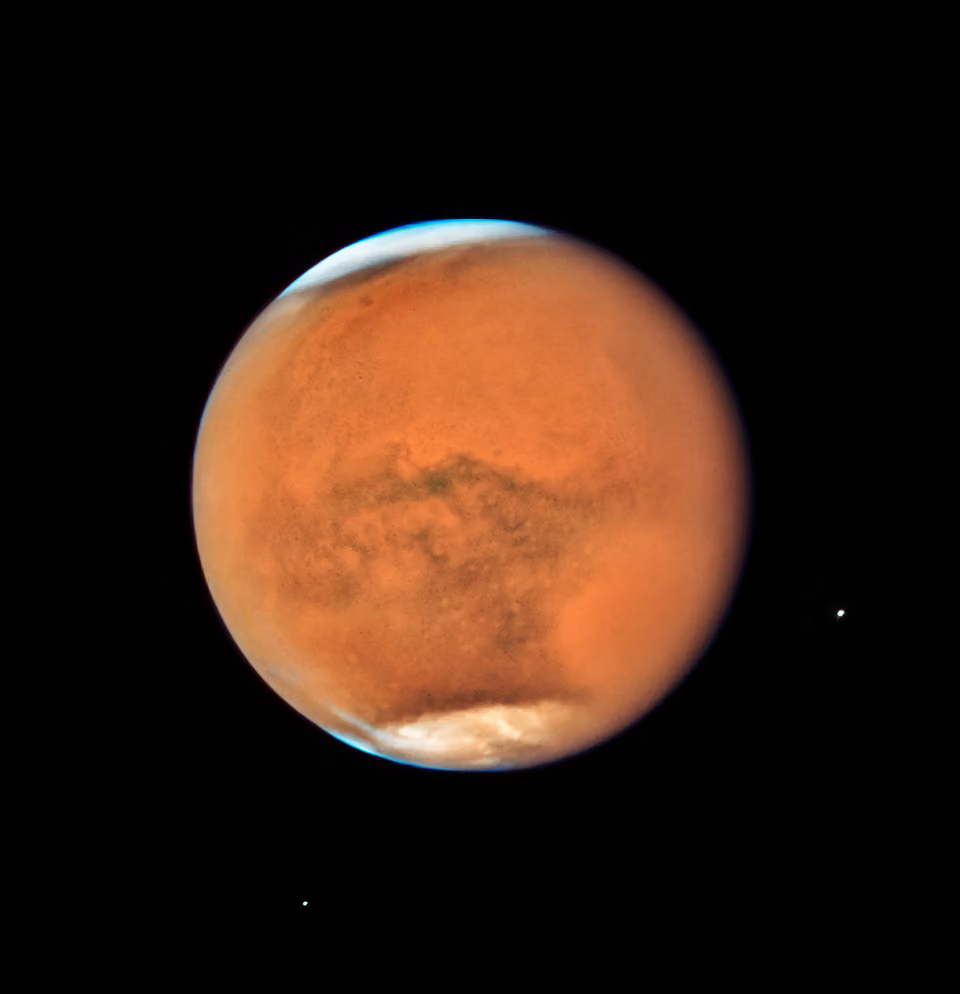
Mars came unusually close to Earth in the summer of 2018, closer than at any time in the previous 15 years. On July 18, a little under two weeks before the closest approach, Hubble turned its Wide Field Camera 3 on the planet. The timing was awkward. A dust storm had been growing for about two months and by then covered almost the whole globe, and there was a real chance the pictures would show a smooth orange ball with nothing on it.
Why 2018 was a close one
Mars reaches opposition when Earth passes between it and the Sun, the point in each cycle when the two planets are nearest. Not every opposition is equally close. The average distance between the planets is about 225 million kilometers (140 million miles). The closest approach on record came in August 2003, at 56 million kilometers (34.8 million miles). On July 27, 2018, the gap was about 59 million kilometers (37 million miles), very nearly as good.
Close oppositions bring a heating penalty for Mars as well. The planet is then also near the part of its orbit closest to the Sun, and the extra warmth drives the winds that can lift dust across continents. That is the season when global storms tend to break out, and 2018 produced one. The same summer, researchers also announced the discovery of a lake of liquid water beneath the south polar cap, so the planet was in the news for several reasons at once.
Filters that see different planets
The observing plan used a spread of Hubble's filters: a wide band in the ultraviolet, a narrower band in blue, and narrow bands in green and red. The raw frames, taken in sequence over about 43 minutes, look like pictures of several different planets. In the ultraviolet and blue, Mars is a featureless disk, softened by dust and marked only by clouds and the polar ice in the far north and south.
The narrowband red filter at 673 nanometers, F673N, behaves differently. Longer wavelengths scatter less off fine dust grains, so in that filter some of the familiar dark surface markings show through the haze. Choosing that filter turned out to be the difference between a usable image and a bland one, helped by the fact that the storm had begun to clear when the observations were made.

From three frames to a color picture
A first color version is straightforward: pick three filters that sit next to each other in wavelength and assign them blue, green and red. One combination used F410M for blue, F502N for green and F673N for red. The result already looks like Mars, with the dust giving the disk its familiar butterscotch tone. The rule of ordering colors by wavelength is described in Are the Colors Real?
To bring out more surface detail, the processing targeted structures between about 3 and 8 pixels across with a local contrast enhancement. Working at that scale lifts the faint surface markings without exaggerating the large-scale shading of the disk or the noise at the pixel level. In an exaggerated test version the effect is obvious; in the released image it is applied gently, together with some color adjustment and a rotation to put north at the top.
Mars in motion
Solar system targets offer something deep-sky objects never do: change on a timescale of minutes. Because the 43-minute sequence had many frames, each set of filters could be turned into its own color image, and aligning them in order produced an animation of Mars rotating.
The same frames held two more objects. With the brightness stretched far beyond normal, the moons Phobos and Deimos appear, tiny points that persist from frame to frame even through the cosmic-ray hits and noise of unprocessed data. Deimos sits high to the upper left of the disk and Phobos moves in from the left edge before slipping into the planet's shadow. In the raw stretch the moons flicker, so the animation made for the release used one clean frame of each moon and interpolated their motion to keep it smooth. Another Hubble sequence in which a Martian moon crosses the frame is described in Phobos Photobombs Mars.
In the 2016 view, Syrtis Major, the oval Hellas basin, Arabia Terra and the dark equatorial bands of Sinus Sabaeus and Sinus Meridiani stand out clearly. In 2018 the polar caps, Terra Meridiani, Schiaparelli crater and Hellas are still there, only softened by dust. The storm-free opposition is covered in Mars Near Opposition 2016.
Questions readers ask
Why did the 2018 dust storm cover the whole planet?
Global storms tend to happen in the southern spring and summer, when Mars is closest to the Sun and the surface heating is strongest. The extra energy drives winds that lift dust high into the atmosphere, and in 2018 the storm grew for about two months until it wrapped almost the entire planet.
Which filter saw through the dust?
The narrowband red filter F673N, centered at 673 nanometers. Longer wavelengths scatter less off the fine dust, so some dark surface markings came through in that filter while the ultraviolet and blue frames showed an almost featureless disk.
How close was Mars to Earth in July 2018?
On July 27, 2018 the distance was about 59 million kilometers, or 37 million miles. That made it the closest approach in 15 years, just short of the August 2003 record of 56 million kilometers.
Can Hubble see the moons of Mars?
Yes, but they are very faint next to the bright planet. In the 2018 data they only appear when the image brightness is stretched far beyond normal, revealing Phobos and Deimos as small points moving around the disk during the 43-minute sequence.