Hubble anniversaries
Southern Crab Nebula: Hubble's 29th Anniversary Image of an Hourglass
Two stars, one dying and one already dead, and the nested hourglass of gas they have blown into space, seen by Hubble twenty years apart.
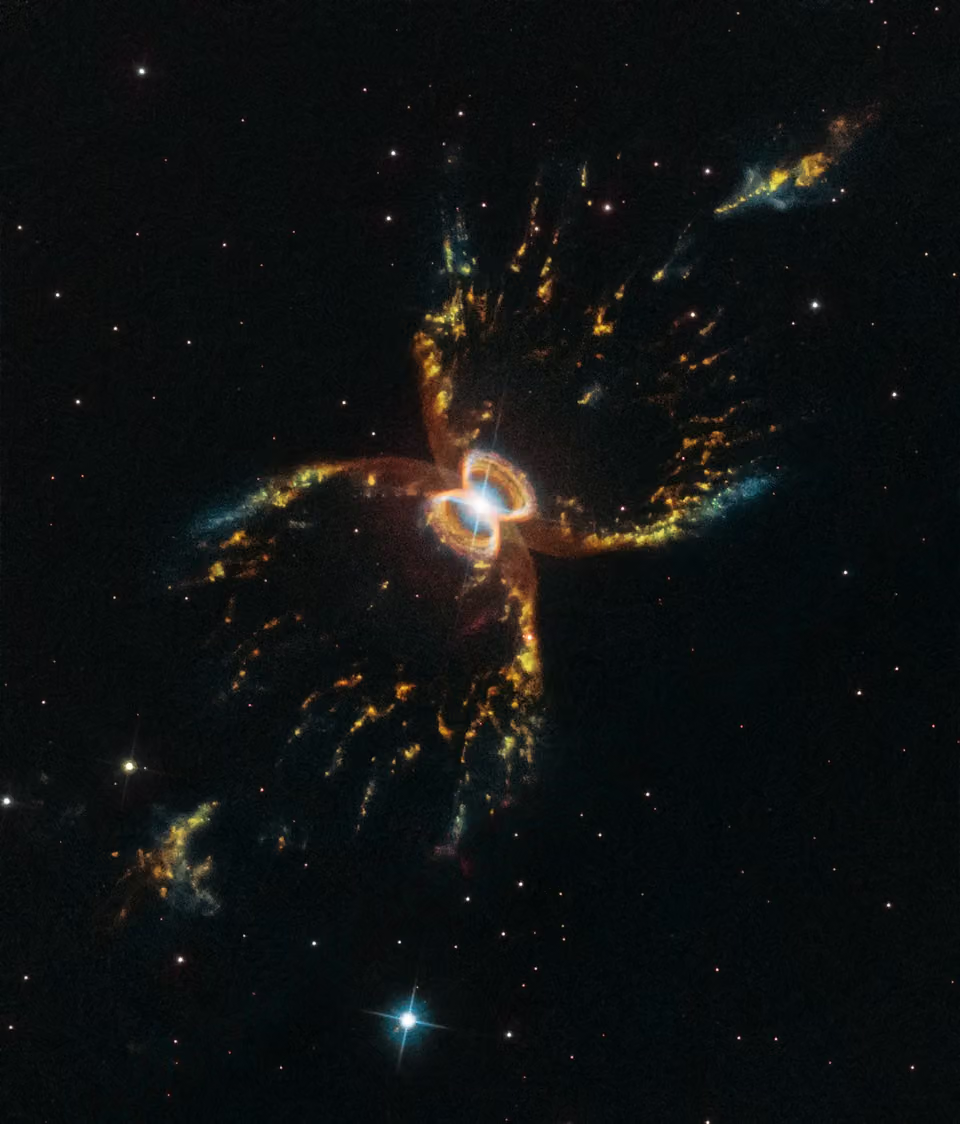
Why point Hubble at the same small nebula twice, twenty years apart? The Southern Crab Nebula, Hen 2-104, about 7,000 light-years away in the constellation Centaurus, answers that question for the telescope's 29th anniversary. Hubble first revealed its full structure in 1999. In 2019 it returned with Wide Field Camera 3 and four narrowband filters, and the new image was released on April 18, 2019, a few days before the anniversary of the April 24, 1990 launch.
Two stars behind one hourglass
At the center of the nebula is an unequal pair of stars: an aging red giant and a white dwarf, the dense remnant of a star that has already died. The giant is near the end of its life, losing its outer layers, and will one day become a white dwarf as well. A disk of material encircles the pair.
Some of the gas the giant throws off is pulled in by the white dwarf's gravity. When enough has piled onto the white dwarf, it is blasted outward again in an eruption. The disk around the stars blocks the outflow along its plane and channels it into two opposing lobes. In three dimensions the result is an hourglass; seen flat on the sky, the lobes and their streamers look a little like a crab.
The pairing is not finished. The red giant will eventually run out of outer layers to lose and stop feeding its companion, and there may be more eruptions before then, each adding new structure to the nebula.
From a star to a crab to nested hourglasses
The object first appeared in the astronomical literature in 1967, but for more than twenty years it was taken to be an ordinary star. In 1989, images from the European Southern Observatory's telescopes at La Silla in Chile showed that it was extended: a roughly crab-shaped nebula of symmetrical bubbles of gas and dust. Those images showed only the outer hourglass emerging from a bright center too small to resolve.

Hubble's 1999 observation, made with the Wide Field and Planetary Camera 2 through a nitrogen filter, brought the whole structure into view: a small, bright hourglass nested inside the large one. Two hourglasses suggested that whatever blew the outer bubbles had happened twice in the astronomically recent past. The 2019 image adds color, sharper detail and twenty years of change to that story.
The two observations differ as much in instrument as in date. The 1999 data came through a single nitrogen filter, so that picture is essentially one color, with the small inner hourglass shown separately in an inset. Wide Field Camera 3, installed in 2009, offers finer resolution over a wider field than the camera it replaced, and for this target it observed through four filters, enough for a full-color composite. Each year Hubble sets aside a small portion of its observing time for an anniversary image of a particularly beautiful and meaningful object. Returning to a nebula it had first explained two decades earlier was a way to show both: an evolving object, and a telescope still capable of adding to its story.
Four filters, four gases
For the anniversary image, Wide Field Camera 3 observed through four narrowband filters, each isolating the glow of one element: oxygen at 502 nanometers, hydrogen-alpha at 656, nitrogen at 658 and sulfur at 673. These elements glow under different conditions of temperature and density, so comparing where each one is bright lets astronomers take the nebula apart layer by layer. The color image combines them in wavelength order, the method described in Are the Colors Real?. In that ordering oxygen, the shortest of the four wavelengths, sits at the blue end of the palette and sulfur, the longest, at the red end, with hydrogen and nitrogen only two nanometers apart in between.
The released picture keeps all four in one frame, with the bright hourglass at the center and the long streamers fanning out above and below it. The field is small, about 1.4 by 1.6 arcminutes, which illustrates how compact the nebula is on the sky despite its size in space.
Pictures and spectra side by side
For this anniversary the image came with a second message. Alongside the picture, Hubble recorded a spectrum of the central region, spreading its light out by wavelength across the visible range. The spectrum shows a continuous glow with strong peaks at exactly the lines that the four filters were chosen to capture.
A diagram made for the anniversary tied the two together: each filter image placed next to the matching peak in the spectrum. The point it makes applies far beyond this nebula. Hubble's scientific results come roughly half from images and half from spectra. Images show the shapes and details of objects; spectra reveal properties no picture can, such as temperature, chemical composition and motion. The 3D shape of the nebula around AG Carinae, for example, was worked out from the Doppler shifts in its spectrum, as described in AG Carinae in 3D.
Not the Crab Nebula
The name needs a footnote. The better-known Crab Nebula, Messier 1, in Taurus, is the remnant of a star that blew itself apart in a supernova, its debris still expanding from the explosion seen in 1054. The Southern Crab is a much gentler object: a dying star in a binary system shedding its gas in a wind and in repeated eruptions. Both mark the late stages of stellar lives, one explosive, one slow. The Crab Nebula page covers the northern namesake.
Questions readers ask
What was Hubble's 29th anniversary image?
The Southern Crab Nebula, Hen 2-104, released on April 18, 2019. Hubble's Wide Field Camera 3 photographed it through four narrowband filters for oxygen, hydrogen, nitrogen and sulfur, twenty years after the telescope first revealed its nested hourglass structure.
What creates the Southern Crab Nebula's shape?
A binary star system: a red giant losing its outer layers and a white dwarf that pulls some of that gas in and then ejects it in eruptions. A disk around the pair channels the outflow into two opposing lobes, forming an hourglass.
Is the Southern Crab Nebula related to the Crab Nebula?
No. The Crab Nebula in Taurus is a supernova remnant from an explosion seen in 1054. The Southern Crab in Centaurus is gas blown off by a dying star in a binary system. The southern object was named to tell the two apart.
How far away is the Southern Crab Nebula?
About 7,000 light-years, in the southern constellation Centaurus. Its central pair of stars is buried in the glow of the small inner nebula and cannot be picked out directly, even in Hubble's images.