How images are made
HH 24, the Cosmic Lightsaber: How a Newborn Star Launches Twin Jets
Two thin beams of gas stream from a newborn star in Orion. Spin and magnetism explain how a collapsing cloud fires them.
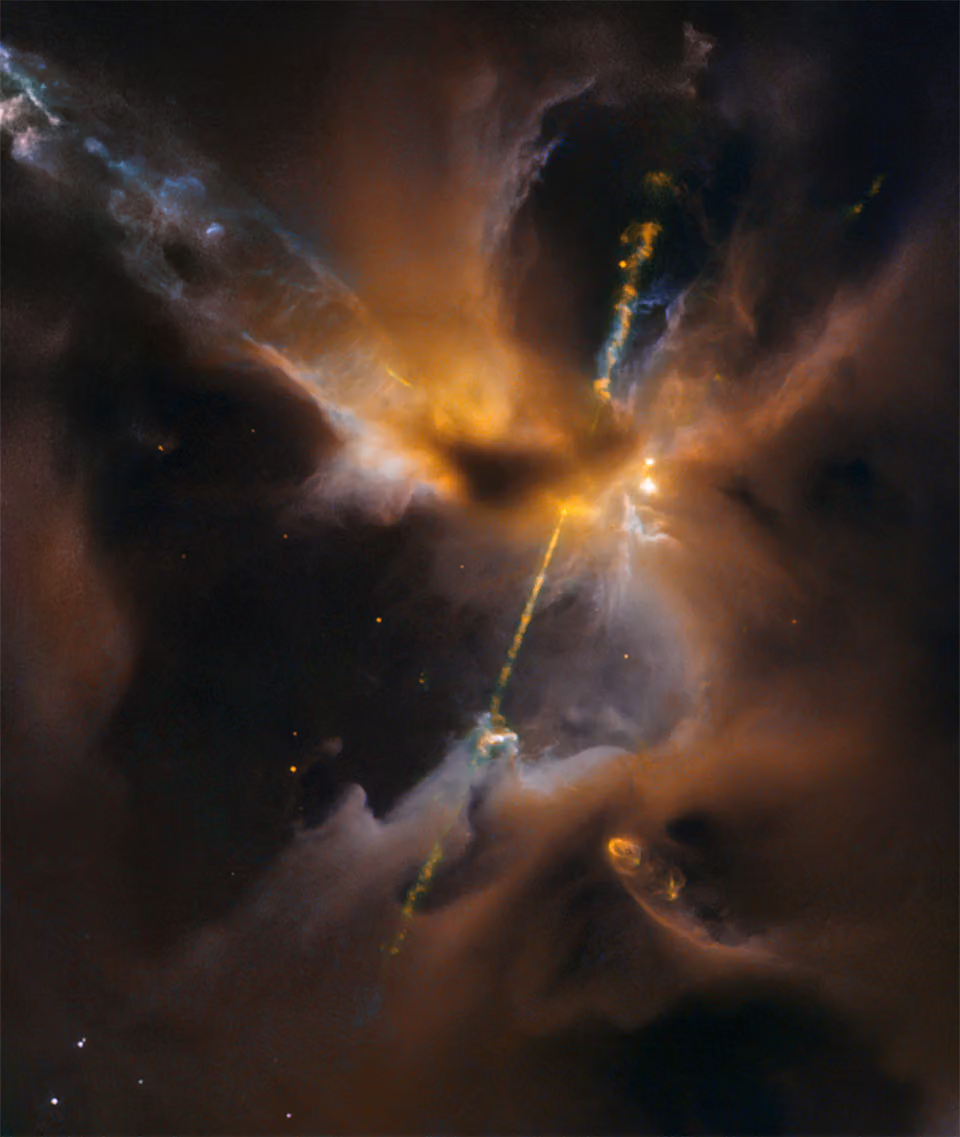
May 4 is unofficially Star Wars Day, and one Hubble image fits it better than any other. In December 2015, in the week the film The Force Awakens opened, Hubble's news office released a picture of a young star with two narrow jets shooting out of it in opposite directions, under the headline "Hubble Sees the Force Awakening in a Newborn Star." The resemblance to a double-bladed lightsaber is hard to miss. The physics that makes it is less familiar.
The scale of the jets
The object is HH 24, in the constellation Orion about 1,500 light-years away. From one end of the picture to the other spans roughly a light-year, about 6 trillion miles. The jets are streams of gas moving at more than 100,000 miles per hour. Where they hit the surrounding gas and dust, they can clear out large spaces and drive curved shock waves that glow as knots; those knots are what astronomers call Herbig-Haro objects, and they give HH 24 its name.
The star itself is hidden. It sits at the center, buried in the dusty cloud it formed from, and only the jets give away its position.
Why a collapsing cloud makes a disk
Stars form when a cloud of gas and dust collapses under its own gravity. No such cloud is perfectly still. Its internal motions add up to a slight overall rotation, and as the cloud shrinks that rotation speeds up. The principle is conservation of angular momentum, the same effect that makes a figure skater spin faster on pulling in their arms: a gentle spin spread over a large distance becomes a fast spin over a small one.
The consequence is that the material cannot all fall straight onto the young star. Much of it settles into a flattened, rotating disk around the star's equator. Given the physics, the disk is close to inevitable; every newborn star is expected to have one.
Why the gas goes out at the poles
At the inner edge of the disk, gas spirals down toward the star. Not all of it is swallowed. Part of the infalling material is thrown back out, and the easy way out is perpendicular to the disk, away from the dense, flat ring of material. That gives two outflows aimed in opposite directions along the star's spin axis.
What makes HH 24 remarkable is how narrow those outflows are. The explanation lies in magnetism. The spinning disk contains ionized gas, gas that carries electric charge, and charged gas drags magnetic field lines along with it. As the disk turns, the field lines wind up around the young star, twisting into tight bundles above and below the disk. Ionized material moving along those lines is funneled into two thin channels and launched at high speed. The magnetic field works like a nozzle, and it keeps the jets pencil-thin over great distances.
Not every jet stays straight
In HH 24 the jets stay tightly confined for a long way, which produces the lightsaber look. Many other young stars produce outflows that are clumpier and broader, with large lobes at the ends.

HH 47, in the southern constellation Vela, is a good example. Its jet is a chain of blobs that ends in a broad, curved bow shock, much like the wave pushed ahead of a ship's bow. Blobs are ejected in bursts at more than 700,000 kilometers per hour, and where a fast blob runs into slower gas ahead of it, the material heats up and glows. The lobes mark where the jet finally dumps its energy into the surrounding interstellar gas. Its two companions in the same set, HH 34 and HH 2, lie near the Orion Nebula, and all three outflows are roughly 1,350 light-years from Earth. In HH 2 several fast clumps have piled up behind one another, each with its own bow shock, like cars bunched in a traffic jam.
These features are short-lived on astronomical scales, lasting thousands of years, and they move fast enough to track. Hubble followed HH 47, HH 34 and HH 2 over three epochs between 1994 and 2008 with the Wide Field and Planetary Camera 2, and the resulting time-lapse sequences show the knots advancing and the shocks brightening and fading. A closer look at how spin governs objects of every size is in Does Angular Momentum Make Your Head Spin?, and another young star shaped by its surroundings is the protostar in IRAS 20324+4057.
Questions readers ask
What is a Herbig-Haro object?
It is a patch of glowing gas created where a jet from a young star slams into the surrounding gas and dust. The collision produces shock waves that heat the gas until it shines. HH 24 and HH 47 are both named for these glowing knots and shocks.
How fast are the jets of HH 24?
The streams of gas move at more than 100,000 miles per hour. Other jets observed by Hubble are faster still: the blobs in HH 47 and its neighbors travel at more than 700,000 kilometers per hour, fast enough that Hubble can see them move over a few years.
Why do young stars have disks?
The cloud that forms a star always rotates a little. As it collapses, that rotation speeds up, just as a skater spins faster with arms pulled in. The spinning material flattens into a disk around the star instead of falling directly onto it.
Why are the jets so narrow?
Magnetic fields carried by the spinning, electrically charged gas in the disk wind up around the young star. Charged material flowing along those twisted field lines is squeezed into two narrow channels, one above and one below the disk, and fired outward at high speed.