Hubble Heritage Archive · Star
IRAS 20324+4057: The Cosmic Caterpillar Protostar in Cygnus
A young star still gathering mass, wrapped in a cocoon of gas that radiation from dozens of nearby giants is slowly stripping away.
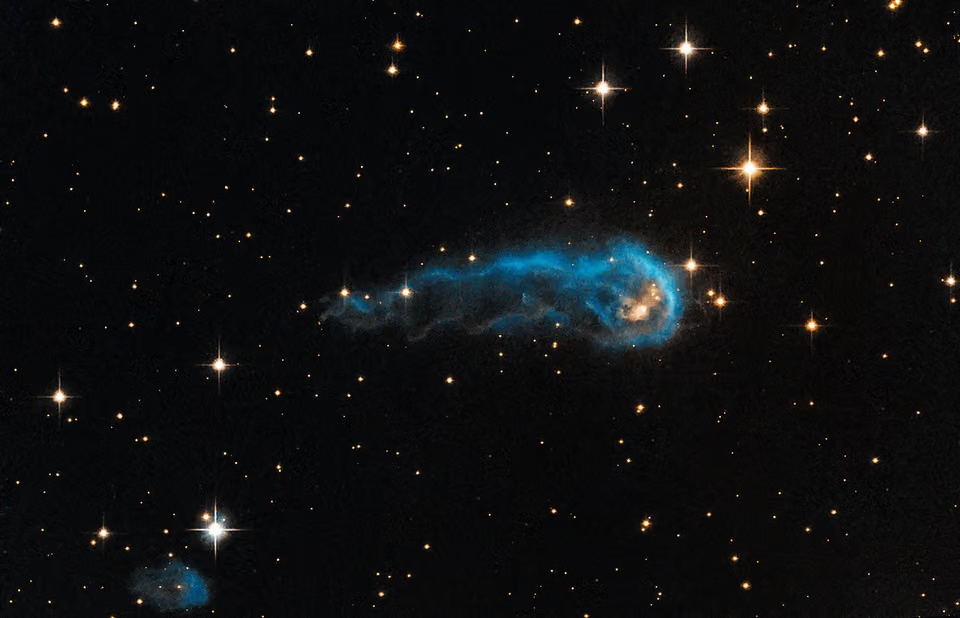
Fifteen light-years from this knot of gas sit 65 of the hottest, most luminous stars known in the Milky Way. Their ultraviolet light is eating the knot from one side, and that is what gives IRAS 20324+4057 its shape: a rounded head facing the onslaught and a long body trailing away from it, about a light-year from end to end. Inside the head a star is still forming.
The object lies about 4,500 light-years away in Cygnus, the Swan, in a part of the Milky Way crowded with gas clouds. Its catalog name comes from the Infrared Astronomical Satellite (IRAS), which recorded it as a source of infrared light, and the digits encode its approximate position in the sky.
A star that has not finished growing
IRAS 20324+4057 is a protostar, a star at a very early stage. It has not yet reached its final mass and is still drawing material in from a surrounding envelope of gas. Spectroscopic observations of the central star show that this inflow is heavy, so the young star is still gaining weight quickly.
How much it ends up with depends on a race. Protostars in this region are expected to become stars with between one and ten times the mass of the Sun. If the radiation from the nearby giants strips the envelope before the protostar has finished collecting it, the supply is cut off early and the finished star will be lighter. The Hubble image shows that race in progress, with the envelope already drawn out into a tail.
The neighbors doing the damage
The hot stars belong to Cygnus OB2, a large stellar association. Alongside the 65 O-type stars, the hottest and brightest class, it holds about 500 B-type stars, less extreme but still highly luminous. Taken together the association is estimated to contain more than 30,000 times the mass of the Sun.
O-type stars are off the right edge of the picture. Their winds and ultraviolet radiation blow across the region from that side. The bright, rounded end of the caterpillar faces right as a result, and the tail streams left, pointing away from the source of the radiation like a windsock. The same process carves the pillars of the Eagle Nebula and the globules around the young cluster Trumpler 14 in Carina: dense gas survives longest where it shields the material behind it.
| Name | IRAS 20324+4057 |
|---|---|
| Type | Protostar in the Cygnus OB2 association |
| Constellation | Cygnus |
| Distance | About 4,500 light-years |
| Position (J2000) | R.A. 20h 34m 14.12s, Dec. +41° 08′ 03.55″ |
| Camera | Advanced Camera for Surveys, Wide Field Channel |
|---|---|
| Observed | July 22, 2006 (Hubble); 2003 (Isaac Newton Telescope) |
| Program | HST proposal 10536 |
| Released | August 29, 2013 |
Hubble data and a survey from the ground
The picture is a blend of two kinds of data. Hubble's Advanced Camera for Surveys photographed the protostar on July 22, 2006, as part of proposal 10536, led by R. Sahai of the Jet Propulsion Laboratory, with exposures through two broad filters, one in visible light and one in near-infrared light.
Those exposures alone do not record the hydrogen glow from the edges of the cloud. For that layer the image uses observations made in 2003 with the Isaac Newton Telescope on La Palma, for IPHAS, the INT Photometric H-alpha Survey of the northern Milky Way. The ground-based data are far less sharp than Hubble's. In the finished picture the fine structure therefore comes from the Hubble frames, while the survey data mainly add the color of the hydrogen glow along the rim and in the faint haze around the knot.
| Filter | What it records | Shown as |
|---|---|---|
| F606W (V) | Broad visible band centered near 606 nanometers | Blue |
| H-alpha (INT) | Hydrogen-alpha emission, from the IPHAS ground-based survey | Cyan |
| F814W (I) | Near-infrared band centered near 814 nanometers | Red |
The assignment is not ordered by wavelength. Hydrogen-alpha, at 656 nanometers, falls between the two Hubble filters, yet it is shown in cyan and not green, so the glowing rim of the caterpillar stands apart from the blue and red starlight. Each exposure started as a grayscale frame. Are the Colors Real? explains how such frames are turned into a color image and why an ordering is sometimes broken.
Where the caterpillar sits
The protostar is a small part of a much larger complex. Wide-field survey images of the area, combining Digitized Sky Survey plates in blue and red light with IPHAS hydrogen data, show it inside the Cygnus molecular cloud, a sprawling region of gas and dust along the plane of the Milky Way. On those plates the object is a tiny speck, and only Hubble's resolution brings out the head, the tail and the bright rim facing the hot stars.
The image was released on August 29, 2013. It joined a group of Heritage pictures that show the same physics at different scales, from pillars several light-years tall down to single knots like this one.
Questions readers ask
Why is IRAS 20324+4057 called the cosmic caterpillar?
Its shape gives it the nickname. Radiation and winds from hot stars to one side have pushed the gas into a long body with a rounded head, about a light-year long, which looks like a caterpillar crawling across the image. The resemblance is entirely due to how the cloud is being eroded.
Is there a star inside the caterpillar?
Yes. A protostar sits inside the bright head and is still pulling in gas from its envelope. Spectra show that it is gaining mass at a high rate. Its final mass is expected to fall somewhere between one and ten times that of the Sun, depending on how much of the envelope survives.
Why does the image include ground-based data?
The Hubble exposures were taken through broad visible and near-infrared filters, which record starlight but not the hydrogen glow from the cloud's surface. The team added hydrogen-alpha data from the IPHAS survey, made with the Isaac Newton Telescope in 2003, to show that glow.
What is Cygnus OB2?
It is a large association of young, massive stars in Cygnus. It includes 65 O-type stars, among the hottest and brightest known, and about 500 luminous B-type stars, with a combined mass estimated at more than 30,000 times that of the Sun.