Hubble Heritage Archive · Galaxy
Sombrero Galaxy (M104, NGC 4594): Hubble's Six-Frame Mosaic of 2003
A bright bulge, a dark rim of dust, and almost 2,000 globular clusters, stitched together from six Hubble frames in a natural-color view.
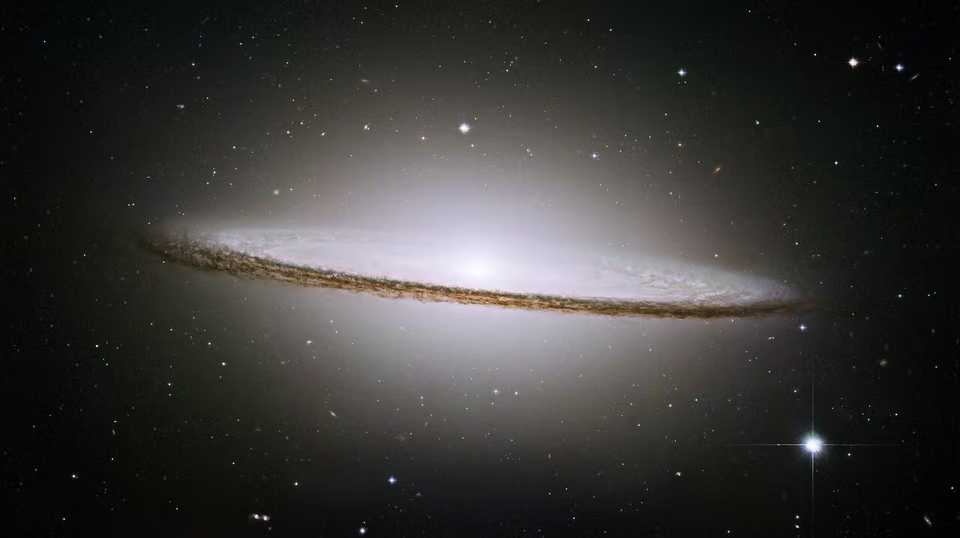
Few galaxies are as easy to name at a glance as M104. Seen from Earth it is tilted only six degrees from edge-on, so its flat disk becomes a thin brim of dust and its large central bulge rises above it like the crown of a hat. The resemblance to a broad-brimmed Mexican sombrero gave it its popular name.
The Sombrero lies about 28 million light-years away, at the southern edge of the Virgo cluster of galaxies, and spans about 50,000 light-years. It is one of the most massive members of its group, equivalent to about 800 billion Suns. At magnitude +8 it is bright enough to see in a small telescope.
Six frames, one galaxy
The Hubble Heritage Team observed M104 in May and June 2003 with the Advanced Camera for Surveys. The galaxy is too large to fit in a single field of that camera: it spans nearly one-fifth of the diameter of the full Moon in the sky. The team took six overlapping pictures and stitched them into a single mosaic, at the time one of the largest assembled from Hubble data. The total exposure was 10.2 hours, under HST program 9714. The finished mosaic is about 10 arcminutes wide, which at the galaxy's distance corresponds to some 82,000 light-years, so the frame leaves a generous margin of dark sky around the disk and the halo of clusters that surrounds it.
The exposures went through three broadband filters close to the blue, green and red sensitivity of the human eye. Because the filters were matched to vision in this way, the finished picture is close to natural color: the bulge appears white and the dust lane brown-black against it, much as it would to an eye with Hubble's sharpness.
| Filter | What it records | Shown as |
|---|---|---|
| F435W (B) | Blue light near 435 nanometers | Blue |
| F555W (V) | Green-yellow visible light near 555 nanometers | Green |
| F625W (r) | Red light near 625 nanometers | Red |
In narrowband images the colors stand for particular gases. Here they follow ordinary starlight, so the hues look familiar. Are the Colors Real? compares the two approaches.
The dust lane and the bulge
The dark band across the galaxy is its spiral disk seen almost exactly side-on. The arms that would appear as a pinwheel from above are reduced to lanes of dust, thick enough to block the light of the stars behind them. The rim of the hat is made of the same material that forms new stars in spiral galaxies everywhere.
The bulge is unusually large and bright for a spiral. Embedded in its center is a smaller disk, tilted relative to the main one. X-ray emission from the core suggests that material is falling into a compact central object, a black hole of about one billion solar masses.
| Names | Sombrero Galaxy, M104, NGC 4594 |
|---|---|
| Type | Edge-on spiral galaxy |
| Constellation | Virgo |
| Distance | About 28 million light-years (9 megaparsecs) |
| Size | About 50,000 light-years across |
| Position (J2000) | R.A. 12h 39m 59.43s, Dec. −11° 37′ 23.0″ |
| Camera | Advanced Camera for Surveys, Wide Field Channel |
|---|---|
| Observed | May to June 2003 |
| Exposure | 10.2 hours |
| Program | HST program 9714 |
| Released | October 2, 2003 |
Two thousand globular clusters
Hubble's resolution breaks the faint glow around the Sombrero into separate points of light. Each is a globular cluster, a dense ball of old stars, and the galaxy has nearly 2,000 of them, ten times as many as orbit the Milky Way. Their ages are similar to those of the Milky Way's clusters, 10 to 13 billion years.
An early clue to the expanding universe
In the 19th century some astronomers thought the Sombrero might be a disk of glowing gas around a young star, a solar system still in the making. The answer came in 1912, when V. M. Slipher measured its spectrum and found it moving away at about 700 miles per second. The speed was among the first evidence that the Sombrero was a separate galaxy, and that galaxies in general are receding from each other as the universe expands.
The Sombrero in infrared light
A different instrument gives the galaxy a different face. NASA's Spitzer Space Telescope recorded M104 in infrared light, and combining its view with the Hubble mosaic shows where the dust really is.

In Spitzer's infrared view the dark lane turns into a bright, smooth ring, and the galaxy looks more like a bull's-eye than a hat. The ring appears warped, often a sign of a past gravitational encounter with another galaxy, and clumps near its far edges mark regions where stars are forming. Infrared light also comes from the center, where the black hole sits. The Spitzer data cover four bands, at 3.6, 4.5, 5.8 and 8.0 microns, and the starlight measured at 3.6 microns was subtracted from the two longest bands so that the dust stands out on its own. Peering Through the Dust explains why infrared cameras see through what blocks visible light.
Questions readers ask
Why is it called the Sombrero Galaxy?
From Earth the galaxy is seen only six degrees from edge-on. Its large, bright bulge looks like the high crown of a hat and its thin dusty disk like a broad brim, so the shape resembles a Mexican sombrero. Its catalog names are M104 and NGC 4594.
Can the Sombrero Galaxy be seen with a small telescope?
Yes. At magnitude +8 it is among the brighter galaxies in the sky and shows up in small telescopes from a dark site, in the constellation Virgo. The dust lane needs a larger instrument and steady skies to stand out clearly against the bulge.
Is the Hubble image of the Sombrero in natural color?
Close to it. The 2003 mosaic used three broadband filters in blue, green and red light, roughly matching the response of the human eye. That makes the colors similar to what an observer would see with sharp enough vision, unlike narrowband images where hues stand for specific gases.
How many globular clusters does M104 have?
Nearly 2,000, about ten times as many as the Milky Way. Hubble resolves them as faint points around the bulge. They are 10 to 13 billion years old, similar in age to the globular clusters of the Milky Way.