Hubble Heritage Archive · Galaxy
The Story of Hoag's Object: Decades Spent Explaining a Ring Galaxy
A planetary nebula, a lens, a pathological galaxy, a shredded companion: every generation of telescopes has offered a new answer for one ring.
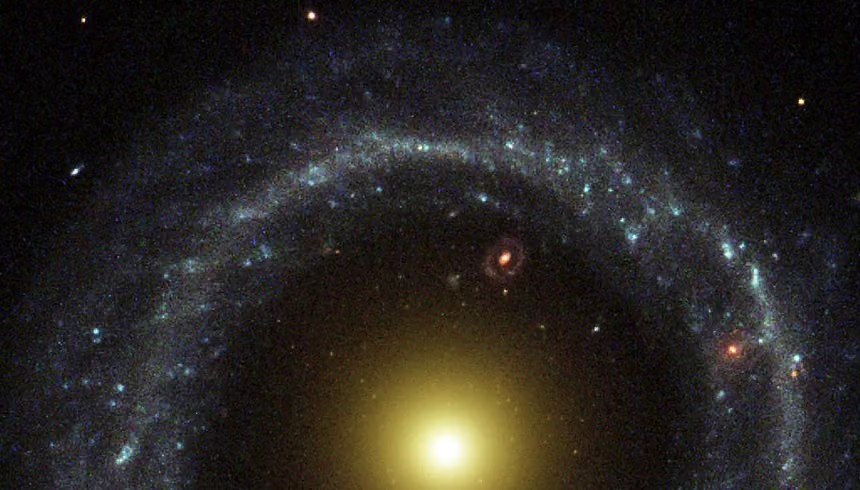
In 1950 the astronomer Art Hoag published a short description of an object that did not fit any category he knew. It had a bright, round center and a detached ring of light, and the obvious comparison was a planetary nebula, the shell of gas thrown off by a dying star inside the Milky Way. Hoag listed the reasons that comparison failed, and the problem he opened has kept astronomers busy ever since.
The object now carries his name. Hoag's Object is a galaxy about 600 million light-years away in Serpens, and the Hubble image of Hoag's Object released in 2002 is the sharpest view of it so far. This is the history of how it was identified and of the explanations offered for its ring.
1950: not a nebula, maybe a pathological galaxy
Hoag's doubts were specific. The object was too large for a typical planetary nebula, and the nucleus was out of proportion with the rest. The ring, which he called the halo, did not shine with the sharp emission lines of particular elements that planetary nebulae show. It also lay at a higher galactic latitude, farther from the plane of the Milky Way, than most known planetary nebulae. He concluded it might be a new example of a "pathological" galaxy, the term then used for galaxies that fit no standard shape.
He also weighed two optical effects. Diffraction, the cause of a ring around the Moon, would have needed dust grains of a very unusual size. A gravitational lens would have needed a foreground mass far greater than a normal galaxy's, and Hoag judged it unlikely.
1974: a distance and a size
The next step came from spectroscopy. In 1974 Robert O'Connell and colleagues measured the object's redshift and obtained a distance very close to the modern estimate. That placed it far beyond the Milky Way and settled that it was a galaxy. They also measured its dimensions: an inner ring diameter of about 23 kiloparsecs, roughly 75,000 light-years, and an outer diameter of about 37 kiloparsecs, roughly 121,000 light-years.
In the 1980s Noah Brosch observed it both optically and with the Westerbork Synthesis Radio Telescope in the Netherlands. He looked for neutral hydrogen gas in the radio and for the emission lines that signal ongoing star formation in the blue ring, and found neither. He also checked whether the ring could be the kind that forms at the ends of a bar in a spiral galaxy, but no bar was present.
1987: stars are forming in the ring
François Schweizer and collaborators imaged Hoag's Object in several colors with the Palomar 200-inch (5-meter) telescope and its 4-Shooter camera, took spectra with the same telescope, and searched again for hydrogen gas with the Arecibo radio telescope.
This time they found what Brosch had not. The spectrum of the ring showed emission lines of hydrogen-beta and of doubly ionized oxygen at 5007 angstroms, a sign of active star formation, and neutral hydrogen appeared as well, possibly extending beyond the ring. At this distance individual star-forming regions cannot be separated, so the knots in the ring were interpreted as very massive clusters of young, hot stars.
Their analysis established several points that still hold. The nucleus and the ring have essentially the same redshift, so they belong together. There is faint light in the apparently empty gap. The core has the smooth brightness profile of a normal spheroidal galaxy. Their conclusion, published in the Astrophysical Journal in September 1987, was that the ring formed when the central galaxy captured material from another galaxy roughly 2 to 3 billion years ago.
A polar ring seen from above?
If the ring is captured material, Hoag's Object may be related to the polar-ring galaxies, in which a ring of gas and stars orbits nearly at right angles to an older disk. NGC 4650A in Centaurus is a well-known case. Whether Hoag's ring is polar depends on the shape and spin of the central galaxy, which could not be measured.
Two geometries were possible. If the core is a flattened galaxy seen from above its pole, the ring lies in or near its equatorial plane, and Hoag's Object resembles the dust-lane ellipticals, galaxies crossed by a band of captured gas. If the core is seen from the side, it would have to be almost perfectly spherical, the E0 type, and the ring would then orbit at 75 to 90 degrees to its rotation axis: a true polar ring seen face-on.
No polar-ring galaxy with a face-on ring turned up in a 1986 survey by Y. Taniguchi and collaborators, which suggested that Hoag-like systems might be rarer still. When Brad Whitmore and colleagues compiled the Polar Ring Catalog, published in 1990, Hoag's Object went into category D. The definite class required firm spectroscopic proof of material rotating in two perpendicular planes, categories B and C held good candidates without that proof, and D was a broad group of objects possibly related to polar rings. Hoag's Object was placed there because the available data could not decide its geometry.
Why the round core matters
Other galaxies have bright rings that seem detached from their centers, but nearly all of them have an elongated or barred central region. Rings like those can form from internal dynamics alone. In 1990 Ken-ichi Wakamatsu compared the known Hoag-like galaxies and found that Hoag's Object was the only one with a truly round central component; all the others were oval. Ron Buta, who has studied ring formation in galaxies in detail, has noted that an oval center can be enough to build a ring. A round one is not, which leaves Hoag's Object without an internal explanation.
Other work supported the capture idea indirectly. A search by C. Horellou and colleagues for carbon monoxide, a tracer of molecular gas, did not detect Hoag's Object, which suggests its gas is thin and widely spread. V. P. Reshetnikov and collaborators found the rings of Hoag's Object and of NGC 6028, another Hoag-like galaxy, photometrically similar to polar rings.
Why not a collision?
The main alternative is a collisional ring, made when one galaxy passes straight through another, as in the Cartwheel Galaxy.

Two facts count against that for Hoag's Object. No companion galaxy close enough to have done the damage has been found. And the stars of the ring are bluer than the central galaxy yet redder than even the reddest of the Cartwheel's ring stars, so they are probably older than the Cartwheel's oldest ring stars. That fits an older event, not a recent splash.
The questions still open
The capture story has its own problems. If the ring is 2 to 3 billion years old, more reddish, aging clusters might be expected among the blue ones. It is also unclear what could keep the ring so clean-edged and so far from the center. Wakamatsu pointed out that several polar-ring galaxies thought to be of similar age still show tidal debris, while Hoag's Object shows none. He proposed that cold gas falling onto an elliptical galaxy could collide with the hot gas, bright in X-rays, that surrounds such galaxies, and that a ring would survive only if it orbited far enough out to avoid that hot gas. He called the accretion idea attractive but unfinished.
The Hubble Heritage image of 2001, taken with the Wide Field and Planetary Camera 2, was processed to bring out the contrast between nucleus and ring and to let faint reddish objects in the gap show. Some could be old, massive clusters left from the original galaxy or the captured one. The image also shows a much more distant Hoag-like ring behind the gap, at about one o'clock. With Hoag-type galaxies estimated at roughly one in a thousand, it is probably not a true twin, though its look is uncanny.
Questions readers ask
What did Art Hoag think his object was?
In 1950 he noted a resemblance to a planetary nebula but doubted it: the object was too large, the ring lacked the emission lines typical of such nebulae, and it lay unusually far from the Milky Way's plane. He suggested it might be a new kind of peculiar, or pathological, galaxy, and spectroscopy in 1974 showed he was right.
What is the leading explanation for the ring of Hoag's Object?
The most widely supported idea is that the central galaxy tore apart a passing or companion galaxy and kept its material roughly 2 to 3 billion years ago. Gas from the victim settled into orbit and formed new star clusters. The idea explains the lack of a nearby companion but leaves questions about the ring's age and clean edges.
Is Hoag's Object a polar-ring galaxy?
It may be related, but that has not been shown. A polar ring needs evidence of material rotating in a plane perpendicular to the central galaxy. For Hoag's Object the shape and rotation of the core are not well enough known, so the 1990 Polar Ring Catalog listed it only as a possibly related object.
Why is Hoag's Object not considered a collisional ring like the Cartwheel?
No companion galaxy has been found that could have plunged through it, and the stars in its ring are older than those in the Cartwheel's expanding ring. Both point away from a recent head-on collision and toward a slower, older capture of material.