Solar System
Saturn's Seasons: A Hubble Yearbook of the Rings from 1996 to 2000
One picture a year for five years, and a ring system that tips from nearly edge-on to wide open as a season turns.
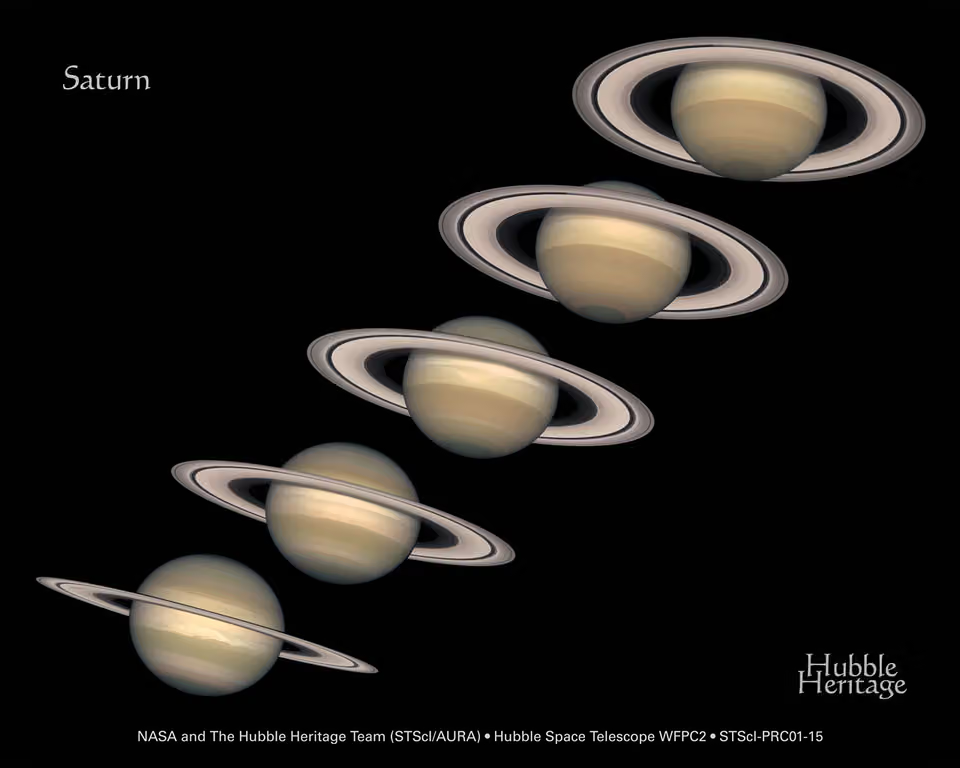
On October 8, 2019, Saturn finished its first full orbit of the Sun since Hubble was launched in April 1990. One Saturnian year takes 29.5 Earth years, and the telescope has watched most of that year from close to Earth, photographing the planet again and again as its rings tipped toward and away from the Sun. Five of those portraits, taken once a year from 1996 to 2000, are lined up in the montage above.
What the five frames show
All five frames come from the Wide Field and Planetary Camera 2, the camera that did most of Hubble's imaging in the late 1990s, so the change from one frame to the next is in Saturn and not in the instrument. Read from the lower left to the upper right, the montage runs from 1996 to 2000. In the first frame the rings are seen nearly edge-on, a thin bright line across the planet. Each year after that they open further, until by 2000 they are tilted wide enough to show how far the system extends from the planet.
The rings themselves did not move. What changed was the angle from which Earth sees them, as Saturn traveled roughly a seventh of the way around its orbit. Over those five years the planet went from just past an edge-on view toward nearly fully open rings, a slow progression from autumn toward winter in the northern hemisphere.
Why Saturn has seasons
Saturn's spin axis is tilted 26.7 degrees relative to the plane of its orbit, a little more than Earth's 23.5 degrees. As on Earth, that tilt means each hemisphere leans toward the Sun for part of the orbit and away from it for the rest. Because Saturn's orbit is so long, each season lasts more than seven years.
The rings make the tilt easy to see. They orbit in the plane of Saturn's equator, so they act like a protractor laid across the planet. Near an equinox the rings are seen almost edge-on. As they open, one pole comes into view and one hemisphere gets more sunlight. In this sequence it is the southern hemisphere that turns toward the Sun, moving from spring into summer, while the north heads from autumn into winter.
Why Hubble photographs Saturn every year
Once a year Earth passes between the Sun and Saturn. At that moment Saturn sits opposite the Sun in the sky, an arrangement called opposition. It is when Saturn is nearest to Earth for that year, at its brightest, and fully lit as seen from here, the best conditions for a portrait. Because Saturn moves slowly along its own orbit, Earth needs a little more than a year to line up with it again, and oppositions come every 378 days.
That steady rhythm turns Hubble's planetary pictures into something like a yearbook. A portrait at each opposition records the season, the angle of the rings and the state of the weather, and the series now covers the planet's whole year. At one opposition every 378 days, a single Saturnian year holds about 28 of them, so a complete yearbook needs nearly three decades of patient revisits. Hubble, working above the blurring of Earth's atmosphere for that entire span, has been in a position to collect it from start to finish. Seasonal storms at different latitudes have come and gone across the decades and are part of the record. Since 2014 the same idea has run as a formal annual program for the outer planets, described in What's Up with Jupiter and Saturn?
A world of fast winds and haze
Saturn is about 120,000 kilometers (75,000 miles) across and noticeably flattened at the poles, because it turns very quickly: a day lasts only about 10 hours. Strong winds stretch its clouds into the horizontal bands seen in every frame. The soft color differences between the bands come from a smog high in the atmosphere, made when ultraviolet sunlight breaks down methane. Below the visible clouds the gas simply grows hotter and denser. There is no solid surface to land on.
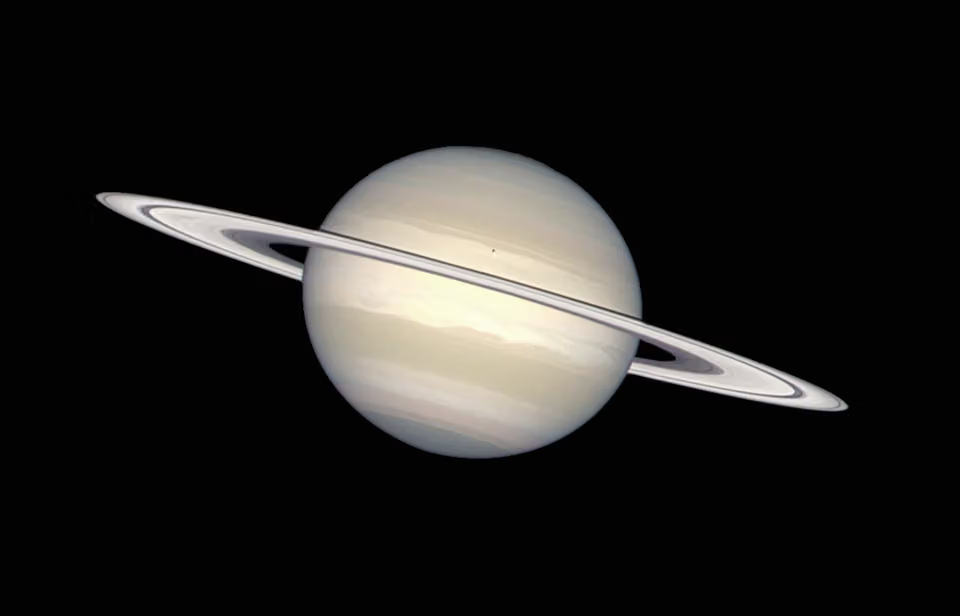
The image in the middle of this page, released in 1998, was processed to show Saturn's colors as accurately as possible, with its pale yellows, browns and grays. A small dark dot on the planet is the shadow of the moon Enceladus.
Questions readers ask
Why do Saturn's rings seem to open and close?
The rings lie in the plane of Saturn's equator, and that plane is tilted by 26.7 degrees to the planet's orbit. As Saturn moves around the Sun, Earth sees the rings from a changing angle: edge-on near an equinox and widely tilted near a solstice. The rings themselves stay the same.
How long is a season on Saturn?
More than seven Earth years. Saturn takes 29.5 years to orbit the Sun, and like Earth it has four seasons per orbit because of its tilted axis. The 1996 to 2000 montage shows about one season's worth of change as the southern hemisphere moves from spring toward summer.
How often is Saturn at opposition?
Every 378 days. Saturn moves slowly along its orbit, so Earth needs slightly more than one year to catch up and line up with it again. Around opposition the planet is closest to Earth for that year, at its brightest and fully lit as seen from Earth.
When did Saturn complete an orbit since Hubble's launch?
On October 8, 2019. Hubble was launched in April 1990, and Saturn's orbit takes 29.5 years, so the planet returned to the same point of its orbit about 29 and a half years after launch. Hubble had recorded its seasons for nearly that whole period.