Hubble Heritage Archive · Nebula
Carina Nebula (NGC 3372): Hubble's 48-Frame Panorama of Star Birth
Fifty light-years of gas being burned away by a dozen giant stars, mapped in 48 Hubble frames and colored with data from a telescope in Chile.
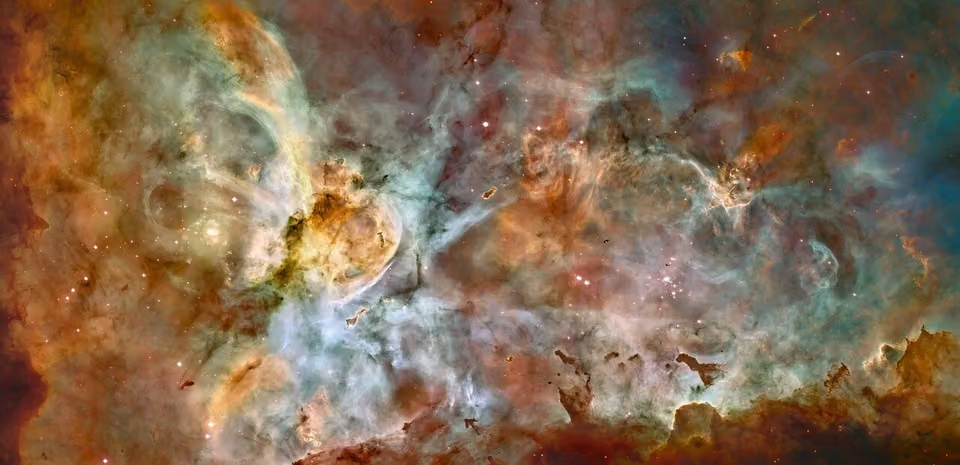
On April 24, 2007, for the 17th anniversary of Hubble's launch, the telescope's team released one of the largest panoramas ever made with its cameras: a view about 50 light-years wide across the heart of the Carina Nebula. It took 48 separate frames from the Advanced Camera for Surveys to cover the field.
At an estimated 7,500 light-years, the Carina Nebula sits in Carina, the Keel, a southern constellation that was once part of Argo Navis, the great ship of the Argonauts in Greek myth, later split into smaller pieces. The nebula is a vast cloud of gas in the middle of being torn apart by the stars it has made.
A dozen giants and one star about to explode
At least a dozen stars in the nebula are estimated to have 50 to 100 times the mass of the Sun. The most extreme of them is Eta Carinae, at the far left of the panorama. It is near the end of a short, violent life, and two billowing lobes of gas and dust around it are the debris of past eruptions. Astronomers expect it to end as a supernova.
The activity began about three million years ago. The first generation of stars condensed and ignited inside a huge cloud of cold molecular hydrogen, and their radiation hollowed out a growing bubble of hot gas. The dark, island-like clumps scattered across the panorama are pockets of dust and gas that have so far resisted being boiled away, a process called photoionization.
The winds and ultraviolet light inside that cavity now press on the cold hydrogen walls around it. Compressing the gas starts a second round of star formation. The young cluster Trumpler 14, with more than 4,300 solar masses of stars, drives much of this sculpting near the center of the field. Regions like this, along the dense spiral arms of galaxies, are where most stars form, and the Sun may have been born in a similar environment 4.6 billion years ago.
| Names | Carina Nebula, NGC 3372 |
|---|---|
| Type | Emission nebula in the Milky Way |
| Constellation | Carina |
| Distance | About 7,500 light-years (2,300 parsecs) |
| Position (J2000) | R.A. 10h 44m, Dec. −59° 53′ |
| Field shown | About 25 arcminutes, roughly 50 light-years |
| Hubble camera | Advanced Camera for Surveys, filter F658N |
|---|---|
| Ground telescope | CTIO 4-meter Blanco telescope, MOSAIC2 camera |
| Observed | March and July 2005 (Hubble); December 2001 and March 2003 (CTIO) |
| Program | HST proposal 10241 |
| Released | April 24, 2007 |
Sharpness from Hubble, color from Chile
The image is a hybrid. Hubble photographed the nebula through a single narrowband filter, F658N, which passes hydrogen-alpha light along with a line of ionized nitrogen. That gave very fine detail but no color. The color came from the 4-meter Blanco telescope at the Cerro Tololo Inter-American Observatory in Chile, which imaged the same region through three narrowband filters with its MOSAIC2 camera.
| Filter | What it records | Shown as |
|---|---|---|
| [O III] 501 nm (CTIO) | Doubly ionized oxygen | Blue |
| H-alpha + [N II] 658 nm (CTIO) | Hydrogen and ionized nitrogen | Green |
| [S II] 672+673 nm (CTIO) | Ionized sulfur | Red |
| F658N (Hubble ACS) | Hydrogen-alpha and nitrogen at high resolution | Brightness detail |
The two data sets were merged with a luminosity technique: brightness was taken from the sharp black-and-white Hubble mosaic and color from the lower-resolution ground-based composite. The result keeps all of Hubble's detail while showing which gas glows where. Red marks sulfur, green hydrogen and blue oxygen, in wavelength order. Around Eta Carinae, the brightest star in the field, the long Hubble exposures saturated, so that small patch was filled in with shorter exposures from the Wide Field and Planetary Camera 2.
The Hubble data came from proposal 10241, led by N. Smith of the University of California, Berkeley. The ground-based observations were taken in December 2001 and March 2003, the Hubble frames in March and July 2005. Are the Colors Real? explains why narrowband colors like these differ from what the eye would see.
Mystic Mountain, three years later
For Hubble's 20th anniversary in 2010, the telescope returned to one pillar in the same nebula with Wide Field Camera 3. Mystic Mountain is a column of gas and dust three light-years tall, eroded from outside by the light of nearby stars and pushed apart from within by young stars buried in it. Jets from two of them, catalogued HH 901 and HH 902, stream out of its peaks.


Seen one at a time, the channels separate the layers of the scene. In the oxygen channel the pillar is almost a dark silhouette and the glow fills the open space around it, where the radiation from the hot stars is strongest. The sulfur channel does the opposite: the sunlit-looking surfaces and ridges of the column are brightest, because that is where gas is being peeled off the cold pillar. Hydrogen and nitrogen sit between the two. The thin jet streaming from the top peak shows in every channel. Like the 2007 panorama, the picture keeps wavelength order for its colors, with the shortest wavelength shown blue and the longest red.
Questions readers ask
How far away is the Carina Nebula?
Its distance is estimated at 7,500 light-years, in the southern constellation Carina. The 2007 Hubble mosaic covers about 25 arcminutes of sky, which corresponds to roughly 50 light-years across the center of the nebula. The full cloud extends well beyond that field.
What is Eta Carinae?
It is the most massive and unstable star in the Carina Nebula, visible at the left of the panorama. Two lobes of gas and dust around it record earlier outbursts. It is in the last stages of its life and is expected to explode as a supernova.
Why does the Carina image combine Hubble and ground-based data?
Hubble imaged the nebula through one hydrogen filter, giving sharp detail without color. A telescope at Cerro Tololo in Chile supplied three narrowband color images at lower resolution. Taking brightness from Hubble and color from the ground produced a sharp, color-coded panorama.
Is Mystic Mountain part of the Carina Nebula?
Yes. It is a pillar about three light-years tall inside the nebula, photographed by Hubble's Wide Field Camera 3 in February 2010 for the telescope's 20th anniversary. Young stars inside it fire jets of gas out of its tips.