Hubble Heritage Archive · Galaxy
NGC 6503: Hubble's Lost-in-Space Galaxy on the Rim of the Local Void
A spiral a third the size of the Milky Way, parked on the rim of a region of space so empty that it has almost no neighbors at all.
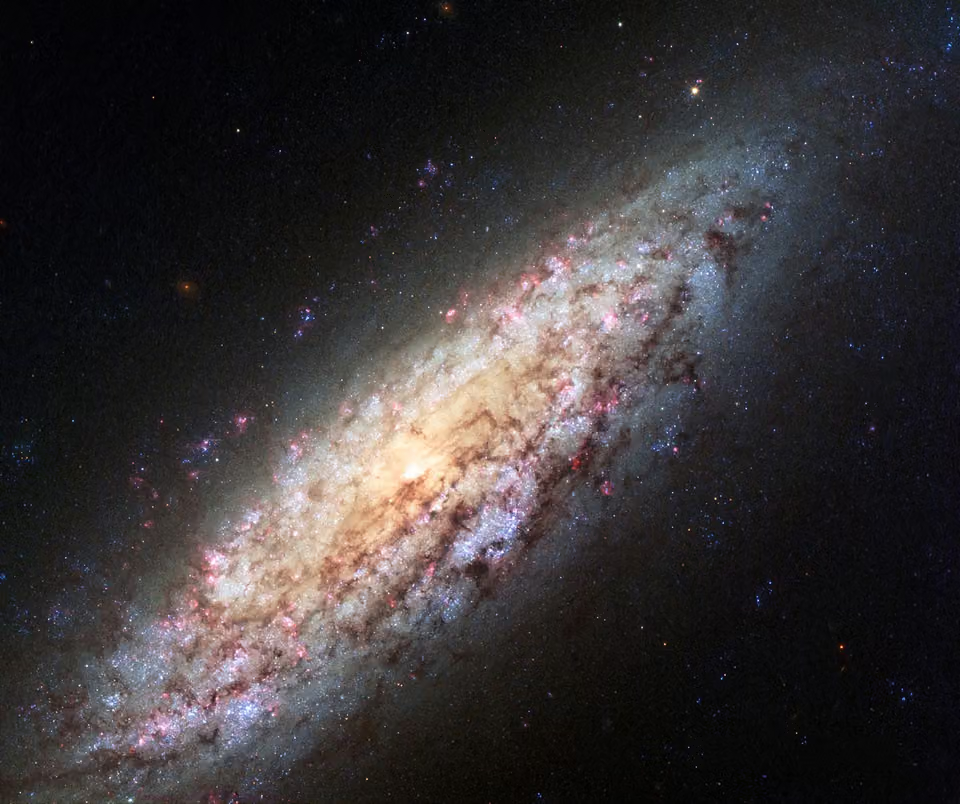
Most galaxies live in company. They gather in groups and clusters, and a neighbor is usually a short way off by cosmic standards. NGC 6503 is an exception. It sits on the edge of the Local Void, a stretch of space at least 150 million light-years across that appears to contain almost no galaxies at all.
That isolation earned it a nickname. In his 2007 book Hidden Treasures, the stargazer and writer Stephen James O'Meara called NGC 6503 the "Lost-in-Space galaxy". It lies about 18 million light-years away in Draco, a constellation that circles the north celestial pole, and its disk measures about 30,000 light-years from edge to edge, roughly a third of the Milky Way's size.
What the 2015 image shows
The picture combines six filters, from the near-ultraviolet to the near-infrared. Its arms are speckled with two kinds of bright spots. Red patches are clouds of hydrogen gas lit up by young, hot stars. Blue regions are where new stars are forming in large numbers, their light dominated by the short wavelengths that massive young stars emit. Dark brown lanes of dust wind across the arms and the bright center, giving the disk a mottled texture.
The data came from two programs ten years apart. The Advanced Camera for Surveys photographed the galaxy on April 21, 2003, through a narrowband hydrogen-alpha filter, under proposal 9293, led by H. Ford of Johns Hopkins University. Wide Field Camera 3 added five broadband filters on August 21, 2013, for proposal 13364, led by D. Calzetti of the University of Massachusetts, Amherst. The combined image was released by NASA and ESA in June 2015. Merging frames taken a decade apart works here because nothing in a galaxy 18 million light-years away changes visibly over ten years, apart from the odd supernova, so the 2003 gas map and the 2013 starlight line up.
The filters reach well past human vision at both ends. The eye responds to light between roughly 400 and 700 nanometers, but F275W is centered near 275 nanometers in the ultraviolet and F814W near 814 nanometers in the infrared, so the set covers almost a factor of three in wavelength. Ultraviolet light in particular cannot pass through Earth's atmosphere, which makes the bluest frames something only a space telescope can provide.
| Filter | What it records | Shown as |
|---|---|---|
| F275W | Near-ultraviolet light | Pink |
| F336W (U) | Ultraviolet U band | Purple |
| F438W (B) | Blue light | Blue |
| F555W (V) | Visible light | Green |
| F814W (I) | Near-infrared light | Red |
| F658N | Hydrogen-alpha and ionized nitrogen [N II] | Red |
With six exposures and only three display primaries, colors had to be shared. The near-ultraviolet F275W frame was shown in pink and the U-band frame in purple, while hydrogen-alpha and the near-infrared frame both went to red. The effect is to make the young, ultraviolet-bright regions stand apart from the gas clouds, even though both sit along the same spiral arms. Are the Colors Real? explains how these choices are made.
| Name | NGC 6503, the Lost-in-Space Galaxy |
|---|---|
| Type | Spiral galaxy with active star formation |
| Constellation | Draco |
| Distance | About 18 million light-years (5.5 megaparsecs) |
| Size | About 30,000 light-years across |
| Position (J2000) | R.A. 17h 49m 26.43s, Dec. +70° 08′ 39.73″ |
| Cameras | ACS Wide Field Channel and WFC3 UVIS |
|---|---|
| Observed | April 21, 2003 and August 21, 2013 |
| Programs | HST proposals 9293 and 13364 |
| Released | June 2015 |
A different palette for the same galaxy
Five years before the six-filter picture, NGC 6503 appeared in ESA/Hubble's Picture of the Week series in a very different coloring. That version used only two Advanced Camera for Surveys exposures: 28 minutes through the hydrogen-alpha filter F658N and 12 minutes through the near-infrared filter F814W.

The hydrogen frame was shown red, revealing the gas clouds around new stars as pink puffs along the arms. The near-infrared frame was colored blue to give contrast, the reverse of the usual wavelength order. As a result the smooth light of the disk, which is strong in the near-infrared, comes out bluish-white, a color the galaxy would never show to the eye. The field was 3.3 by 1.8 arcminutes. Set next to the 2015 picture, it shows how strongly the look of a galaxy depends on the filters chosen and on the colors assigned to them.
Life on the edge of a void
The Local Void is bordered by the Local Group of galaxies, which includes the Milky Way, and by the Hercules and Coma galaxy clusters. Estimates of its diameter range from about 30 million to more than 150 million light-years. A galaxy on its rim has very little company. NGC 6503 is structurally similar to the Milky Way but much smaller, and the 2010 description classed it as a dwarf spiral. The German astronomer Arthur Auwers discovered it in July 1854. The spiral NGC 253 is the opposite case: a crowded, starbursting galaxy close to its neighbors.
Questions readers ask
Why is NGC 6503 called the Lost-in-Space galaxy?
It sits alone at the edge of the Local Void, a huge region of space with very few galaxies. The writer Stephen James O'Meara gave it the nickname in his 2007 book Hidden Treasures because of that isolated position.
What is the Local Void?
It is a vast, sparsely populated region of space next to the Local Group, the group of galaxies that includes the Milky Way. It is bordered also by the Hercules and Coma galaxy clusters. Estimates of its size range from about 30 million to more than 150 million light-years across.
How big is NGC 6503?
Its disk spans about 30,000 light-years, roughly a third of the diameter of the Milky Way. That small size led astronomers to classify it as a dwarf spiral galaxy, even though its structure, with spiral arms, dust lanes and star-forming regions, resembles that of much larger spirals.
How far away is NGC 6503?
The 2015 Hubble release gave a distance of about 18 million light-years, in the constellation Draco. An earlier ESA/Hubble description from 2010 quoted about 17 million light-years. The small difference reflects the uncertainty in measuring distances to nearby galaxies.