Hubble Heritage Archive · Planetary nebula
Ring Nebula (M57, NGC 6720): Hubble Looks Down a Tunnel of Gas in Lyra
The best-known planetary nebula looks like a smoke ring, but its dust clouds give it away as a cylinder of gas seen almost straight down its axis.
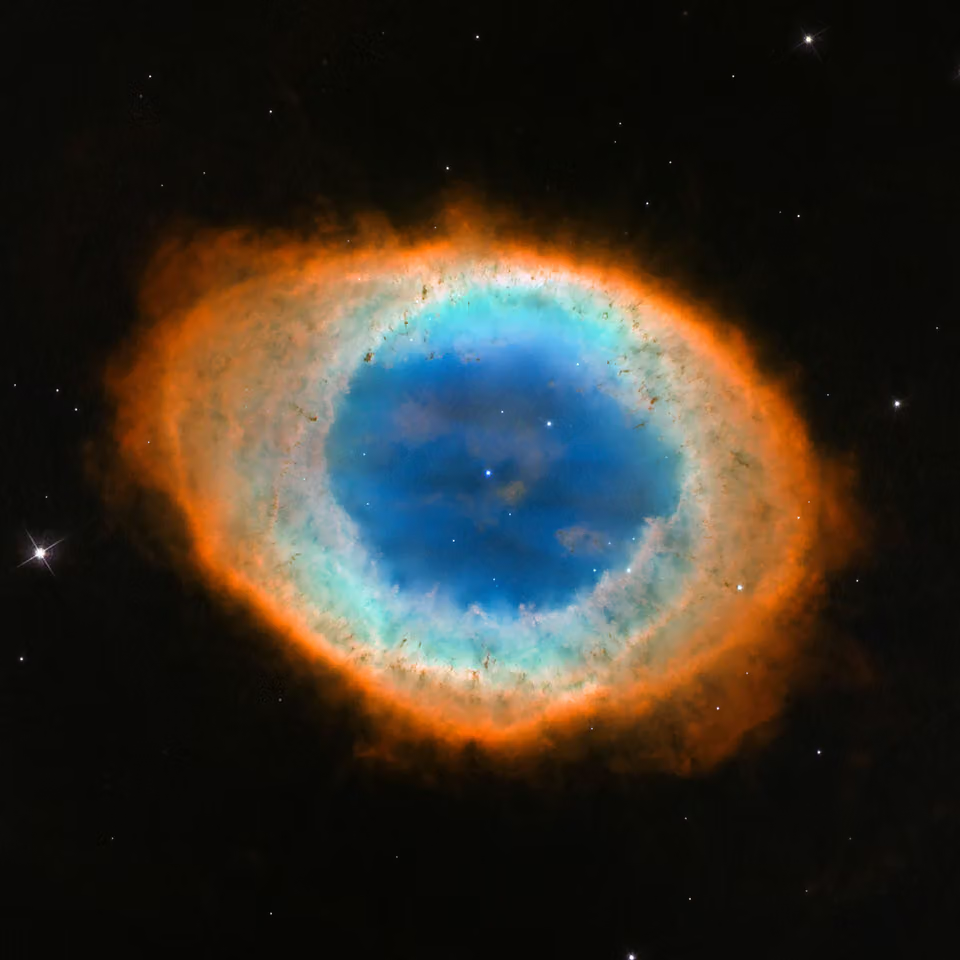
The Ring Nebula is not a ring. It looks like one because it is seen almost exactly end-on: the glowing gas is shaped more like a barrel or a short tube, and the line of sight runs nearly down its axis. Hubble's images made that clear by revealing something ground-based telescopes could not: small dark clouds of dust that sit only on the walls of the tube, never in front of its middle.
M57 lies about 2,000 light-years away in the constellation Lyra and is about a light-year across. Charles Messier catalogued it more than 200 years ago, and no planetary nebula is better known, the cloud of gas thrown off by a dying star.
The first target Hubble Heritage chose for itself
When the Hubble Heritage Project began in October 1998, most of its pictures came from data already in the archive. For its first new observation it picked the Ring Nebula, because the object is so well known among amateur astronomers. Short Hubble exposures in 1995 had already covered part of the nebula, and the result encouraged the team to go back for the whole thing.
The nebula's bright ring is about 90 arcseconds across along its long axis, too large for a single field of the Wide Field and Planetary Camera 2. It needed two pointings. The exposures were taken on October 16, 1998, and the finished image was released on January 6, 1999. The data were placed in the Hubble archive at the same time, so professional astronomers could analyze them. The Hubble Heritage essay covers why the project combined public pictures and usable data in this way.

Three colors, three temperatures
The image was built from three black-and-white exposures through narrowband filters, each isolating the light of one element in one state of ionization.
| Filter | What it records | Shown as |
|---|---|---|
| F469N | Ionized helium He II at 468.6 nanometers, the hottest gas | Blue |
| F501N | Doubly ionized oxygen [O III] at 500.7 nanometers | Green |
| F658N | Ionized nitrogen [N II] at 658.4 nanometers, the coolest gas | Red |
The colors are roughly true to the light of each gas, and they also trace temperature and distance from the star. Blue marks very hot helium, close to the central star. Green shows ionized oxygen, a little farther out. Red comes from ionized nitrogen in the coolest gas, at the outer edge. The gradient appears because all of it glows under the ultraviolet light of the central star, whose surface is a white-hot 120,000 degrees Celsius, and the energy available to ionize each element falls with distance. Here the narrowband colors happen to sit close to the real hues of the three emission lines, which is not always the case, as Are the Colors Real? explains.
| Names | Ring Nebula, Messier 57, M57, NGC 6720 |
|---|---|
| Type | Planetary nebula |
| Constellation | Lyra |
| Distance | About 2,000 to 2,300 light-years (0.7 kiloparsecs) |
| Brightness | Magnitude 9.7; central star magnitude 15.8 |
| Position (J2000) | R.A. 18h 53m 35s, Dec. +33° 01′ 43″ |
| Camera | Wide Field and Planetary Camera 2, two pointings |
|---|---|
| Observed | October 16, 1998 |
| Exposure | 1 hour |
| Released | January 6, 1999 |
Dust clouds that reveal the shape
Close inspection of the 1999 image shows many small, dark clouds of dust silhouetted against more distant glowing gas. They are too small to see from the ground but easy for Hubble. Many are drawn out into shapes that point away from the central star, stretched by its radiation and by the outflowing gas.
Their placement settles the geometry. Dark clouds appear only in the outer part of the ring and none are seen against the central region. If the dust were spread through a sphere, some clouds would have to lie in front of the middle. Their absence means the dust sits on the walls of a cylinder or a torus, and the nebula is axisymmetric, like many other planetary nebulae, seen from a direction close to its axis. A 1994 ground-based study of the gas motions by Bryce, Balick and Meaburn had already pointed to the same bipolar shape and low viewing angle.
Elongated shapes are common among planetary nebulae. A thick disk of gas and dust around a star's waist slows the expansion in that plane and lets the gas escape more freely at right angles to it.
The star at the center
The faint speck in the middle was once a star more massive than the Sun. Near the end of its life it ejected its outer layers, and what remains will cool into a white dwarf about the size of Earth. Howard Bond, a Heritage astronomer who had been an amateur observer as a teenager in the 1950s, recalled learning from his books that the Ring was a round, expanding sphere. The name planetary nebula itself is a leftover from that era: in small telescopes these objects show round disks like planets.
The 2013 image at the top of the page added new Wide Field Camera 3 data and ground-based observations, and described the shape as a distorted doughnut with a lower-density, rugby-ball-shaped region filling its central gap.
Questions readers ask
Why does the Ring Nebula look like a ring?
Because of the viewing angle. The gas forms a barrel or tube shape, and Earth looks almost straight down its axis. The walls of the tube, seen through their full depth, glow brightly and form the ring, while looking through the middle passes through far less glowing material.
What are the colors in the Hubble image of the Ring Nebula?
In the 1999 image blue shows hot ionized helium near the central star, green shows ionized oxygen farther out, and red shows ionized nitrogen in the coolest gas at the edge. The three filters each pass the light of one element, and the colors are close to the true hues of those lines.
Can the Ring Nebula be seen with a small telescope?
Yes. With a total magnitude of 9.7 it is a popular target for amateur telescopes, appearing as a small, faint oval ring in Lyra. The central star is much fainter, at magnitude 15.8, and needs a larger instrument to see.
What will happen to the Ring Nebula?
The gas will keep expanding and fading into space. The central star, which has already lost its outer layers, will cool and shrink into a white dwarf about the size of Earth. The glowing nebula is a short phase at the very end of the star's life.