Hubble anniversaries
NGC 2020 for 2020: How Hubble's 30th Anniversary Image Was Planned
A catalog number that matched the year started the idea. The colors, a 12-tile mosaic and a New Year's Eve observation did the rest.
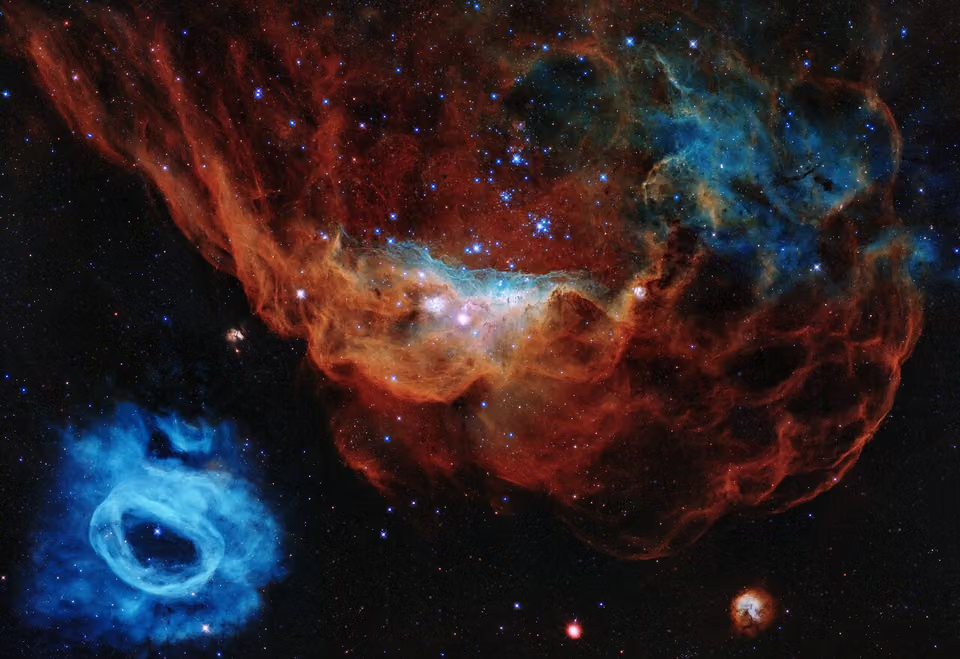
In the summer of 1990, shortly after launch, Hubble's main mirror was found to be flawed, and an informal guess among people working on the mission gave it about 18 months. On New Year's Eve 2019, the same telescope was observing a nebula called NGC 2020 as the calendar turned into 2020, the start of its 30th year in orbit. The picture that came out of that observation, released on April 24, 2020, is one of Hubble's most colorful.
Outreach observations with research standards
Most Hubble time goes to research proposals. A smaller share goes to outreach imaging, observations designed first of all to produce beautiful pictures for the public. They are planned and processed with the same care as a science program: the same observing strategies, the same calibration, and high-level data products delivered to the public archive, where researchers can use them and regularly do, in published papers.
Outreach targets come from a running wish list, each with a rough idea of how many Hubble orbits it would cost. The largest ones, needing many pointings stitched into a mosaic, tend to wait for anniversaries, when that many orbits can usually be granted.
The 30th anniversary carried extra weight. Hubble had been planned as a 15-year mission, so reaching twice that span invited the question of whether this would be the last round-number celebration. For those who remembered the gloom of the early 1990s, it also marked how far the telescope's reputation had traveled since then.
Why NGC 2020
The idea began almost as a joke. Years earlier, a former leader of the outreach imaging team had wondered whether an object with a numerical link to the 30th anniversary in 2020 might be worth a look. Many entries in the New General Catalogue are unremarkable, but NGC 2020 turned out to be striking. It stayed on the shortlist after he retired in 2018, and when the team weighed candidates in mid-2019, it came out first.
The number was not the main reason. What won the team over was the color contrast between the bluish glow of ionized oxygen in NGC 2020 and the reddish hydrogen of its neighbor NGC 2014, already visible in an older picture taken with the European Southern Observatory's Very Large Telescope. The field is crowded with colorful stars and smaller nebulae, and it offered the chance of a larger, sharper view than any made before of this corner of the Large Magellanic Cloud, about 163,000 light-years away.

From two cameras to one big mosaic
The first plan used two of Hubble's cameras at once. The main camera would cover the target while the second, pointing at an adjacent field in parallel, collected a bonus image of more of NGC 2014's nebulosity for researchers. That parallel field was not expected to be part of the anniversary picture, because the image quality differs between the cameras.
The parallel field turned out to be interesting in itself: a wall of bubbles with an aquatic, brain-coral look. So the plan changed to capture everything with one camera, Wide Field Camera 3, installed by astronauts in 2009, giving uniform image quality and the same filters across the whole field. The mosaic was laid out as a grid of 4 by 3 pointings.
The target posed a classic dilemma. Its faintest wisps needed long exposures, but bright stars scattered through the field would saturate and bleed across the nebula if the exposures ran too long. Pointings, filters and exposure times were debated at length before the program was submitted. The finished image uses four filters, centered on 475, 502, 657 and 814 nanometers, and covers about 11.4 by 7.8 arcminutes of sky.
Nine months from proposal to press release
The work took about nine months: getting the proposal approved by the Institute's director, getting a large mosaic onto Hubble's schedule, repeating a few observations that failed, stitching 12 pointings into a single seamless image for each of the four filters, preparing the color composite and delivering the processed data to the archive. Observations began right on time on New Year's Eve, and the telescope was pointed at NGC 2020 at the stroke of the new year. The color processing of the composite is described in Surfing the Cosmic Reef, and the 3D flight made from it in Cosmic Reef in 3D.
The release came at a moment no one had planned for. The anniversary fell during the COVID-19 pandemic, celebrated by a team working apart from one another. Hubble's own early history, from the flawed mirror to the repair, is told in Hubble's Public Images: 30 Years From First Light to Icons.
Questions readers ask
Why was NGC 2020 chosen for Hubble's 30th anniversary?
The matching number started the idea, but the decision came down to color and structure: blue oxygen gas in NGC 2020 next to red hydrogen in NGC 2014, a crowded star field and the chance to make the largest, sharpest view yet of the region.
How was the 30th anniversary image observed?
With Wide Field Camera 3, in a mosaic of 4 by 3 pointings through four filters. Each filter's 12 frames were stitched into one image before the color composite was made. Observations started on New Year's Eve 2019.
What is outreach imaging?
Hubble observations made mainly to produce public images. They follow the same observing and data-processing standards as research programs, and the processed data go into the public archive, where scientists use them in published research.
Where are NGC 2014 and NGC 2020?
In the Large Magellanic Cloud, a satellite galaxy of the Milky Way about 163,000 light-years away, in the southern constellation Dorado. They look separate in the image but are part of one large star-forming complex.