Hubble anniversaries
Hubble's Future Science at 30: Expansion Rate, Exoplanets, Planets
A fifth of the telescope's time in 2020 went to a field that did not exist when it launched. The rest of the agenda was just as unforeseen.
About 20 percent of Hubble's science observing at its 30th anniversary in 2020 went to exoplanets, a field that had barely begun when the telescope launched. That single number says much about where Hubble's science was heading. The telescope was conceived as a general-purpose Great Observatory, and its flexibility, along with a research community that sets its program each year, kept it at the front of fields nobody had planned for. The 30th anniversary came eleven years after the last servicing mission, and despite slowly aging parts, the prospect of at least five more years of operations was considered sound.
Measuring the expansion rate three ways
One of Hubble's original key projects was to measure the Hubble constant, H0, the local expansion rate of the universe. At the time it carried a paradox: the accepted value implied a universe younger than its oldest stars. Hubble's refined value brought the two into agreement. Later observations of distant supernovae with Hubble helped confirm and extend the evidence that the expansion is accelerating, pointing to dark energy, work for which three astronomers shared the Nobel Prize in 2011.
By 2020 the best measurements had an uncertainty of about 2 percent, against an original goal of 10 percent. Some of those local values disagree significantly with the value inferred from observations of the early universe. If the gap is real, it opens a window onto new physics: a property of dark energy, an unknown aspect of dark matter, or something beyond the standard cosmological model. Three independent Hubble programs were attacking the problem.

The first continues the line that runs from Henrietta Swan Leavitt and Edwin Hubble. Cepheid variable stars pulse with a period tied to their true brightness, the relation known as the Leavitt law. Calibrating that relation with Cepheids in the Milky Way, whose distances are now known from the Gaia satellite, lets it be applied to Cepheids in galaxies that also host supernovae used as distance markers. These measurements use an observing mode developed after the last servicing mission, which scans a bright star across the detector for very high precision.
The second uses a different kind of star: red giants at the tip of the red giant branch, the peak brightness in their evolution. They occur in more kinds of galaxies and usually lie in regions free of current star formation and less crowded. Recent results from this method gave a value between the Cepheid result and the early-universe value.
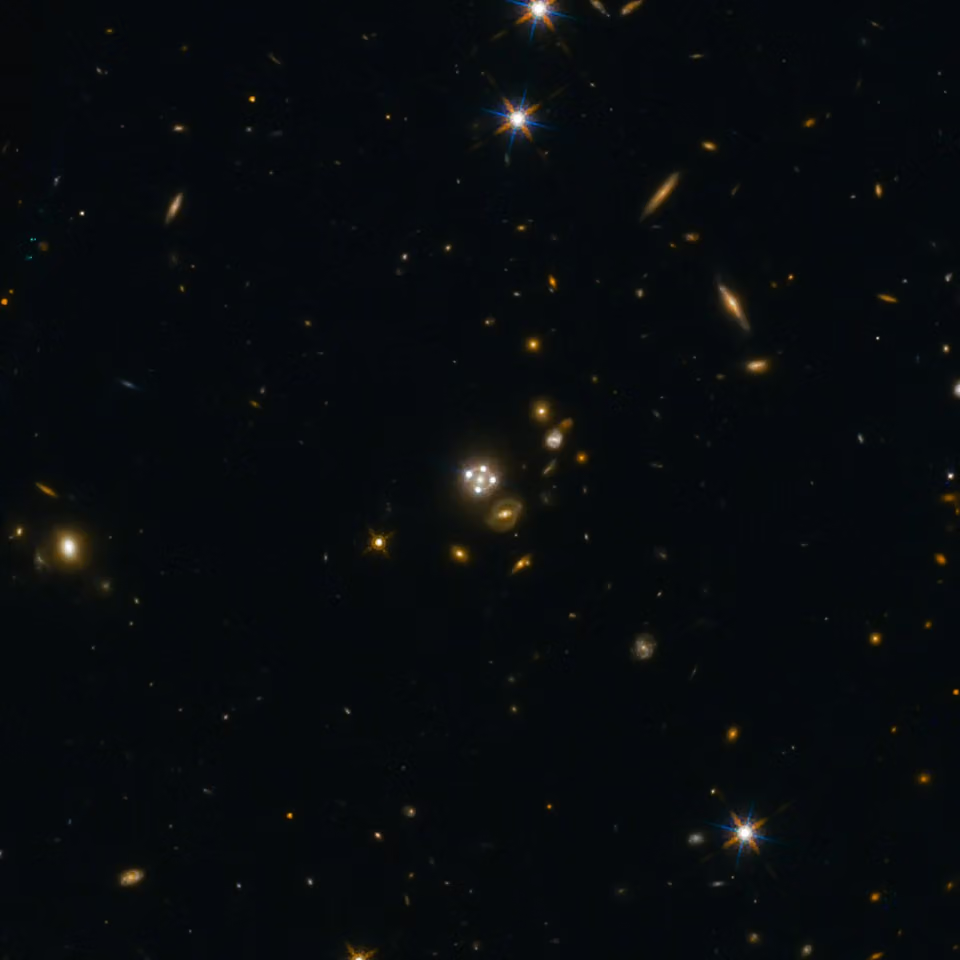
The third method uses gravitational lensing. When a foreground galaxy lies along the line of sight to a distant quasar, the powerful black hole at the heart of a galaxy, its mass bends the quasar's light into several images, as in the picture at the top of this page. Each image travels a slightly different path. Quasars flicker, so the same flicker reaches Earth at different times in each image, and measuring those delays gives H0 without relying on the local distance ladder at all. The method needs sharp images that show exactly how the light is distributed.
Exoplanet atmospheres
Hubble's instruments were built years before the first exoplanet discoveries, yet they became the workhorse for studying planets that pass in front of their stars. Hubble was first to measure an exoplanet's atmosphere directly, first to find organic molecules on one and first to catch an exoplanet atmosphere changing. Once Earth-sized planets turned up around nearby red dwarf stars, it was also first to probe the atmospheres of such worlds. In 2020 the planet K2-18b, a super-Earth, was the only one known with water vapor and temperatures that could support life, a signature found with Hubble.
Some exoplanets show hazy atmospheres, some patchy clouds and some clear skies, and a census of that variety is needed to understand how planets form and evolve. Candidates from the Kepler and K2 missions and from TESS would keep Hubble busy for years. Its ultraviolet and visible coverage, combined with near-infrared measurements, constrains a planet far better than the near-infrared alone, so Hubble would still fill gaps left by the James Webb Space Telescope. Hubble's ultraviolet spectra of host stars also record flares that can change a planet's atmospheric chemistry and threaten life on its surface.
The solar system up close and over time
Even with spacecraft visiting planets, Hubble adds two things: a long baseline of observations and a global view. It has followed changes in Jupiter's spots and dark vortices appearing in Neptune's atmosphere, and its ultraviolet images of aurorae, clouds and storms on Jupiter complement the close-up measurements of NASA's Juno mission. More on the giant planets is in What's Up with Jupiter and Saturn?.
Ultraviolet sensitivity and sharp imaging were also key to the discovery of possible water plumes on Jupiter's moon Europa. Plumes would let a future mission sample the moon's subsurface ocean without drilling through its ice. Hubble has discovered four of Pluto's five moons, helped keep New Horizons safe on its approach to Pluto and found the next Kuiper Belt object for the spacecraft to visit. For NASA's Lucy mission to the Trojan asteroids, Hubble found that Eurybates, one of its targets, has a small moon. The telescope's 30-year story up to that point is told in Hubble's Public Images.
Questions readers ask
What is the Hubble constant?
It is the current expansion rate of the universe, how fast galaxies recede per unit of distance. Measuring it was one of Hubble's original key projects. Local measurements now reach about 2 percent precision but disagree with the value inferred from the early universe, a tension that may point to new physics.
How does gravitational lensing measure the expansion of the universe?
A foreground galaxy splits a distant quasar's light into several images that travel paths of different lengths. When the quasar flickers, each image flickers at a different time. The delays depend on cosmic distances, so they give the Hubble constant independently of other methods.
What has Hubble discovered about exoplanets?
It was first to measure an exoplanet atmosphere directly, first to detect organic molecules on such a planet and first to see an exoplanet atmosphere change. It found water vapor on the super-Earth K2-18b and has studied Earth-sized planets around red dwarf stars.
Which of Pluto's moons did Hubble discover?
Four of the five known moons. Hubble's observations of the Pluto system also helped plan a safe path for the New Horizons spacecraft, and later found the Kuiper Belt object that New Horizons visited on its extended mission.