Hubble anniversaries
Hubble's Public Images: 30 Years From a Blurry First Light to Icons
The first picture was a few gray stars with tentacles. Within five years the same telescope had produced the most recognized astronomical image ever made.
On May 20, 1990, the press assembled at NASA's Goddard Space Flight Center in Maryland for a look at the first image from the Hubble Space Telescope, launched less than a month earlier. They were shown a black-and-white frame of a few stars in the open cluster NGC 3532. Thirty years later, Hubble's pictures are on coffee mugs, album covers, billboards in Times Square and the sides of moving trucks. The path between those two points runs through a flawed mirror, a repair mission and a handful of images that changed how the public pictures space.
A first light nobody planned for the public
Before launch, NASA's public materials promised a telescope above Earth's blurring atmosphere that would see the universe about ten times more clearly. A proposed Early Release program, a quick look at a set of photogenic targets, had been dropped. Some of the scientists who built the instruments worried that a sharp Hubble picture on a magazine cover could hand a discovery to someone outside their teams before they could publish it.
The press did not want to wait. Two days before launch, at an April 22 briefing in Florida, reporters who had spent years covering the telescope's $1.5 billion cost pressed NASA for the first picture as soon as possible. The first-light target, however, had been chosen for engineering calibration, not for looks. NGC 3532 is much wider than Hubble's field of view, so the frame showed only a scattering of stars.
To show progress, the same field was photographed with a telescope of similar mirror size at the Las Campanas Observatory in Chile. The Hubble frame came out a little sharper, and the coverage was positive. But the stars in it had curious tentacles of light around them, which engineers at first put down to incomplete focusing.
The flaw and the workaround
Within weeks astronomers knew the truth. The 8-foot primary mirror had been ground to a slightly wrong curve, too flat by a tiny amount toward its rim, and every Hubble image was blurred. Some light still came to a sharp core in each star, but most was scattered into a halo. NASA officials explained the problem to Congress in early July 1990 with no pretty pictures to show, and the telescope became a punchline in political cartoons and on late-night television.
The images were better than their reputation. By late July, computer processing had removed much of the blur for reasonably bright targets, and NASA released a picture of the star cluster R136 to show it. The Faint Object Camera, which had no color filters, produced a sharp black-and-white view of the ring around Supernova 1987A. To make a color image for the public, it was tinted by hand: the ring yellow for sulfur emission, the central debris red for hydrogen, the background stars blue. The object has its own page at Supernova 1987A.
Before 1990 was out, true-color views of Jupiter and Saturn had followed, both planets bright enough for restoration algorithms to work well. In 1992, still with flawed optics, Hubble photographed disks of dust around young stars in the Orion Nebula, the first direct visible-light evidence for the planet-forming disks long proposed on theoretical grounds.
The repair and the comeback picture
In December 1993, astronauts on the shuttle mission STS-61 installed a new camera with corrective optics, in effect glasses for the telescope. The demonstration image compared the core of the spiral galaxy M100 before and after the fix, and in January 1994 Senator Barbara Mikulski of Maryland held it up at a NASA press conference and declared the trouble with Hubble over.

Six months later the telescope had a front-row seat to a once-in-a-thousand-years event. In July 1994 the fragments of comet Shoemaker-Levy 9 struck Jupiter one after another, and for a week Hubble pictures of the planet's bruised clouds led the news. The images spread over the young internet, and the era of mailing out photographic prints was over.

A newer reprocessing of that event is described in A New Take on a Comet's Impact for Hubble's 30th.
Pillars and a deep field
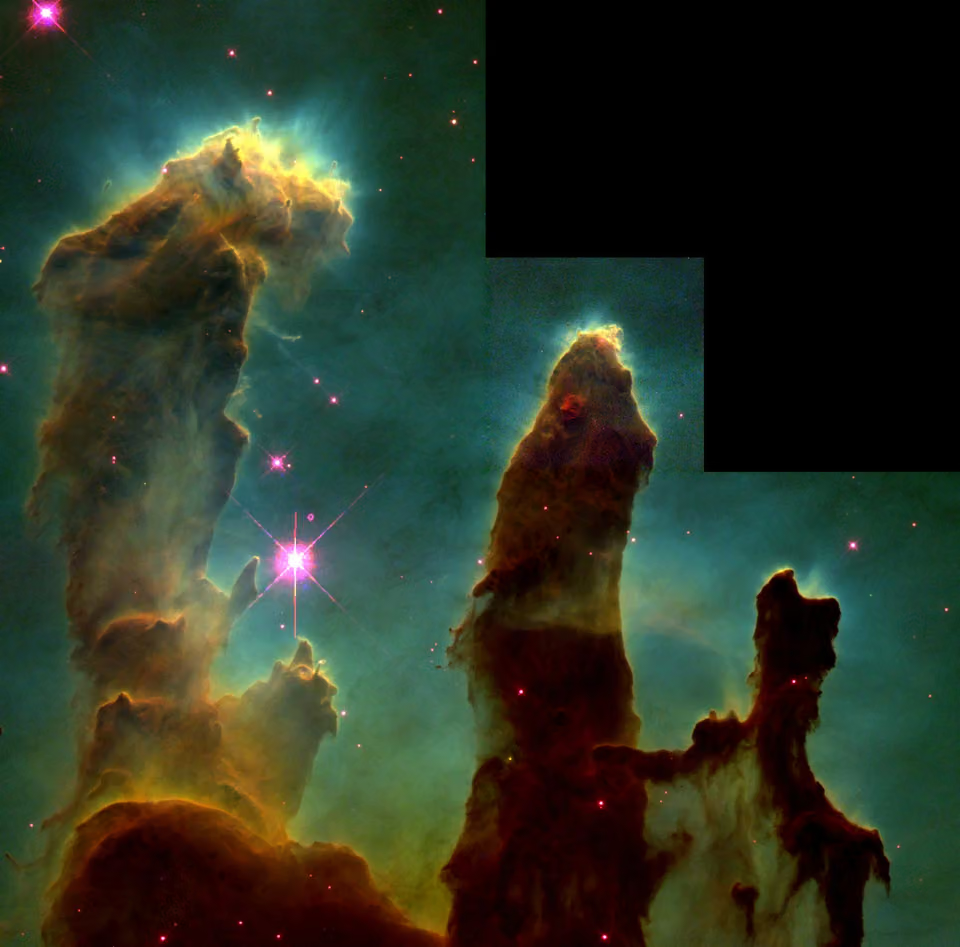
After 1994, new Hubble pictures appeared almost weekly. The one that became the best known of all was made in 1995: three dark columns of gas in the Eagle Nebula, given the name Pillars of Creation in the Institute's news office that year. The name stuck. The image looks organic and unlike anything people expected space to contain, and versions of it have turned up in special effects for many science fiction films. The Eagle Nebula page compares it with the 2014 remake.
The other landmark of 1995 was more cerebral. The Hubble Deep Field spent about a million seconds of exposure on a seemingly blank patch of sky, a gamble that some feared would show nothing. It showed galaxies everywhere, a core sample through billions of years of cosmic history, followed in later years by ultra and extreme deep fields.


Colliding galaxies like the Antennae became another staple: two disks torn into streamers, with bursts of star formation lit up where their gas collides.
The fight for one more servicing mission
After the loss of the shuttle Columbia in early 2003, the planned fourth servicing mission to Hubble was canceled in 2004. Public reaction was strong, from newspaper editorials to schoolchildren collecting money for the telescope, and in 2006 the next NASA administrator reinstated the mission.
Atlantis launched on May 11, 2009, with Endeavour standing by on the next pad as a rescue shuttle. After wrestling a stuck bolt on an older camera, the astronauts installed Wide Field Camera 3. Its near-infrared channel, nearly cut for budget reasons, lets Hubble see galaxies within about 400 million years of the Big Bang, across some 97 percent of the history of the universe. The 30th anniversary picture of NGC 2014 and NGC 2020 was taken with that same camera.
Questions readers ask
What was Hubble's first image?
A black-and-white frame of a few stars in the open star cluster NGC 3532, shown to the press at Goddard Space Flight Center on May 20, 1990. It was an engineering target, and the odd tentacles around its stars turned out to be a sign of the mirror flaw.
What was wrong with Hubble's mirror?
The 8-foot primary mirror was polished to a slightly wrong shape, a little too flat near its rim. Light from a star no longer came to one sharp focus. Astronauts fixed the problem in December 1993 by installing instruments with corrective optics.
Why are the Pillars of Creation so famous?
The 1995 image of three tall columns of gas in the Eagle Nebula looked like nothing people expected to see in space, and its name, coined that same year, made it easy to remember. It became the best-known Hubble picture and was reshot in 2014.
What was the first color image Hubble released?
An image of the ring around Supernova 1987A from the Faint Object Camera. The camera had no color filters, so the black-and-white picture was tinted: yellow for sulfur in the ring, red for hydrogen in the center and blue for the stars. True-color images of Jupiter and Saturn followed by the end of 1990.