How images are made
The Cosmic Reef: How Hubble's 30th Anniversary Image Was Assembled
A red star-forming cloud, a blue bubble blown by one star, twelve mosaic tiles and three that had to be taken again.
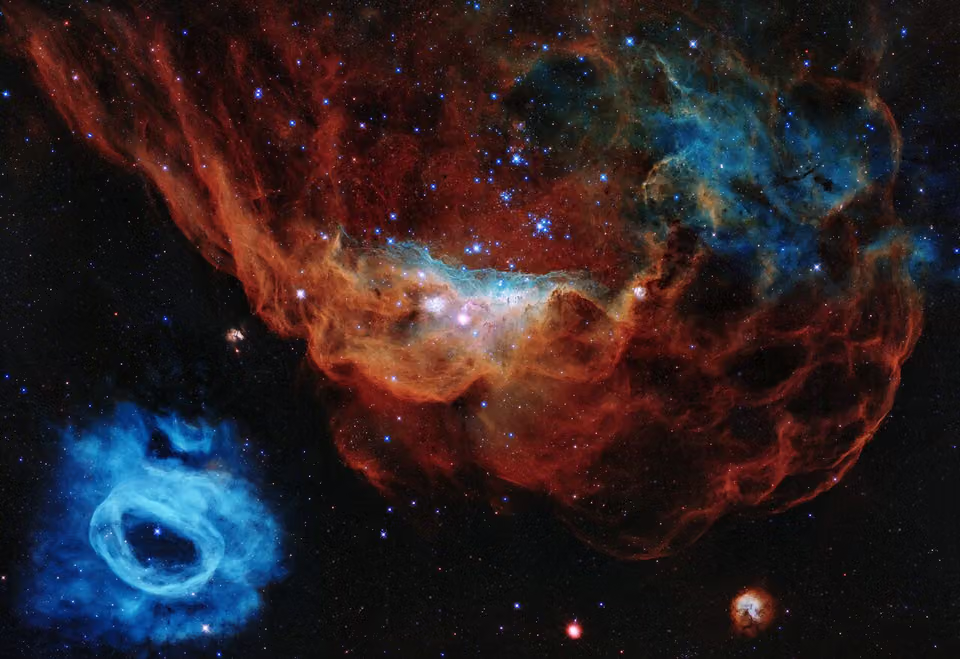
For its 30th year in orbit, Hubble needed a picture worthy of the occasion, and the target was found through a bit of numerology. Searching the New General Catalogue for a number that matched the anniversary year turned up NGC 2020, a nebula in the Large Magellanic Cloud, a satellite galaxy of the Milky Way about 163,000 light-years away. It proved to be a fine subject, especially paired with its large neighbor NGC 2014. Released on April 24, 2020, the image was nicknamed the Cosmic Reef, because the two clouds look like a coral reef in a sea of stars.
Two nebulae, two kinds of sculptor
The image holds two very different objects. NGC 2020 is the small round blue nebula at lower left. It is a bubble blown by a single star, a Wolf-Rayet star catalogued as Br 48 (HD 269748), visible as a bright point near the bubble's center. Wolf-Rayet stars are extremely hot and drive fierce winds of high-energy particles. When those winds slam into layers of gas the star shed earlier, they shape a nebula like this one. This particular star is about 15 times as massive as the Sun and around 200,000 times as luminous.

NGC 2014, the large red cloud that fills most of the frame, is a star cluster and star-forming nebula. Its shape is the combined work of many stars. A cluster of bright, young blue stars at its center has blown bubbles into the surrounding gas and dust, leaving loose tendrils that look like brain coral. In the densest part, near the middle of the picture, the cluster's winds and ultraviolet light strike thick gas and make it glow, like waves breaking on a shore.
Behind that bright front rise mountain-like ridges of gas, denser than their surroundings and able to resist erosion longer, which gives them the same kind of spires seen in the Pillars of Creation in the Eagle Nebula. At full resolution the image holds plenty more for a wandering eye: a bright cave-like hollow within NGC 2014, small independent nebulae around the edges, and even a background galaxy shining through the gas.
Planning a big mosaic
The observations had two aims that pull in opposite directions. The first was to make the mosaic as large as possible within the available observing time. The second was to expose long enough to record faint wisps in the nebulae without overexposing the bright stars of the central cluster. Several versions of the observing plan were drawn up to balance the two, and the camera chosen was Wide Field Camera 3. The first data reached the ground in early January 2020 and looked excellent. The finished mosaic is enormous, 17,043 by 11,710 pixels, large enough that the small details described above only appear when the full file is opened and explored.
Three missing tiles and a twist
Then something went wrong. Hubble circles Earth at about 18,000 miles per hour, yet it has to hold its aim precisely during every exposure. It does this by locking onto guide stars, bright stars that the pointing system tracks throughout an observation. Very occasionally that lock fails and the telescope drifts, smearing the image. That happened for three of the twelve mosaic tiles. Their data were unusable, and the first draft of the mosaic had a gaping hole in the middle.
The missing tiles were scheduled again as soon as possible, but about six weeks had passed before Hubble could return. Over that time the telescope's orientation on the sky, its nominal roll angle, changes as Hubble follows Earth around the Sun. The new tiles therefore came in rotated relative to the originals. Where rotated and unrotated tiles met, the mosaic showed triangular artifacts and differences in background noise, which were largely handled during calibration and cleaned up afterward. Other ways the instrument itself leaves marks on a picture are collected in Image Artifacts.
Four filters and a hard balance
The filter set combined two narrowband filters, for oxygen and for hydrogen with nitrogen, with two broad filters that collect blue and red starlight. That way the stars could appear in natural colors while the nebulae showed their structure. Colors were assigned in order of wavelength, the convention explained in Are the Colors Real?: the longest, the broad red filter, became red, and the others moved through orange and teal to blue at the short end.
| Filter | What it records | Shown as |
|---|---|---|
| F475W | Broad blue band, mostly starlight | Blue |
| F502N | Doubly ionized oxygen [O III] at 502 nanometers | Teal |
| F657N | Hydrogen-alpha with ionized nitrogen near 657 nanometers | Orange |
| F814W | Broad near-infrared band at 814 nanometers, mostly starlight | Red |
The first previews, made while data were still arriving, used only the two narrowband filters as two-color images. The nebulae looked striking, but the stars came out washed out; the central cluster, known to be mostly blue, did not look blue at all. All four filters were needed.
That created a problem of its own. To avoid saturating the bright stars, the broad-filter exposures were kept very short, so they captured little nebula and a lot of background noise. Each of the four images had to be stretched carefully before combining, and the overall color turned out to be very sensitive to those first stretches. Getting NGC 2020 to look blue, NGC 2014 to show its range of hydrogen-dominated reds, and the cluster stars to keep their natural colors took many rounds of adjustment.


By the time the makeup tiles arrived, the processing recipe was largely worked out. Adding the final central panel filled the hole with detail that had been entirely absent from the drafts. A closer look at the features in the finished picture follows in Diving into the Cosmic Reef.
Questions readers ask
Why is it called the Cosmic Reef?
The large red nebula, NGC 2014, resembles part of a coral reef, with bubbly, brain-coral-like structures, and the smaller blue NGC 2020 sits beside it. Together the pair suggests an undersea scene, a reef floating in a sea of stars in the Large Magellanic Cloud.
What made NGC 2020 blue?
It is a bubble blown by a single Wolf-Rayet star, about 15 times the mass of the Sun. Its winds and ultraviolet light energize oxygen in the surrounding gas. Oxygen was recorded through the F502N filter and shown in teal and blue, so the bubble stands out against the redder hydrogen of NGC 2014.
Why were some tiles of the mosaic taken twice?
During three of the twelve tile observations Hubble lost its lock on its guide stars and drifted, smearing the data. Those tiles were observed again about six weeks later, by which time the telescope's orientation had changed, so the new tiles were rotated and needed extra calibration.
How far away is the Cosmic Reef?
NGC 2014 and NGC 2020 are in the Large Magellanic Cloud, a small satellite galaxy of the Milky Way, about 163,000 light-years from Earth. The image was released on April 24, 2020, to mark 30 years since Hubble's launch.