Hubble Heritage Archive · Star
V838 Monocerotis: Hubble Follows an Expanding Light Echo Through Dust
A flash in January 2002 lit up dust that had been invisible for thousands of years, and Hubble watched the illumination spread outward at light speed.
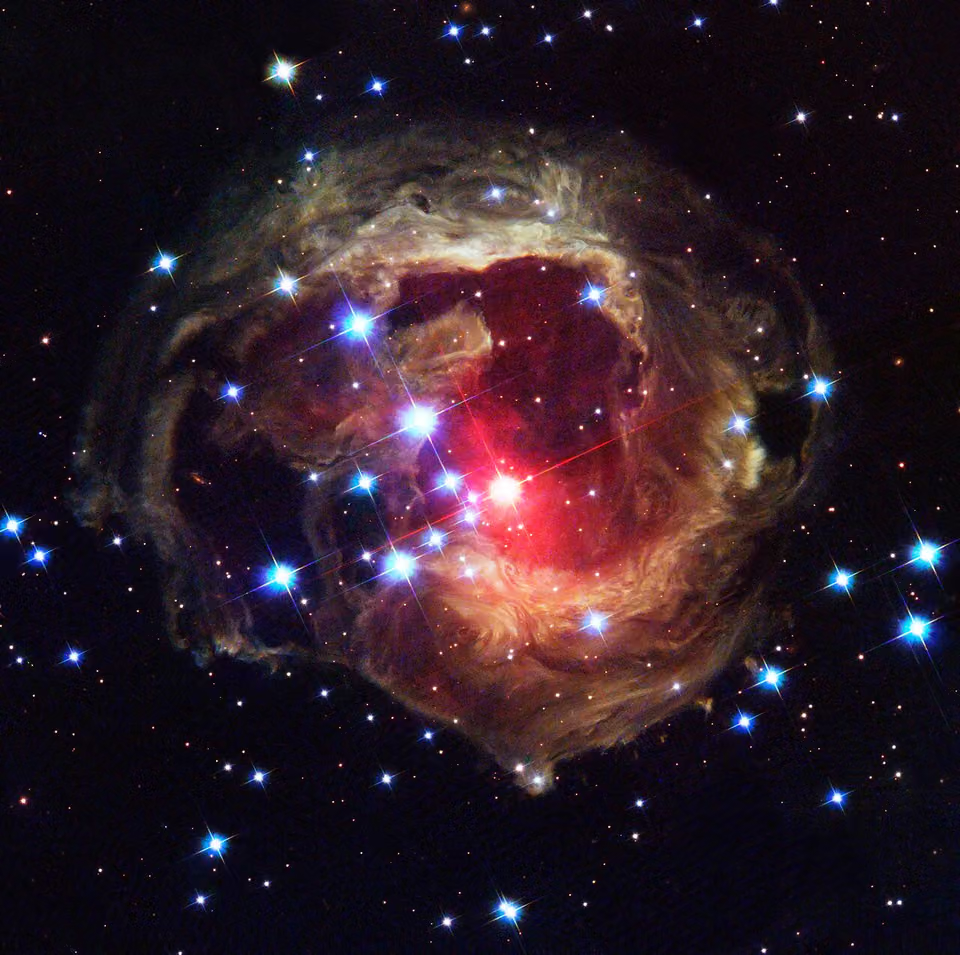
In January 2002 an unremarkable star in the constellation Monoceros, the Unicorn, suddenly became one of the brightest stars in the Milky Way. For several weeks V838 Monocerotis shone about 600,000 times as brightly as the Sun. Then it faded again by April. The flash it sent out has been revealing its surroundings ever since.
The star is about 20,000 light-years away, near the outer edge of the Milky Way. Around it lie shells of dust, probably thrown off in an earlier outburst some tens of thousands of years ago, which had never been seen because nothing lit them. The 2002 flash did.
How a light echo works
Light from the outburst traveled outward in every direction. Some of it came straight to Earth and arrived first, as the brightening itself. Some went sideways, struck the dust, and scattered toward Earth along a longer path, arriving later. As the flash moved outward through the dust, ever more distant layers lit up, and from Earth the illuminated region appeared to grow.
That effect is called a light echo. The expanding rings in the Hubble images are not dust moving outward at the speed of light. The dust is nearly stationary, and what moves is the pulse of illumination sweeping across it. Because each image shows a different slice of dust, a series of them works like a CAT scan, letting astronomers map the three-dimensional structure of the shells around the star.
Hubble's sequence of images
Hubble began observing the echo soon after the outburst and returned to it repeatedly. The early views, from May, September, October and December 2002, show the illuminated region growing from a compact glow into a wide disk.

On February 8, 2004, the Hubble Heritage Team observed the star with the Advanced Camera for Surveys, using 1.8 hours of exposure through blue, visible and near-infrared filters. The observation belonged to program 10089, which the Heritage Team ran itself: one of the occasions when the project spent its own small share of telescope time, here on an object that was changing from month to month. That image showed swirls and eddies in the dust for the first time, probably caused by turbulence in the gas and dust as they slowly drift away from the star. It was released on March 4, 2004, and its whorls invited comparison with Vincent van Gogh's painting The Starry Night.

The image at the top of this page, released on February 3, 2005, shows how much the scene had changed again, with new patterns of dust lit as the pulse reached farther layers. The echo was expected to remain visible for years as the light continued outward.
| Name | V838 Monocerotis (V838 Mon) |
|---|---|
| Type | Nova-like variable star and surrounding light echo |
| Constellation | Monoceros |
| Distance | About 20,000 light-years (6 kiloparsecs) |
| Position | R.A. 07h 04m 04.8s, Dec. −03° 50′ 50″ |
| Camera | Advanced Camera for Surveys, Wide Field Channel |
|---|---|
| Observed | February 8, 2004 |
| Exposure | 1.8 hours |
| Filters | F435W (B), F606W (V), F814W (I) |
| Program | HST program 10089 |
The 2004 frame covers about 2.4 arcminutes of sky. At the star's distance that corresponds to roughly 13.6 light-years, so the dust caught in the echo spans a region several light-years across around the star. The three filters record reflected starlight, not glowing gas. The colors of the dust therefore come from the flash itself and from how the grains scatter it. Are the Colors Real? explains how three such filters are turned into a color image.
A star unlike a nova
At first V838 Mon looked like a nova, a common type of stellar outburst. In a typical nova a white dwarf collects hydrogen from an ordinary companion star. The gas accumulates on its surface until it ignites in a runaway fusion explosion, which blows off material and leaves behind an exposed core hundreds of thousands of degrees hot.
V838 Mon did something different. It kept its outer layers. Instead it swelled to an enormous size, and its surface cooled to a temperature not much hotter than a light bulb filament. Its extremely red color during and after the outburst set it apart from every previously known nova. The bright red star at the center of each Hubble image is that bloated star.
What caused the outburst is not understood. It may represent a rarely seen, short-lived stage in the life of a star, and it shares some traits with eruptive variables, unstable aging stars that brighten suddenly and without warning.
Questions readers ask
What is a light echo?
A light echo is light from a brief flash that reaches an observer late because it has scattered off dust on a longer path. Around V838 Mon, the 2002 outburst lit up successive layers of dust as it traveled outward, so the illuminated region appeared to expand at the speed of light, while the dust itself barely moved.
How bright did V838 Monocerotis become?
During its outburst in early 2002 it reached about 600,000 times the luminosity of the Sun, which for a short time put it among the brightest stars of the Milky Way. It faded again by April 2002, but the light it emitted continued to illuminate the dust around it for years.
Was V838 Monocerotis a nova?
It resembled one at first, but its behavior was different. A nova blows off its outer layers and exposes a very hot core. V838 Mon instead swelled to huge size and cooled, turning extremely red. Its outburst remains unexplained and may be a rare phase in a star's evolution.
Why was the 2004 image compared to The Starry Night?
The Hubble image from February 2004 showed swirling eddies in the illuminated dust for the first time. Their curling patterns resemble the bold whorls of light in Vincent van Gogh's painting of a night sky, and the release made that comparison explicitly.