Hubble Heritage Archive · Star cluster
Westerlund 2 and Gum 29: The Cluster Hubble Picked for Its 25th Year
About 3,000 young stars, 20,000 light-years away, photographed through the dust with a near-infrared camera to mark a quarter century in orbit.
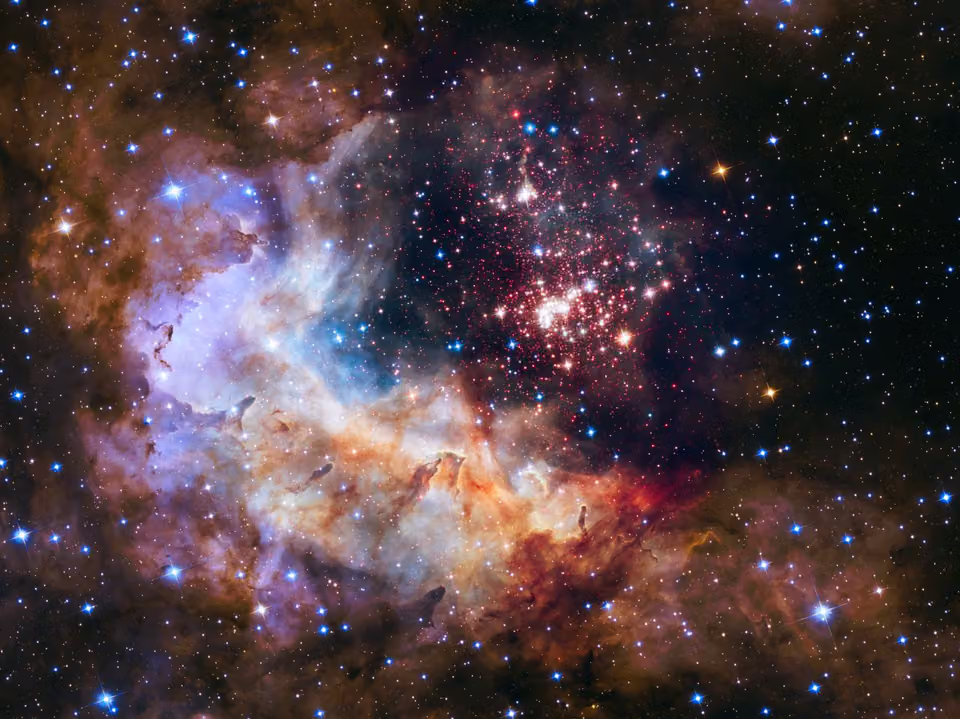
Hubble was launched on April 24, 1990, and for the 25th anniversary of that day the picture released was this one: Westerlund 2, a cluster of roughly 3,000 stars sitting in a cavity it has cleared in the gas cloud Gum 29, 20,000 light-years away in the southern constellation Carina. The image went public on April 23, 2015.
A cluster that has barely left home
The Swedish astronomer Bengt Westerlund found the grouping in the 1960s, and it still carries his name. At about two million years old it is an infant even by the standards of star clusters, and it holds some of the hottest, brightest and most massive stars known in the Milky Way. Its core measures somewhere between 6 and 13 light-years across.
That youth is what makes it useful. Older clusters drift apart as their stars wander off into the galaxy, and the evidence of how they formed goes with them. Westerlund 2 has not had time to scatter, so the stars can still be studied inside the cloud that produced them.

The color of a point of light in this picture is a rough guide to what it is. The brilliant blue stars spread across the frame are mostly in the foreground, between Earth and the cluster. The tiny red dots belong to Gum 29 itself, and the next section explains why they matter.
How the brightest stars shape Gum 29
The heaviest stars in the cluster pour out ultraviolet light and fast winds of charged particles. Both eat into the hydrogen cloud around them, and the result is the landscape seen in the image: ridges, valleys and columns of dense gas, the pillars a few light-years tall and all pointing back toward the cluster that is eroding them. Reddish-brown filaments of gas and dust fill the spaces between.

The same forces that destroy the cloud also make new stars in it. Where a stellar wind runs into a thick wall of gas, the shock can compress the gas enough to start collapse, and a fresh generation forms along the edge of the cavity. The faint red dots scattered over the nebula are that generation: stars between one and two million years old, still wrapped in dust, not yet hot enough at their centers to fuse hydrogen.
Two cameras in one picture
The image is a composite of two instruments with different jobs. Across the whole field, the Advanced Camera for Surveys recorded visible light through two broad filters, F555W and F814W, with exposures spread from September 2013 to November 2014. In the central region the processors added near-infrared data from the Wide Field Camera 3, taken through F125W in November 2014. Infrared light passes through dust that stops visible light, so it shows the cluster stars that the visible exposures alone would leave dim or hidden. The approach is covered more generally in Peering through the Dust.
| Names | Westerlund 2 (cluster) and Gum 29 (nebula) |
|---|---|
| Type | Young star cluster inside an emission nebula |
| Constellation | Carina |
| Distance | 20,000 light-years (6,130 parsecs) |
| Position (J2000) | R.A. 10h 23m 58.10s, Dec. −57° 45′ 48.96″ |
| Image width | 7.4 arcminutes, about 43 light-years |
| Visible light | ACS/WFC, F555W (9,531 s) and F814W (9,755 s), Sept. 2013 to Nov. 2014 |
|---|---|
| Near-infrared | WFC3/IR, F125W (3,788 s), November 2014 |
| Programs | HST proposals 13038 and 14039 |
| Released | April 23, 2015 |
The finished frame spans 7.4 arcminutes, which works out to about 43 light-years at the distance of the cluster. On the sky that is roughly a quarter of the width of the full Moon, a small patch for a telescope whose cameras each cover only a few arcminutes at a time.
In the finished color version, shades of red trace hydrogen and the blue-green tones come mainly from oxygen. As with every Hubble color image, each filter was recorded in grayscale and then given a hue before the layers were stacked; Are the Colors Real? explains how those hues are chosen.
The original science observations came from a team led by Antonella Nota (ESA/STScI) under proposal 13038, which included Elena Sabbi, Eva Grebel, Peter Zeidler, Monica Tosi, Alceste Bonanos, Carol Christian and Selma de Mink. Additional pointings to complete the anniversary picture were made under proposal 14039.
Westerlund 2 against other star-forming regions
Apparent size on the sky says little about real size, because the regions lie at very different distances. A comparison graphic made at STScI shows four regions drawn to one common scale: the Orion Nebula, the Carina Nebula, Gum 29 and the Tarantula Nebula in the Large Magellanic Cloud. The Tarantula, among the biggest stellar nurseries astronomers have mapped, outsizes every Milky Way example in the set. The Carina complex sits in the same constellation and is covered in the Carina Nebula entry.
Questions readers ask
How many stars are in Westerlund 2?
The cluster contains about 3,000 stars. Many more faint, newly forming stars are scattered through the surrounding nebula, Gum 29, and appear in the Hubble image as small red dots. Astronomers estimate the cluster's age at around two million years.
What are the small red dots around the cluster?
They are stars still forming, between one and two million years old and wrapped in cocoons of gas and dust. They have not yet started fusing hydrogen in their cores. The bright blue stars in the same picture are mostly foreground stars that have nothing to do with the cluster.
Can Westerlund 2 be seen from the Northern Hemisphere?
Carina lies far south, and the cluster sits at a declination of about −58 degrees. It never rises for observers at mid-northern latitudes. Observers in the Southern Hemisphere can see the region well placed in the sky.
Which Hubble cameras took the data?
Two. The Advanced Camera for Surveys covered the whole field in visible light through the F555W and F814W filters. Wide Field Camera 3 added a near-infrared exposure through F125W in the central region, where dust hides much of the cluster from visible-light cameras. The two data sets were blended into one picture.