Hubble Heritage Archive
Asteroid Trail in Centaurus: The Rock That Crossed a Hubble Star Field
A 33-minute exposure of crowded Milky Way stars, and one blue curve left by a rock less than a light-hour away.
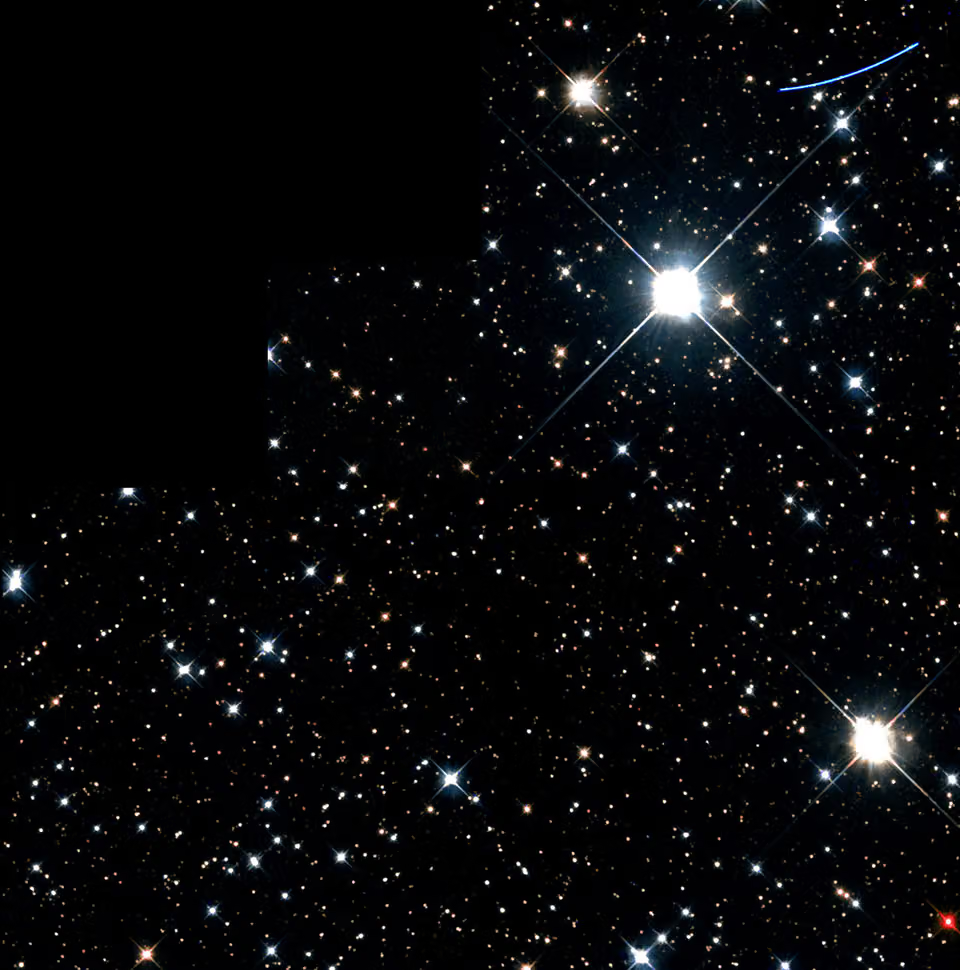
Almost every point of light in this picture is a star about 25,000 light-years away, deep in the crowded central regions of the Milky Way. One mark is different. The thin blue arc near the top was drawn by a lump of rock roughly two kilometers wide, so close by comparison that its light took only minutes to reach the telescope.
A camera working on the side
On April 6, 1994, Hubble was busy with a different target. Its Fine Guidance Sensors were measuring the position of Proxima Centauri, the closest star to the Sun, with enough precision to catch a tiny wobble. A program run by Benedict and Jefferys of the University of Texas and their collaborators was looking for that wobble as a sign of an unseen planet tugging on the star.
The guidance sensors do not need the main cameras, so the Wide Field and Planetary Camera 2 was free. A program set up by Ed Groth of Princeton used such idle periods to take what astronomers call parallel observations: the camera simply records whatever patch of sky happens to sit in its field while the telescope points somewhere else for another reason. Here the camera landed on a rich star field in Centaurus, close to Proxima on the sky.
Fields like this are useful in their own right. Counting and measuring the stars in them helps trace how stellar populations in the inner galaxy have aged. Nobody planned to catch an asteroid in one.
Why the trail is blue and curved
| Filter | What it records | Shown as |
|---|---|---|
| F606W | Wide V band, broad visible light | Blue |
| F606W + F814W | The two filters averaged | Green |
| F814W | I band, near-infrared light | Red |
The camera exposed the field for 33 minutes in total, through two broad filters. Stars sit still over that time, so each one appears as a single point, colored by the mix of the two filters. The asteroid moved. In the exposures through F606W it was in one place, and in the F814W exposures it had shifted to another, and the processed frames give the moving rock a color that no star shares. That is the most likely reason the trail looks pure blue while the stars around it look white and yellow. The colors follow the usual rule of shorter wavelength shown bluer, explained in more detail in Are the Colors Real?
The bend in the trail comes from Hubble itself. The telescope circles Earth roughly every 90 minutes, and that orbital motion shifts its point of view. For a background star the shift is far too small to notice, but for an object less than one astronomical unit away it adds a sideways swing to the asteroid's own motion, turning a straight track into an arc.
| Field | Milky Way star field in Centaurus |
|---|---|
| Position (J2000) | R.A. 14h 28m 08.74s, Dec. −62° 45′ 43.20″ |
| Image height | 2.7 arcminutes |
| Designation | u2805m01t4 |
|---|---|
| Magnitude | 18.7 |
| Diameter | About 2 kilometers (1.25 miles) |
| Trail length | 19 arcseconds |
| Distance | 0.93 AU from Earth, 1.68 AU from the Sun |
| Camera | Wide Field and Planetary Camera 2 (parallel observation) |
|---|---|
| Observed | April 6, 1994, 33 minutes of exposure |
| Released | March 4, 1999 |
Who found it, and what they learned
The trail went unnoticed until astronomers Robin Evans and Karl Stapelfeldt at the Jet Propulsion Laboratory began going through Hubble's stored images on purpose, hunting for exactly this kind of streak. With collaborators they turned up about a hundred asteroids in frames that had been taken for other reasons. The one in Centaurus was 87 million miles from Earth and 156 million miles from the Sun when Hubble saw it, and its estimated orbit could cross the path of Mars.

The science version of the image above shows the field almost raw. The scattered orange and blue specks are cosmic-ray hits on the detector, which the processing for the 1999 Heritage picture removed. Objects this faint and this briefly observed cannot be followed long enough from the ground to pin down a precise orbit, so the rock carries only a provisional label, u2805m01t4, and nothing more is known about where it is today. A similar search, run decades later with machine learning across a far larger set of frames, is described in Asteroids Photobomb the Universe.
Proxima Centauri, just out of frame
The star that brought Hubble to this part of the sky is close enough to the Sun that its own motion across the sky can be measured over a few years, against the far more distant stars behind it. Two plates from the Digitized Sky Survey, one exposed through a blue filter in 1976 and one through a green filter six years later, show Proxima clearly displaced between them. The survey was produced by Barry Lasker and his group at the Space Telescope Science Institute.
The asteroid image was released on March 4, 1999, as part of the monthly series collected in the Hubble Heritage archive. It remains one of the few Heritage pictures in which the most interesting object is the one nobody was looking for.
Questions readers ask
How far away was the asteroid when Hubble photographed it?
It was 0.93 astronomical units from Earth, about 87 million miles, and 1.68 astronomical units from the Sun. The stars behind it are roughly 25,000 light-years away, so the two kinds of object in the picture differ in distance by a factor of more than a billion.
Why did the asteroid leave a trail and the stars did not?
During the 33 minutes of exposure the telescope held steady on the stars, which are so distant that they do not appear to move. The asteroid travels along its own orbit around the Sun, and Hubble's orbit around Earth adds a further apparent shift, so its light was smeared into a line across the detector.
Was Hubble looking for asteroids?
No. The camera was taking a parallel observation while the Fine Guidance Sensors measured Proxima Centauri. The asteroid was found later, when researchers at the Jet Propulsion Laboratory searched Hubble's stored images for moving objects and identified about a hundred of them.
Does the asteroid have a name?
Only a temporary designation, u2805m01t4. A permanent number needs a well-determined orbit, and the asteroid was seen too briefly and is too faint for ground-based telescopes to follow it long enough to calculate one.