Hubble Heritage Archive · Star cluster
Center of the Milky Way: Hubble's Infrared Look at the Galactic Core
Half a million stars around a black hole four million times the mass of the Sun, seen through dust that hides them from visible light.
The center of the Milky Way lies about 27,000 light-years away in the direction of Sagittarius, and visible light from it never reaches Earth: the dust in the galaxy's disk absorbs it along the way. To see the stars packed around the galaxy's central black hole, a telescope has to work in infrared light. Hubble's Wide Field Camera 3 did exactly that, and the result, a mosaic of more than half a million stars, was released on March 31, 2016.
The densest cluster in the galaxy
Nearly every star in that picture, apart from a few blue ones in the foreground, belongs to the Milky Way's nuclear star cluster. It is the most massive and most densely packed star cluster in the galaxy. Its crowding is hard to picture: it amounts to roughly a million stars like the Sun squeezed into the space between the Sun and its nearest neighbor, Alpha Centauri.
At the middle of the cluster sits the Milky Way's supermassive black hole, about four million times the mass of the Sun. The cluster wraps around it on all sides.
Seeing through the dust
| Filter | What it records | Shown as |
|---|---|---|
| F127M | Near-infrared at 1.27 micrometers, water and methane continuum | Blue |
| F139M | Near-infrared at 1.38 micrometers, water and methane line | Green |
| F153M | Near-infrared at 1.53 micrometers, water and ammonia | Red |
The 2016 image used the infrared channel of Wide Field Camera 3 with three medium-width filters between about 1.27 and 1.53 micrometers, all well beyond what the eye can see. To make a picture, the processors mapped them onto visible colors in order of wavelength, the shortest shown blue and the longest red. The choice of hues for invisible light follows the same logic described in Are the Colors Real?
In that color scheme, stars that look red are either embedded in dust or lie behind thick lanes of it, which dims their shorter-wavelength light more than their longer. Some clouds are so dense that even Hubble's infrared view cannot get through. They appear as dark shapes outlined against the bright field of stars behind them. How infrared light reveals what visible light hides is the subject of Peering through the Dust.
| Name | Galactic Center, the nuclear star cluster around Sagittarius A* |
|---|---|
| Type | Nuclear star cluster at the center of the Milky Way |
| Constellation | Sagittarius |
| Distance | About 27,000 light-years |
| Central black hole | About 4 million times the mass of the Sun |
| Position (J2000) | R.A. 17h 45m 36.00s, Dec. −28° 55′ 58.8″ |
| Camera | Wide Field Camera 3, infrared channel |
|---|---|
| Observed | 2010 to 2014 |
| Programs | HST proposals 13049, 12663 and 12182 (PI T. Do) and 11671 (PI A. Ghez) |
| Mosaic | Nine WFC3 pointings, about 50 light-years across |
| Released | March 31, 2016 |
Four years of motion
The picture was not made for its own sake. It was built from archival data gathered for science programs led by Tuan Do and Andrea Ghez of the University of California, Los Angeles, between 2010 and 2014. Hubble's sharpness let the team measure how individual stars moved across the sky over four years.
Those motions are the useful part. From them astronomers worked out key properties of the nuclear star cluster, including its mass and structure. The motions may also hold clues to how the cluster was assembled: either by globular star clusters that sank into the galaxy's center over time, or by gas flowing inward from the disk and forming stars at the core.
Zooming in from the whole sky
A four-panel graphic released with the image shows how narrow Hubble's view is. The first panel is a wide visible-light view of the Milky Way across the sky. The second zooms into a boxed area toward Sagittarius, where dark lanes of interstellar dust block most of the core. The third zooms again and switches to infrared, and the dust thins enough for the starlight behind it to show. The fourth is the Hubble close-up itself, with a small marker in the middle placed on the nucleus, home of the supermassive black hole. On the sky the Hubble mosaic measures about 6.5 by 5.6 arcminutes, a small fraction of the area of the full Moon.
A mosaic and what it leaves out
The image is a mosaic stitched from nine separate Wide Field Camera 3 pointings, covering about 50 light-years. Even with more than half a million stars recorded, it is only part of the population. Astronomers estimate that about ten million more stars in the cluster are too faint to show up.
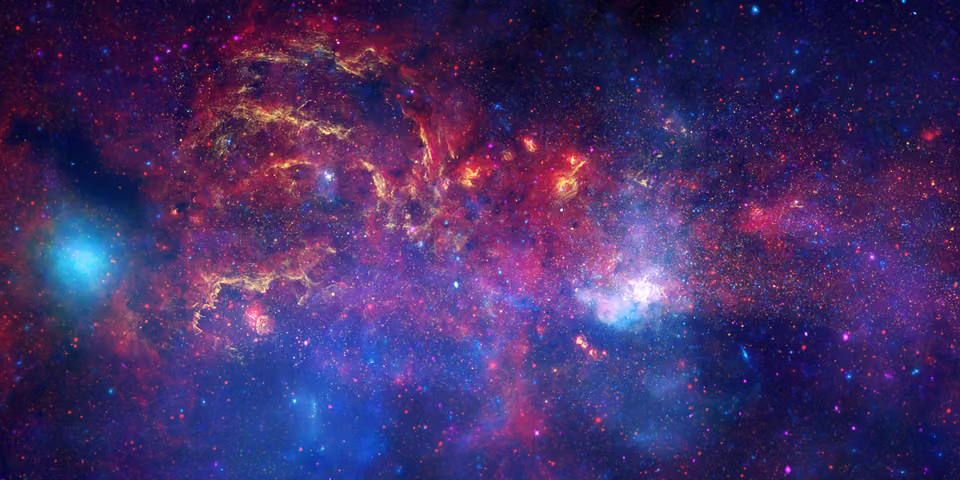
The picture at the top of this page is a different view of the same region, released in 2009. It combines near-infrared data from Hubble's older NICMOS camera, shown in yellow, with Spitzer Space Telescope infrared in red and Chandra X-ray Observatory data in blue and violet. It spans about half a degree, roughly the width of the full Moon, and the galaxy's center lies in the bright white region just right of and below the middle. In this composite the Spitzer data show glowing dust shaped into globules and long filaments by the radiation and winds of stars, while the Chandra data trace gas heated to millions of degrees by stellar explosions and by outflows from the black hole. The bright blue blob at the left is X-ray emission from a double star system that contains either a neutron star or a black hole. The 2016 infrared mosaic can be viewed on its ESA/Hubble image page.
Questions readers ask
How far away is the center of the Milky Way?
About 27,000 light-years. It lies in the direction of the constellation Sagittarius, along the plane of the galaxy's disk, where thick dust absorbs visible light. Infrared light gets through most of that dust, which is how Hubble's Wide Field Camera 3 could record the stars there.
What is the nuclear star cluster?
It is the dense cluster of stars at the very center of the Milky Way, surrounding the central supermassive black hole. It is the most massive and most crowded star cluster in the galaxy, packing the equivalent of about a million Suns into the volume between the Sun and Alpha Centauri.
How many stars does the Hubble image show?
More than half a million. Apart from a few blue foreground stars, they belong to the nuclear star cluster. Astronomers estimate that roughly ten million further stars in the cluster are too faint to appear even in this infrared mosaic.
Why are some regions of the image completely dark?
They are clouds of gas and dust so dense that even infrared light cannot pass through them. They show as dark silhouettes against the background stars. Thinner dust only reddens the stars behind it, so many stars in the mosaic look red.