Solar System
Jupiter and Saturn: The Great Conjunction of 2020 and Hubble's Images
Two planets a tenth of a degree apart in the evening sky, and the opposite alignment that gives Hubble its best yearly portraits of them.
The Jupiter and Saturn conjunction of December 21, 2020 drew people outdoors all over the world. Shortly after sunset, low in the southwest, the two largest planets of the solar system appeared just a tenth of a degree apart, so close that they could look like a single bright point to the naked eye. Jupiter and Saturn had not appeared that close together in the sky since 1623, and they will not do so again until 2080.
The great conjunction of 2020
A conjunction happens when two objects in the sky seem to pass each other. Nothing actually comes close: on December 21, 2020, Jupiter and Saturn were still hundreds of millions of miles apart. They lined up only from Earth's point of view, with the distance between them compressed along the line of sight, the way two distant lamps on a road can seem to touch.
All the planets orbit the Sun in nearly the same plane, the ecliptic, so seen from Earth they all travel along roughly the same band of sky. Each moves at its own pace. Jupiter goes around the Sun every 12 years and Saturn every 30, so every 20 years or so Jupiter catches up with Saturn and passes it as seen from here. Those meetings of the two giants are called great conjunctions. Most are not especially close. What made the great conjunction 2020 remarkable was the tiny separation, about ten times closer than usual, the closest Jupiter and Saturn conjunction in nearly 400 years.
For anyone who missed it, the next great conjunction comes around 2040, but the pair will not look this tight in the sky until 2080. The great conjunction 2020 needed no telescope at all: NASA's advice was simply to look low in the southwestern sky shortly after sunset, where both planets shone brightly.
A small telescope turned the view into something richer. Photographs taken through amateur telescopes in the days around the Jupiter and Saturn conjunction fit both planets into a single field, along with Jupiter's four large moons, Io, Europa, Ganymede and Callisto, and Saturn's biggest moon, Titan. After the great conjunction 2020 peaked, the pair stayed within about a degree of each other for the rest of the year, setting shortly after the Sun each evening.
Conjunction and opposition: two kinds of alignment
The alignments that matter for Hubble are different. Once a year Earth comes to opposition with each of the outer planets. At opposition Earth sits between the Sun and the planet, so the planet appears opposite the Sun in the sky. It is then about as close to Earth as it gets that year, and its disk is fully lit by the Sun as seen from here. Those are the best conditions for a sharp portrait, and Hubble usually observes Jupiter and Saturn close to their oppositions.
A conjunction of two planets with each other is something else: it says nothing about how close either planet is to Earth, only that they share a line of sight. The December 2020 event happened when both planets were far from opposition and low in the evening twilight, poor conditions for a telescope. Hubble's 2020 pictures were taken months earlier, around the summer oppositions.
How Hubble's Jupiter and Saturn images are made
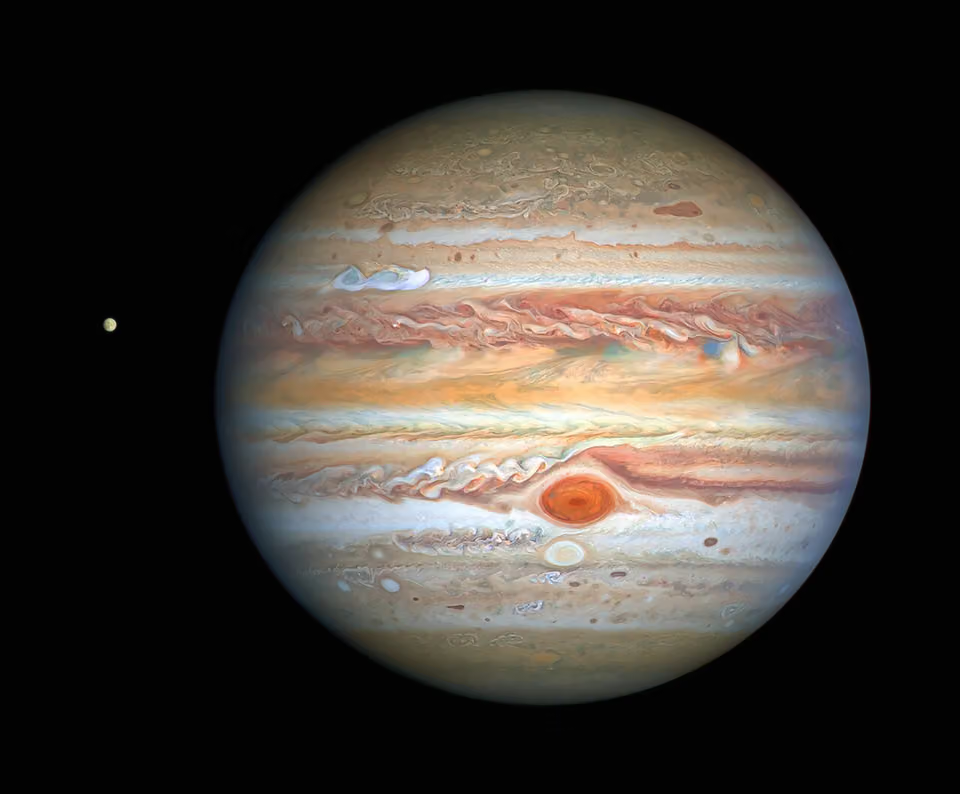
Those yearly portraits come from the Outer Planet Atmospheres Legacy program, OPAL. It photographs Jupiter, Saturn, Uranus and Neptune once a year to build a long record of how their atmospheres change; by 2020 it had run for seven years. The 2020 results included new storms on Jupiter and summer in Saturn's northern hemisphere.

Both planets are awkward subjects. Each rotates in about ten hours, fast for worlds so large, and they move along their orbits while Hubble moves along its own. The situation is a bit like skating around a large rink and trying to take a sharp photograph of a figure skater spinning on the far side.
The camera also records only one color at a time. A color image is assembled from separate exposures through red, green and blue filters, and between those exposures the clouds rotate. Combining the frames without correction gives a picture in which each moving feature appears in three slightly offset colors, a rainbow fringe around every storm.
The fix is derotation: shifting each frame so the planet's features line up as they would have at a single moment. It can be done by hand in image-editing software, but that is slow, subjective and easy to get wrong. Because the exact time of every exposure is known, the amount of rotation between frames can be calculated in degrees and corrected precisely. Software such as WinJUPOS is built for this. A different, 3D-based approach to the same problem is described in Rebuilding Hubble's Comet Impact in Color.


After derotation the image is assembled like any other Hubble color composite, as described in Are the Colors Real?. Color balance needs special care for planets, since the filters often isolate narrow parts of the spectrum and the goal is to show the atmospheric colors faithfully. Processing tools make it easy to push contrast and saturation too far and end up with a garish, overcooked planet. A light hand gives a more honest result.
Finding the moons in the images
Many exposures of the two giants also catch some of their moons, at least the larger and brighter ones. The moons are far dimmer than the planets, so a single stretch rarely suits both. Adjusted to show the planet's clouds, the moons vanish; adjusted to show the moons, the planet burns out to white. A published image may therefore combine two versions, each balanced for its own subject.
Identifying which moon is which takes care, because raw frames are peppered with cosmic-ray hits that can look like small moons. Astronomers rely on an ephemeris, a table of predicted positions for the planets and their moons. NASA's Planetary Data System offers tools that use ephemeris data to plot where each moon should appear for any date and any field of view, Hubble's included. Overlaying that plot on a raw Saturn frame from the 2020 opposition shows which points of light are moons and which are artifacts. The same information goes into the compass versions of published images: the annotated Saturn image from July 2020 labels each moon in the frame, so a reader can tell Mimas from Enceladus without guessing. Getting those labels right matters, since a cosmic-ray hit misread as a moon would put an object in the picture that was never there.
Questions readers ask
When was the 2020 Jupiter and Saturn conjunction?
The closest approach was on December 21, 2020. The two planets appeared about a tenth of a degree apart, low in the southwestern sky shortly after sunset. It was the closest they had appeared since 1623, and they will not look this close again until 2080.
Why is it called a great conjunction?
The name is used for conjunctions of Jupiter and Saturn, the two largest planets. Jupiter orbits the Sun every 12 years and Saturn every 30, so Jupiter overtakes Saturn as seen from Earth about every 20 years. Most of these meetings are much wider than the one in 2020.
Did Hubble photograph the great conjunction?
No. A conjunction is only a line-of-sight effect, and in December 2020 both planets were low in the evening sky and far from Earth. Hubble observes them near opposition, when each is closest and fully lit. Its 2020 portraits of Jupiter and Saturn were taken during the summer.
Why do Hubble images of Jupiter need derotation?
Jupiter turns about once every ten hours, and Hubble takes the red, green and blue exposures one after another. The clouds move between frames, so features would appear in three offset colors. Derotation shifts each frame by the calculated rotation so the features line up.
How are moons identified in Hubble images of Saturn?
Image processors compare the frame with an ephemeris, a list of predicted positions of the planet and its moons. Tools from NASA's Planetary Data System plot those positions for Hubble's exact field of view, which separates real moons from cosmic-ray hits that look similar.