Solar System
What Color Is Mars? The Real True Color of Mars and Why It Looks Red
From a distance it is red, on the ground it is butterscotch and tan, and every published picture has made a choice about which of the two to show.
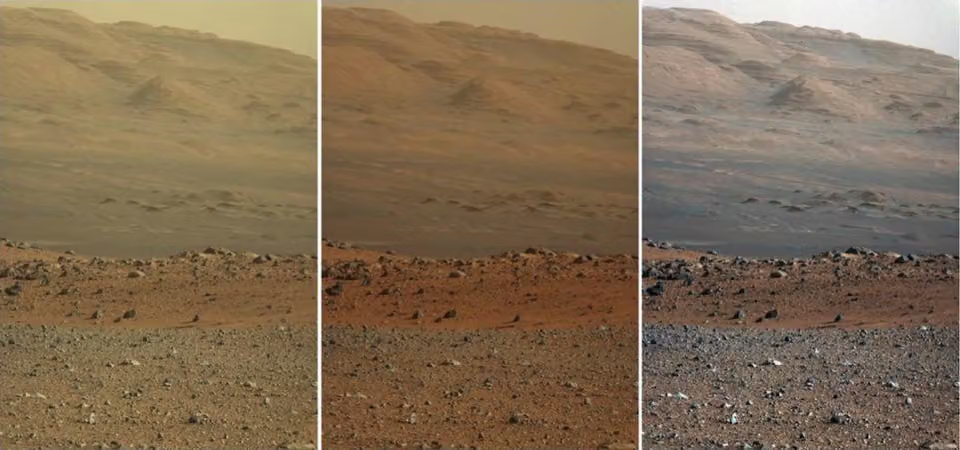
Mars is not red the way a stop sign is red. Seen from Earth it glows a rusty orange, but the true color of Mars at ground level is closer to butterscotch, with tans, browns and golds, under a hazy sky the color of the dust that hangs in it. Which of those colors a published picture shows depends on the camera, the light and a deliberate processing decision.
The image above makes the point with a single frame. On August 23, 2012, the 19th Martian day of its mission, the Curiosity rover's Mast Camera photographed the view south-southwest from its landing site toward Mount Sharp. The left panel is the data exactly as it arrived from Mars. The center panel was calibrated to estimate the colors a person standing there would see. The right panel was white-balanced to show the same ground as if it were lit by the Sun on Earth. All three are honest, and they disagree. Anyone asking what color is Mars is really asking which of these versions counts.
Why Mars looks red: rusted iron and very fine dust
The short answer to why is Mars red is oxidized iron. Iron in Martian rocks has rusted, and the weathered material breaks down into dust that winds lift into the atmosphere and spread across the planet. NASA describes the effect plainly: from a distance, that airborne and settled dust makes Mars look mostly red. The ancient Romans named the planet after their god of war because its color reminded them of blood.
Rust is a family of minerals, though, and the exact one matters. A study published on February 25, 2025, in Nature Communications proposed that the main coloring agent in Martian dust is ferrihydrite, an iron oxide that holds water in its structure. The work, led by Adam Valantinas of Brown University, compared orbital observations from NASA's Mars Reconnaissance Orbiter and ESA's Mars Express and Trace Gas Orbiter with ground measurements from the Curiosity, Sojourner and Opportunity rovers. In the laboratory, the team mixed ferrihydrite with ground basalt into particles smaller than one micrometer, a close stand-in for the real dust.
The choice of mineral changes the story of the planet. Ferrihydrite forms in the presence of cool water and at lower temperatures than hematite, the drier iron oxide often credited with the red color. If ferrihydrite dominates, Mars rusted while liquid water was still around. The researchers present this as a model to be tested, and samples collected by the Perseverance rover could confirm or reject it.
So why is Mars red? Because a thin coat of very fine, iron-rich dust covers most of it and floats in its air. The red is a skin, and in many places the rock under it is darker and grayer. Wind-blown sand ground from old lava flows, for example, is coarser than the dust and reflects less light. Regions covered by it, such as Syrtis Major, look almost black in the 2016 Hubble portrait of Mars near opposition.
The true color of Mars on the ground: butterscotch, tan and brown
NASA's own description of the surface lists brown, gold and tan. Close up, much of the landscape is a muted butterscotch. Rocks that look uniformly orange from orbit turn out to differ from one another in shade, from pale buff layers to dark boulders.
The trouble with the phrase "true color" is that it bundles two separate ideas. One is the color of the material itself, the hue a geologist would record if the rock sat on a lab bench under neutral light. The other is the color an eye would perceive on site, after sunlight has been filtered and tinted by a dusty atmosphere. On Earth the two are nearly identical, because daylight is close to neutral. On Mars they are not, so the true color of Mars has two defensible answers, and what color is Mars depends on which one a picture sets out to show.
Human perception adds a third layer. Roughly 1 in 12 men and 1 in 200 women have some form of color vision deficiency, and even people with typical vision disagree about colors under unusual lighting, as the long online argument over a photographed dress (blue and black, or white and gold?) showed. The brain constantly corrects for the color of the light falling on a scene. A visitor to Mars would likely notice the tint less over time, much as photographs taken underwater skew blue while a diver's eyes partly compensate.
Raw, natural and white-balanced: three versions of one real scene
Rover cameras do not deliver a finished picture. Curiosity's Mastcam takes color frames through a Bayer filter, a grid of tiny red, green and blue filters over the detector, much like an ordinary digital camera. What happens next produces the three standard versions seen in rover releases.
Raw color is the camera's output before calibration. NASA compares it to what a typical smartphone photo would show. It is also the form posted on the mission's public raw-image website, so many first impressions of the Martian surface come from uncalibrated frames.
Natural color applies the measured response of the camera so that the result approximates what a person would see standing on Mars. In the Sol 19 frame it is the darkest and most orange of the three, because the sunlight reaching the ground has already passed through a dusty sky.
White-balanced color goes one step further and removes the tint of the Martian light, as if the scene were illuminated on Earth. It is the version geologists find most useful, because it lets them recognize rock types using a lifetime of experience with rocks under Earth's sky.


The Mount Sharp mosaic above, assembled from dozens of frames taken with Mastcam's 100-millimeter telephoto camera on September 20, 2012, shows the trade-off. Mount Sharp, also called Aeolis Mons, rises more than 3 miles (5 kilometers) above the floor of Gale Crater. In raw color its slopes sit under a murky yellow-brown sky. White balancing reveals the layering and the different hues of the beds, but the sky turns an unrealistic blue. The reason is mathematical: a Martian landscape contains very little blue light to begin with, so a correction that boosts blue to neutralize the scene overshoots wherever blue is scarce. NASA's caption for the mosaic notes that to a human eye the Martian sky would look more like butterscotch.
Not everyone treats Earth-like lighting as the only useful reference. The astrophotographer Vicent Peris has argued for white-balancing rover images against the average light of the whole frame, which strips out much of the red glare and lets the inherent colors of the rocks show. The result is not what an astronaut would see, but it carries more geological information.
The color of the Martian sky: butterscotch by day, blue at sunset
Daytime skies on Mars are hazy and tinted by suspended dust, a pale butterscotch to tan in calibrated images. Earth's sky is blue because air molecules scatter short wavelengths in all directions. The Martian atmosphere is mostly carbon dioxide, with nitrogen and argon, and so thin that molecular scattering is weak. Dust dominates instead.
Sunset reverses the expectation. Around the setting Sun the Martian sky turns blue, while the rest of the sky stays yellow to orange. The fine dust grains are the right size to let blue light pass through the atmosphere a little more efficiently than longer wavelengths, and the blue light they scatter stays close to the direction of the Sun. Yellow and red light spread across the whole sky. The effect is strongest at dusk, when sunlight crosses the longest path through the air.

Curiosity photographed its first color sunset on April 15, 2015, the 956th sol of the mission. That frame was calibrated and white-balanced only to remove camera artifacts, and NASA notes that Mastcam is, if anything, slightly less sensitive to blue than human eyes, so the blue halo is not an exaggeration of the camera. Earlier landers recorded the same phenomenon: Viking 1 photographed a sunset on August 21, 1976, and the Spirit rover caught a bluish glow above the setting Sun on May 19, 2005. When the Perseverance rover recorded a sunset on November 9, 2021, there was less dust in the air than usual and the colors came out more muted.
How Hubble shows the color of Mars from orbit
From 50 million miles away, Hubble cannot see individual rocks, but it can record the planet's disk with filters chosen for the job. For its May 12, 2016 portrait, Wide Field Camera 3 used four: F275W in the ultraviolet at 275 nanometers, and F410M, F502N and F673N at 410, 502 and 673 nanometers, spread across the visible range from violet to red. The ultraviolet band lies outside what the eye can see; in it, clouds and polar ice stand out against a nearly featureless disk.
During the planet-wide dust storm of 2018, a color version of Hubble's July 18 observations was built by assigning F410M to blue, F502N to green and F673N to red. Because those three filters sit in the same order as the eye's own blue, green and red sensitivity, the result is close to natural color, and the disk comes out the familiar butterscotch. The red filter also peered a little deeper through the storm, since longer wavelengths scatter less off fine grains. How the team pulled surface detail out of that haze is described in Peering through the Dust.
Hubble's processing philosophy differs from a rover's natural-color product in one respect. Processors usually balance the filters so that the brightest parts of an image combine to white, a choice that reveals the most detail even when it does not reproduce the response of a human eye exactly.
Comparing Hubble's own portraits shows how much the look of the planet can vary without any change in processing philosophy. On June 26, 2001, near a close approach at about 43 million miles, the older Wide Field and Planetary Camera 2 photographed a Mars streaked with large pale dust storms, including one spilling out of the Hellas basin. The 2016 portrait, taken with a different camera and a different set of filters, shows a cleaner disk with sharp dark markings and clouds. The tilt of the planet, the Martian season, daily weather and the angle of sunlight all changed between the two, and each changes the balance of bright dust, dark ground and white ice that the eye reads as one overall color.
The July 2018 images make the same point more dramatically. With a global storm in progress, the ultraviolet and blue frames showed little more than a smooth ball marked by clouds and polar ice, and the composite came out paler and hazier than the 2016 view, with surface features muted. Nothing about the dust had changed chemically; there was simply more of it in the air, scattering light before it reached the ground.
The 2016 frames also held a surprise: stretched far beyond normal brightness, they revealed the small moon Phobos edging out from behind the planet, an episode told in Phobos Photobombs Mars.
Enhanced color and false color: why scientists change the colors on purpose
Some Mars images are meant to look different from anything an eye could see. NASA labels them enhanced color: the color bands are processed to raise contrast and exaggerate the differences between materials. Perseverance's Mastcam-Z camera produced both versions of its 360-degree panorama of an area called Turquoise Bay, built from 818 images taken between October 5 and October 16, 2023. The natural-color release looks like Mars; the enhanced-color companion reveals subtle bands of different rock that the natural version hides.
To keep its natural-color products honest, Perseverance carries a calibration target on its deck, with color swatches and a central shadow post. Scientists photograph it to fine-tune the cameras and to measure the color of the sky, which sets the lighting correction for each scene. The targets were designed by the Arizona State University team that leads Mastcam-Z and built at the University of Copenhagen.
Space telescopes push the idea further. Many famous Hubble pictures of nebulae assign colors to light that the eye would never see as different hues. In Hubble's view of the Pillars of Creation, oxygen, hydrogen and sulfur emission would all look cyan or deep red if shown at their natural wavelengths, and two of the three would collapse into nearly the same red. Shifting the shortest wavelength to blue, the middle one to green and the longest to red, the convention later nicknamed the Hubble palette, turns an all-red picture into a map of three gases. The story of that image is told on the Eagle Nebula page, and the general rule of ordering colors by wavelength is the subject of Are the Colors Real?
Images that combine X-rays, infrared and radio with visible light, such as composite portraits of the galaxy Centaurus A, take the logic to its limit. None of those wavelengths has a color, so every hue in such a picture is a label. The same reasoning applies on Mars at smaller scale: a white-balanced or enhanced rover image does not claim to be a view through human eyes, but it shows real differences in real rock.
What color is Mars to the naked eye?
For a stargazer, the answer to what color is Mars is simple: in the night sky it looks like a steady point with a distinct orange-red cast, easy to pick out among the stars. It is best placed around opposition, which comes about every 26 months, when Earth passes between the Sun and Mars and the planet is fully lit and at its closest. A global dust storm does not turn it a different color, but it does blur the dark markings a telescope would otherwise show.
Through a telescope the disk shows the same palette Hubble records at higher resolution: an ocher-orange background, dark gray-brown regions where coarse sand and bare rock are exposed, and white polar caps of ice. The overall red is a blend of all of those, averaged by distance.
Questions about how much of a space picture is "real" come up for every planet and nebula. What Makes Them Real? follows that question through measurement and human vision, using examples from Hubble's own archive.
How this chart was made
The four filter names and wavelengths come from the ESA/Hubble release of the 2016 Mars portrait, and the blue, green and red assignment of F410M, F502N and F673N is the one used to build the color version of the 2018 dust-storm images. Each filter is placed at the wavelength in its name on a linear scale; the visible band of 380 to 700 nanometers follows NASA. The nine swatches were measured from the published file of Curiosity image PIA16800 by averaging every pixel in three horizontal strips of each panel: the top of the sky, the middle of the slope and the foreground ground. They show how far the treatments move the colors apart; they are not a calibrated color standard, and a screen will render them with its own color profile.
Questions readers ask
What color is Mars really?
Mars is a dusty butterscotch to orange-brown overall, with tan, gold and dark gray-brown regions and white polar caps. From Earth it looks orange-red because fine, iron-rich dust coats most of the surface and drifts in the atmosphere. On the ground, much of the rock under that dust is darker and grayer than the planet's reputation suggests.
Why is Mars red?
Iron in Martian rock has oxidized, much as iron rusts on Earth, and the weathered material has broken down into extremely fine dust. Wind spreads that dust across the surface and lifts it into the air, so the whole planet takes on its color. A 2025 study suggests the main coloring mineral is ferrihydrite, a water-bearing iron oxide.
What is the true color of Mars?
It depends on the definition. The color a person would see on the surface, under sunlight filtered through dust, is a warm butterscotch and brown. The color of the rocks under neutral, Earth-like light is cooler, with grays and browns. Rover teams publish both: natural color for the first, white-balanced color for the second.
What color is the sky on Mars?
In daytime the Martian sky is a hazy butterscotch or tan, colored by dust suspended in a thin carbon dioxide atmosphere. It is not blue, because the air is too thin for molecules to scatter much blue light. Images that show a blue daytime sky over Mars have usually been white-balanced, a correction that overshoots on the blue channel.
What color is a sunset on Mars?
Blue around the Sun, with the rest of the sky yellow to orange. Fine dust lets blue light pass through the atmosphere slightly more efficiently and scatters it close to the direction of the Sun. Curiosity recorded its first color sunset on April 15, 2015, and the Spirit rover had photographed the same bluish glow in 2005.
Why do NASA rover images of Mars look different from each other?
Rover teams release raw, natural-color, white-balanced and enhanced-color versions, often of the same scene. Each answers a different question: what the camera recorded, what an eye would see on Mars, how the rocks would look under Earth light, or where different materials lie. Lighting, dust in the air and time of day also change the colors from one frame to the next.
What does white-balanced mean in Mars pictures?
White balancing removes the color of the light falling on a scene, so the surface looks as if the Sun on Earth were shining on it. On Mars that means taking out the warm cast from atmospheric dust. Geologists prefer it because they can compare Martian rocks with familiar rocks on Earth, though it tends to turn the sky an unrealistic blue.
Is Mars red or orange?
Orange is closer. Seen with the naked eye, Mars has a distinct orange-red tint that sets it apart from the stars. Calibrated close-up images show butterscotch, ocher and brown more than true red. The name Red Planet goes back to ancient observers who compared its color to blood, and the Romans named it after their god of war.
Is the surface of Mars actually red?
Only the dusty coating is. Underneath, much of the bedrock is dark basalt, and drill holes and wheel tracks often expose gray or bluish-gray material. Large dark regions seen from Earth, such as Syrtis Major, are areas where coarse sand and rock are exposed and less of the bright, fine dust has settled.
What gives Mars its color?
Iron oxide minerals in a layer of very fine dust. The grains are smaller than a micrometer in laboratory analogs and spread over almost the entire planet, so they control the color of both the ground and the sky. Ferrihydrite, which forms in the presence of cool water, is a leading candidate for the main pigment.
Are Hubble's pictures of Mars in true color?
Close to it. For the 2018 color image, filters at 410, 502 and 673 nanometers were shown as blue, green and red, the same order the eye uses, so the result looks much like a sharp telescopic view. Hubble also observes Mars in ultraviolet light, which is invisible to the eye and helps trace clouds and haze.
Why do some Mars images have a blue sky?
Because they were white-balanced. Martian scenes contain little blue light, and a correction that neutralizes the warm tint has to boost the blue channel strongly. Where blue is scarce, such as the sky, the boost overshoots and turns it blue. NASA's own captions point out that the Martian sky would actually look butterscotch to a human eye.
What is an enhanced-color image of Mars?
An enhanced-color image stretches the differences between color bands to raise contrast. Rocks that look the same shade in natural color turn into distinct tones, which helps scientists map layers and mineral changes. Perseverance released an enhanced-color version of its 2023 Turquoise Bay panorama alongside the natural-color one, built from 818 Mastcam-Z images.
Do dust storms change the color of Mars?
They change how it looks. During the planet-wide storm of 2018, dust hid most surface markings and Hubble's ultraviolet and blue filters saw an almost featureless disk. Only the red filter at 673 nanometers picked out some dark regions, because longer wavelengths scatter less off fine dust. On the ground, dusty skies dim the light and deepen its warm tint.
What color would Mars look like to an astronaut?
Probably a warm butterscotch landscape under a hazy, similar-colored sky, close to the natural-color rover images. Human vision also adapts to the color of the light, as it does indoors under warm lamps, so after a while the tint might seem less pronounced.
Why is Mars called the Red Planet?
Because of its orange-red appearance in the night sky, which comes from iron-rich dust. NASA notes that the ancient Romans named the planet after their god of war because its color reminded them of blood. The nickname stuck, even though calibrated images from the surface show more butterscotch and brown than red.