How images are made
NGC 5775: Combining Hubble Light With Radio Halos and Magnetic Fields
Hubble maps where stars are born in the disk. A radio telescope maps the halo of fast electrons and magnetic fields above and below it.
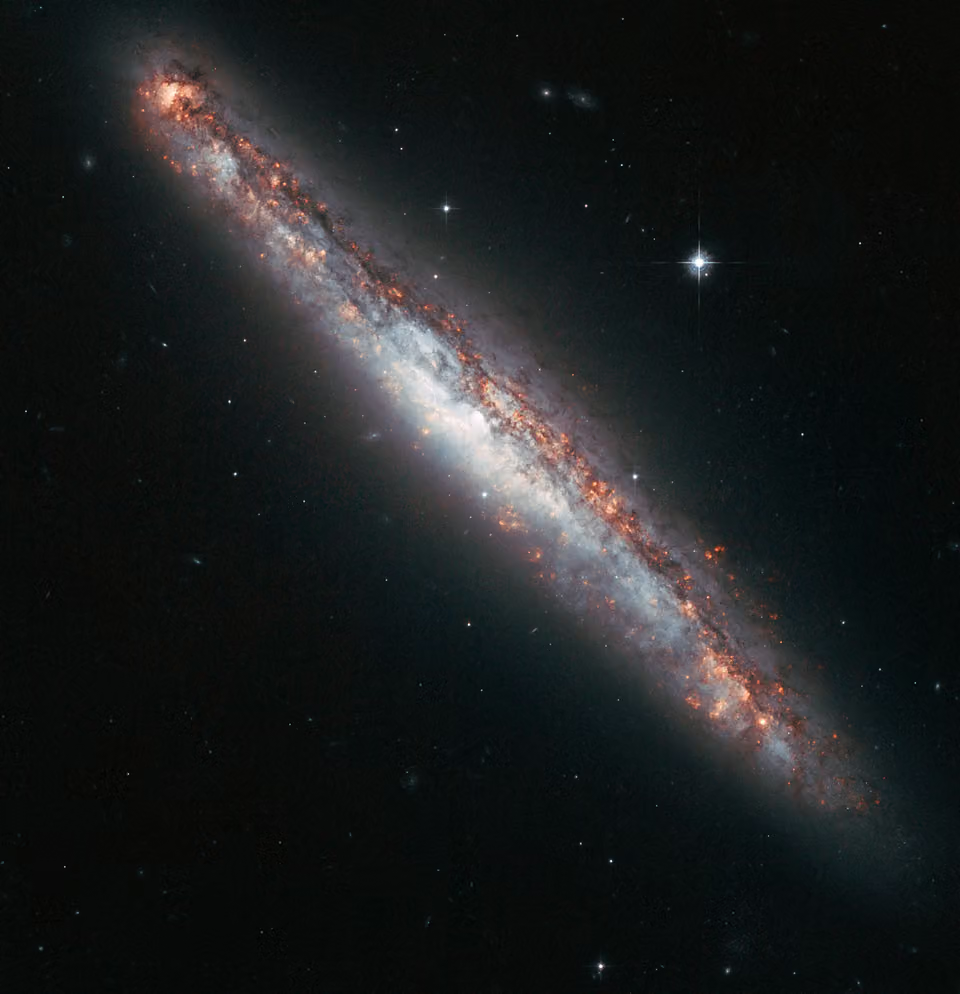
NGC 5775 is a spiral galaxy seen almost exactly edge-on, a thin streak of stars crossed by a dark lane of dust. That angle hides the spiral arms but exposes something a face-on view cannot show: the space above and below the disk. Radio telescopes find a vast halo there, made of electrons moving at nearly the speed of light and spiraling around magnetic field lines, some of which reach several thousand light-years out from the disk. One composite image combines that invisible halo with Hubble's view of the stars, so that both can be examined at once.
The scientific question behind it is where the halo electrons come from. Supernovae in the disk produce huge numbers of them. One hypothesis says winds from busy star-forming regions push and drag those electrons out of the disk into the halo. Testing it means putting the star-forming regions, which Hubble sees in visible light, on the same picture as the radio glow, which no eye can see.
The Hubble layer: stars and hydrogen
The visible-light base comes from the Advanced Camera for Surveys, retrieved from the Hubble Legacy Archive. Two filters were enough. The broadband F625W filter records the general light of stars. The narrowband F658N filter isolates the light of ionized hydrogen, gas heated by hot young stars, so it traces where stars are forming.
Each black-and-white exposure was given a color. The hydrogen frame became reddish, close to how glowing hydrogen looks to the eye. The starlight frame became a bluish-green, and when the two were combined the stars came out the expected cream color. This is the same assignment of colors to filters described in Are the Colors Real?, applied to only two frames.
The ESA/Hubble description of this galaxy adds context. Spirals with high star formation rates, NGC 5775 among them, are surrounded by halos of hot gas that show up in X-rays, and one idea is that supernovae drive hot gas out of the disk, which then cools and falls back like a galactic fountain. NGC 5775 is also in the early stages of a merger: bridges of hydrogen gas connect it to its face-on neighbor, NGC 5774.


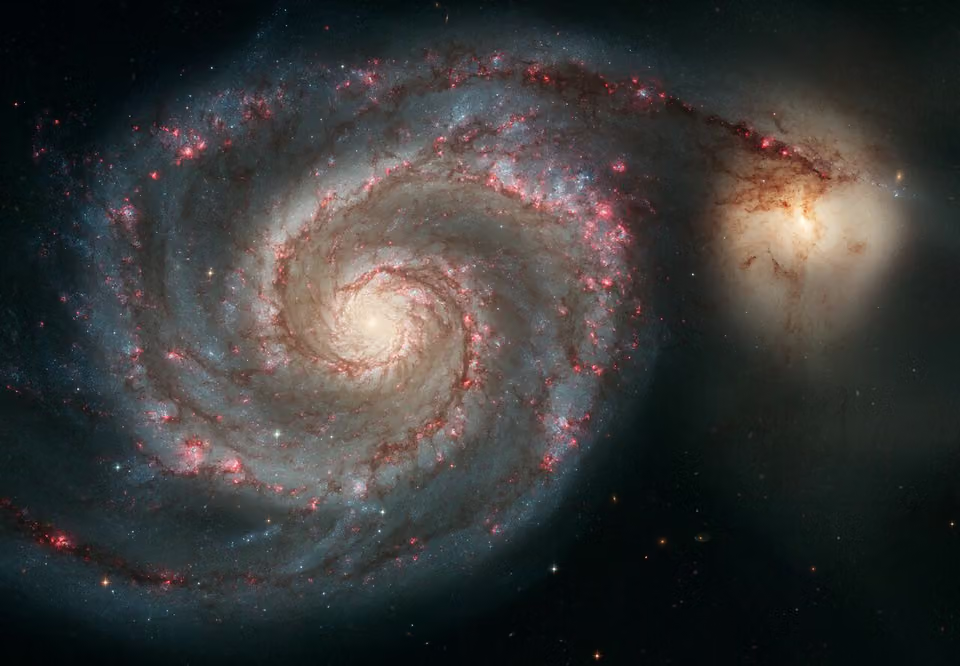
Separating the channels of a familiar face-on spiral, the Whirlpool Galaxy, shows how much a visible-light composite already sorts by component. The longest-wavelength channel picks out the pink star-forming knots and the smooth glow of older stars, while the shortest-wavelength channel sharpens the dust lanes along the inner edge of each arm. The NGC 5775 composite builds on exactly that kind of separation, then adds layers that no optical filter can record.
The radio layer: a halo from the VLA
The radio data come from CHANG-ES, short for Continuum Halos in Nearby Galaxies, a survey that grew out of the upgrade of the Very Large Array, operated by the National Radio Astronomy Observatory. The radio halo of NGC 5775 was given a bluish-gray tone and laid over the Hubble picture of the disk.
Radio telescopes record more than brightness. They can also measure polarization, the orientation in which the electromagnetic waves vibrate. A simple way to picture it: point a thumb at your nose with the index finger raised. The thumb shows the direction the wave travels; the finger shows the orientation of its vibration. Roll the hand and the finger tilts, even to horizontal, without the thumb moving.
Astronomers usually plot polarization as short lines called vectors across the image. In a 2020 study of NGC 5775 published in Astronomy & Astrophysics, the vectors are longest over the disk: the share of radio light with the same orientation, called polarized intensity, is higher in the disk than in the halo.
From vectors to filaments
For the picture, the vectors were joined into continuous lines using an algorithm called line integral convolution. One analogy is drawing in sand: the code is given a random texture, the sand, and the field of vectors, the pattern, and it smears the texture along the flow to produce long filaments.
The filaments are a way of drawing the measured vectors, not a new measurement. A plot of short lines asks the viewer to connect them mentally across the halo; the convolution does that connecting in the image itself, so the overall shape of the field can be read at a glance.
Because the radio-emitting electrons spiral along magnetic field lines, the direction of those filaments follows the magnetic field. Filaments that run parallel to the disk, where polarized intensity is highest, were colored pink. The tips that curve away from the disk and stand perpendicular to it, where polarized intensity is lower, were colored blue. Those colored layers were then combined in the same way as filter images.
Masking the bright radio glow
One problem remained. The radio data are bright enough to swamp the Hubble disk if they are simply added on top. The fix was masking, the image-processing equivalent of holding a hand up to block the Sun so that an airplane beside it can be seen. Masks dimmed the radio layers over the region of the optical disk. As a result, the colored magnetic-field filaments look darker there than in the plain grayscale version.
With the masks in place, all the layers could be combined: star-forming regions, the radio halo, the extended magnetic field lines and the spurs reaching out of the halo. Members of the survey team studying NGC 5775 find that star formation spread across the disk drives a strong wind that widens as it moves outward, and that this outflow helps shape much of what the final picture shows. The same image-making approach has been used for other CHANG-ES galaxies, including NGC 4666.
Questions readers ask
What is a radio halo around a galaxy?
It is a large region of radio emission above and below a galaxy's disk. The radio light comes from electrons moving at nearly the speed of light as they spiral around magnetic field lines, a process that radio arrays like the VLA can detect and map.
Why is NGC 5775 a good target for this kind of image?
It is seen nearly edge-on, so the regions above and below the disk are not hidden behind it. It also forms stars at a high rate, the condition under which halos of hot gas and radio emission are found, and it is interacting with its neighbor NGC 5774.
Which Hubble filters were used for NGC 5775?
Two Advanced Camera for Surveys filters: F625W, a broad red filter that records starlight, and F658N, a narrow filter for the light of ionized hydrogen. The hydrogen layer was colored reddish and the starlight bluish-green, which combine into cream-colored stars.
What do the pink and blue filaments show?
They trace the orientation of the galaxy's magnetic field, derived from radio polarization measurements. Pink marks filaments running along the disk, where the polarized intensity is highest. Blue marks the ends that curve away from the disk into the halo, where it is lower.