How images are made
Hubble Telescope Images and the History of Astrophotography Since 1840
Every Hubble picture rests on 150 years of silver, glass, film and patience that began with one fuzzy daguerreotype of the Moon.
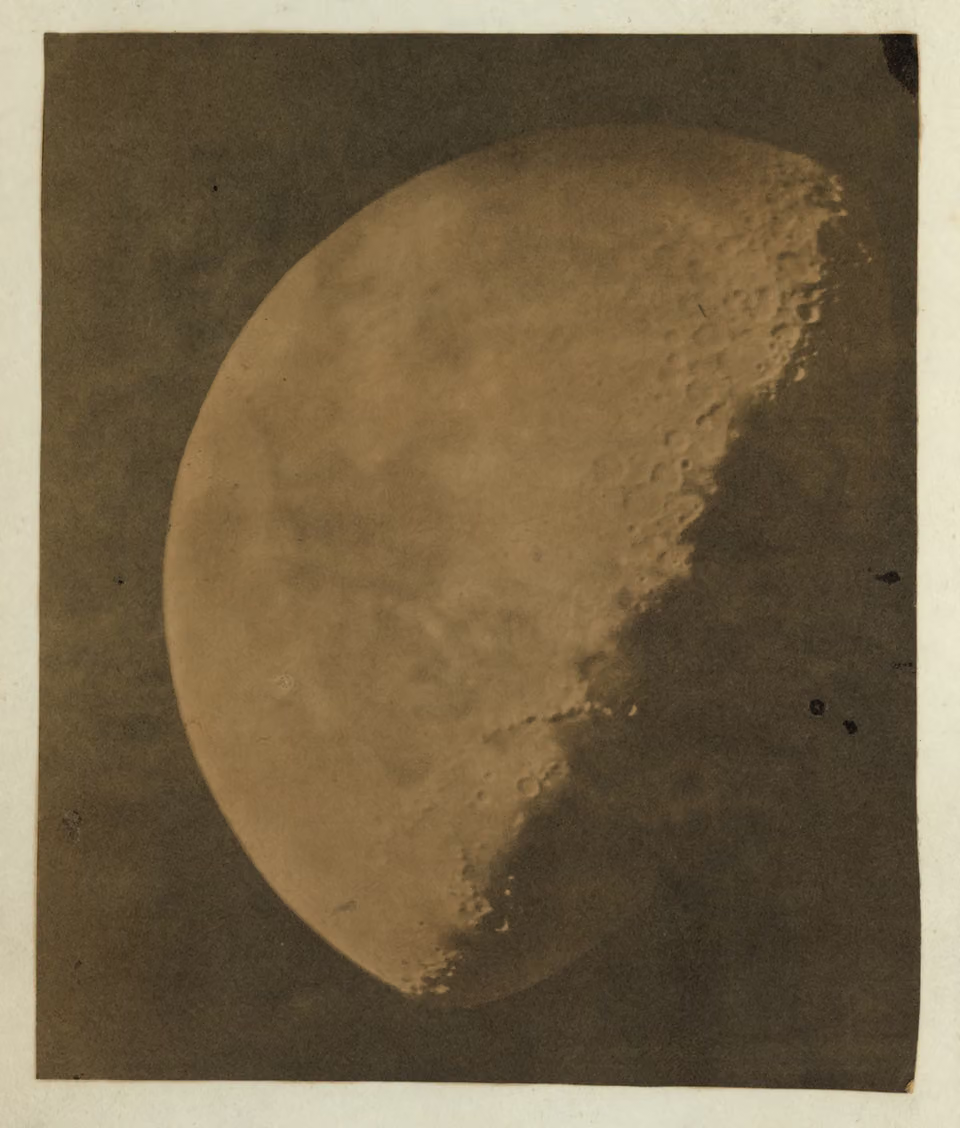
Hubble telescope images look so far removed from the night sky that many people first meet them with suspicion. A dark-sky site shows the Milky Way and thousands of pale points; it does not show glowing pillars of gas or fields crowded with galaxies. The difference is not trickery. It is the result of a long chain of inventions that began in 1840, when John William Draper caught the light of the Moon on a silvered plate, and that runs through glass plates, color film and electronic detectors to a 2.4-meter mirror in orbit.
The history of astrophotography is the story of one idea repeated with better tools: a photograph can collect light for longer than an eye can, and so it records things no observer has ever seen. Each new medium in that story, from the daguerreotype to the charge-coupled device, pushed the limit a little further. Hubble and its successor Webb are the latest entries, not a break with the past. Knowing the earlier steps makes it easier to see why the pictures in the Hubble image artifacts explainer and in the case for what makes Hubble pictures real are measurements first and pictures second.
Two kinds of telescope appear throughout the story. A refractor gathers and focuses light with a large glass lens at the front of a tube. A reflector does the same job with a curved mirror at the back. Refractors led the early decades; reflectors took over once lenses became too heavy to make any larger and too hard to keep in shape, and every large telescope since, Hubble and Webb included, is a reflector.
Before the camera: an eye, a pencil and a notebook
For more than two centuries after the first telescopes were turned on the sky in the early 1600s, the only record of an observation was what the observer wrote or drew. A sketch of a planet or a nebula depended on the skill of the hand, the steadiness of the air that night and what the person at the eyepiece expected to see. Two observers looking at the same object could produce drawings that hardly agreed.
That changed when light itself could be made to leave a permanent mark. Early experiments with light-sensitive materials produced images that faded or darkened within a short time. The breakthrough came in 1839 with the daguerreotype, named for Louis Daguerre, who built on earlier work with Joseph Nicéphore Niépce. A silver-coated copper plate was made sensitive with iodine, exposed in the camera and then developed over heated mercury, which brought out the latent image. In the same period the English astronomer John Herschel gave the new art its name: photography, from the Greek for writing with light.
The first astronomical photographs: the Moon, a star and the Sun
The first astronomical photographs went after the brightest targets available, because the early plates needed a great deal of light. In 1840 John William Draper fixed an image of the Moon on a daguerreotype, using a reflecting telescope with a mirror about 5 inches (13 centimeters) across. The exposure lasted around twenty minutes. That length matters more than the picture's sharpness. No eye accumulates light for twenty minutes; a plate does, and that one property is the thread that runs from Draper's Moon to the Hubble telescope images of distant galaxies.
Ten years later the target was a star. At Harvard College Observatory, William Cranch Bond and the photographer John Adams Whipple recorded Vega in 1850, the first star ever caught on a plate. They worked with the observatory's Great Refractor, a lens telescope 15 inches across. Whipple went on to make a series of lunar daguerreotypes there, including one dated February 26, 1852. The print at the top of this page comes from another of his Moon plates, made in March 1851.

The Sun was the third early subject, and it suited a new process better than the daguerreotype did. In 1851 the English sculptor Frederick Scott Archer introduced the wet collodion plate: a sheet of glass coated with a sticky, light-sensitive film that had to be exposed and developed while still damp. It was cheaper than a daguerreotype, gave finer detail and, unlike the one-off silver plate, produced a negative from which any number of prints could be made.
For faint objects it had a serious flaw. The plate stopped responding to light as soon as the coating dried, which capped every exposure at a few minutes and forced astronomers to keep a darkroom full of chemicals beside the telescope. For the Sun, which needs only a fraction of a second, that limit did not matter. During the total solar eclipse of July 18, 1860, the English amateur Warren de la Rue used a telescope built for solar work to photograph the eclipse in detail. His plates settled an old argument by showing that the glowing prominences around the eclipsed disk belong to the Sun, not to the Moon passing in front of it.
Around the same time the physicist James Clerk Maxwell proposed a method for color photography: take three black-and-white pictures through red, green and blue filters and combine them. Astronomers would not put the idea to regular use for about a century. Today the same three-filter principle is how most color Hubble images are assembled, as described in how Hubble's colors are chosen.
Dry plates and the first images of nebulae
The next step removed the chemistry from the observatory. In 1871 Richard Leach Maddox proposed a dry plate: glass coated with silver bromide held in gelatin, ready to use straight from the box. In 1879 George Eastman, who later founded Eastman Kodak, perfected a machine to coat the plates in quantity, a direct ancestor of roll film. Dry plates were more sensitive than wet ones, came ready to load and, most important for astronomy, could stay in the telescope for hours.
Long exposures opened the faint sky. In 1880 Henry Draper, the son of the man who had photographed the Moon forty years earlier, made the first photograph of a nebula: a 51-minute exposure of the Orion Nebula on a dry plate. Only the bright core and its brightest stars registered, heavily overexposed. Two years later, in 1882, he returned with an exposure of 137 minutes that showed far more of the cloud's structure.


The pair above spans 126 years of the same target. In 1883 Andrew Ainslie Common photographed Orion with a reflector 36 inches (91 centimeters) across and recorded stars in the region that had never been seen through an eyepiece. In 1885 the brothers Paul and Prosper Henry, working with a 13-inch (33-centimeter) refractor, found faint nebulosity wrapped around the stars of the Pleiades on a long exposure. When they turned the same instrument on the Milky Way, the plates held more stars than anyone could count.
At this point in the history of astrophotography the camera stopped being an experiment; it became the working method of professional astronomy. Observatories began to map the whole sky on glass. The largest collection, at the Harvard College Observatory, holds more than 500,000 plates covering both hemispheres from 1885 to 1995, and it is being digitized so that a century of sky can be searched for stars that changed. Through the late 1800s and early 1900s plates became steadily faster and their grain finer, so the same detail needed less exposure time.
Edwin Hubble, a glass plate and the size of the universe
Telescopes grew to match the plates. Mount Wilson Observatory, above Pasadena in California, was founded in 1904, and in 1917 it completed the Hooker telescope, a reflector with a mirror 100 inches (2.5 meters) across. It remained the largest telescope in the world until 1949.
In the early 1920s astronomers were split over the scale of the universe. One camp held that the Milky Way was the whole of it. The other argued that the faint spirals seen on photographs, then called spiral nebulae, were separate galaxies far beyond it. The question was settled on a glass plate. Using the Hooker telescope, Edwin Hubble photographed the Andromeda spiral on the night recorded on a plate dated October 6, 1923. He first marked a star on it with "N" for nova, then crossed the letter out and wrote "VAR" once he realized it was a Cepheid variable.
Cepheids brighten and fade on a regular cycle, and the length of that cycle is tied to how luminous the star really is. The relationship had been found by Henrietta Leavitt at Harvard, who measured the brightness of stars in the Magellanic Clouds by eye on glass plates. Comparing a Cepheid's true luminosity with how bright it appears gives its distance. Hubble's star, now called V1, placed Andromeda at about 900,000 light-years by the calibration of the day, much farther than any estimate of the Milky Way's size. Modern measurements put it at about 2 million light-years. Andromeda was a galaxy in its own right.

In 1929 Hubble went further. Comparing the distances of nearby galaxies with the speed at which their light showed them moving, he found that they are receding, and that the farther a galaxy is, the faster it moves away. The result, known as Hubble's law, is the evidence for an expanding universe, which implies that the expansion had a beginning. The telescope launched in 1990 carries his name because his glass plates changed the scale of everything astronomers study. In 2011 it was pointed at V1 again, nearly ninety years after the original plate, and followed the star through its cycle.
Color comes to astrophotography
For a century every astronomical photograph was black and white. Color film improved rapidly in the first half of the 20th century, and in 1948 Palomar Observatory in California opened with two instruments that would carry it to the sky: the 200-inch (5.1-meter) Hale telescope and the 48-inch (1.2-meter) Samuel Oschin Schmidt telescope, a wide-field survey camera.
In 1958 William Miller used them to make the first color photographs of the Andromeda galaxy and of several nebulae. His picture of the Ring Nebula, M57, taken with the 200-inch telescope, showed in one frame colors that astronomers had until then only inferred from the physics of glowing gas. The same nebula's appearance through Hubble's cameras is covered on the Ring Nebula page.
In the late 1970s David Malin, at the Anglo-Australian Observatory, went back to Maxwell's method for balanced color: three black-and-white plates exposed through red, green and blue filters, printed and combined into one color image. His 1977 view of the Orion Nebula with the UK Schmidt telescope became a classic. He also used darkroom techniques such as unsharp masking to bring out detail in the bright parts of a nebula without losing the faint parts. Both ideas, separate filtered exposures and careful control of contrast, are still at the heart of how Hubble data is turned into pictures, only now on a computer.
From film to electronic detectors
The single largest change in modern photography was the charge-coupled device, or CCD. Willard Boyle and George E. Smith invented it at Bell Labs in 1969. A CCD is a grid of light-sensitive cells on a silicon chip; each cell converts arriving photons into electric charge, and the charge is read out cell by cell to build a digital image. Within about ten years professional observatories had begun to replace photographic plates with CCDs, and the same technology later put a capable camera in nearly every pocket.
For astronomy in space, electronics were close to a requirement. The idea of a large telescope above the atmosphere was proposed in the 1940s, long before CCDs existed, and early plans had to consider film. One scheme would have dropped exposed film back to Earth in capsules to be caught in mid-air, a method later used by reconnaissance satellites in the 1970s. In the 1960s NASA's Lunar Orbiter spacecraft took a different route: they developed their film on board, then scanned the negatives and radioed the strips home to map landing sites for Apollo, a story told among the early space exploration pictures. The Voyager probes, launched in 1977, used vidicon cameras, vacuum-tube sensors that came before CCDs. A telescope meant to work for decades needed a detector that never ran out of film.
Above the air: how Hubble telescope images became possible
The final obstacle was Earth's atmosphere. Air moves in layers of different temperature, and each layer bends light slightly differently. Starlight that crosses it arrives blurred and shimmering. That turbulence makes stars twinkle, and it explains why observatories are built on high mountains: not to get closer to the stars, but to put as much air as possible below the telescope.
The Hubble Space Telescope removed the problem by leaving the atmosphere behind. The space shuttle Discovery launched it on April 24, 1990, and released it into orbit the next day, about 340 miles (547 kilometers) above the ground. That height is trivial compared with the distance to any star; Hubble does not see better because it is closer. It sees better because nothing stands between its 2.4-meter mirror and the sky, and because above the air it can also record ultraviolet light that never reaches the ground. Its cameras cover wavelengths from 115 to 2,500 nanometers, from the ultraviolet through the visible into the near-infrared.
Hubble's first image, of the star cluster NGC 3532, was taken on May 20, 1990. Soon afterward the mirror was found to have a flaw in its shape, and the first servicing mission in December 1993 installed corrective optics. Astronauts returned four more times, in 1997, 1999, 2002 and 2009, each time replacing worn parts and fitting newer cameras. The limits of the telescope's sharpness, even with perfect optics, are explained in what angular resolution means for Hubble.
Hubble telescope images that changed astrophotography
Three pictures from Hubble's first fifteen years show how the old techniques were carried into orbit.
In 1995 the Wide Field and Planetary Camera 2 photographed three columns of gas and dust in the Eagle Nebula through narrowband filters for oxygen, hydrogen and sulfur. Combined in Maxwell's way, the frames became the Pillars of Creation, one of the most reproduced images in science. The stepped black notch in one corner comes from the camera's layout of four detectors. The full story, including the 2014 revisit, is on the Eagle Nebula page.
In December 1995 the same camera stared at a tiny, apparently empty patch of sky for ten days. The Hubble Deep Field, released on January 15, 1996, showed several hundred galaxies never seen before, some nearly four billion times fainter than the limit of the human eye. It was Draper's twenty-minute idea taken to its extreme. In 2004 the Hubble Ultra Deep Field, made with the newer Advanced Camera for Surveys and released on March 9, went deeper still and showed nearly 10,000 galaxies in a field one-tenth the width of the full Moon.
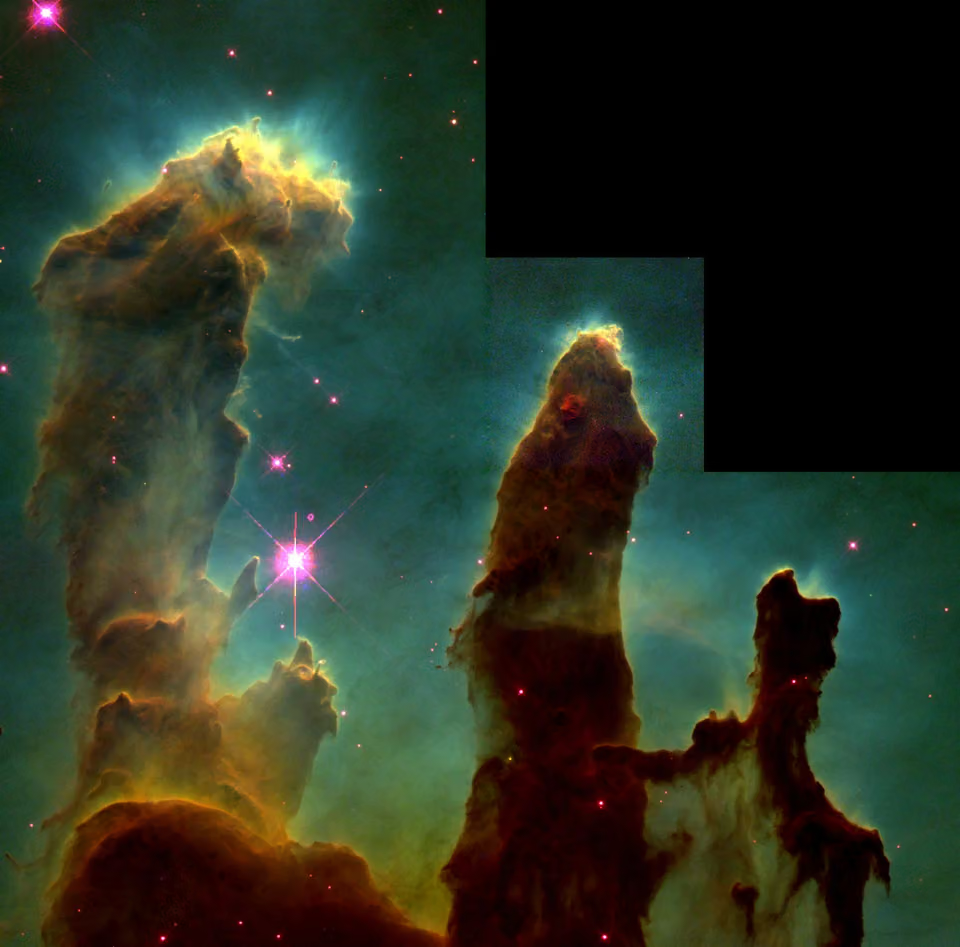
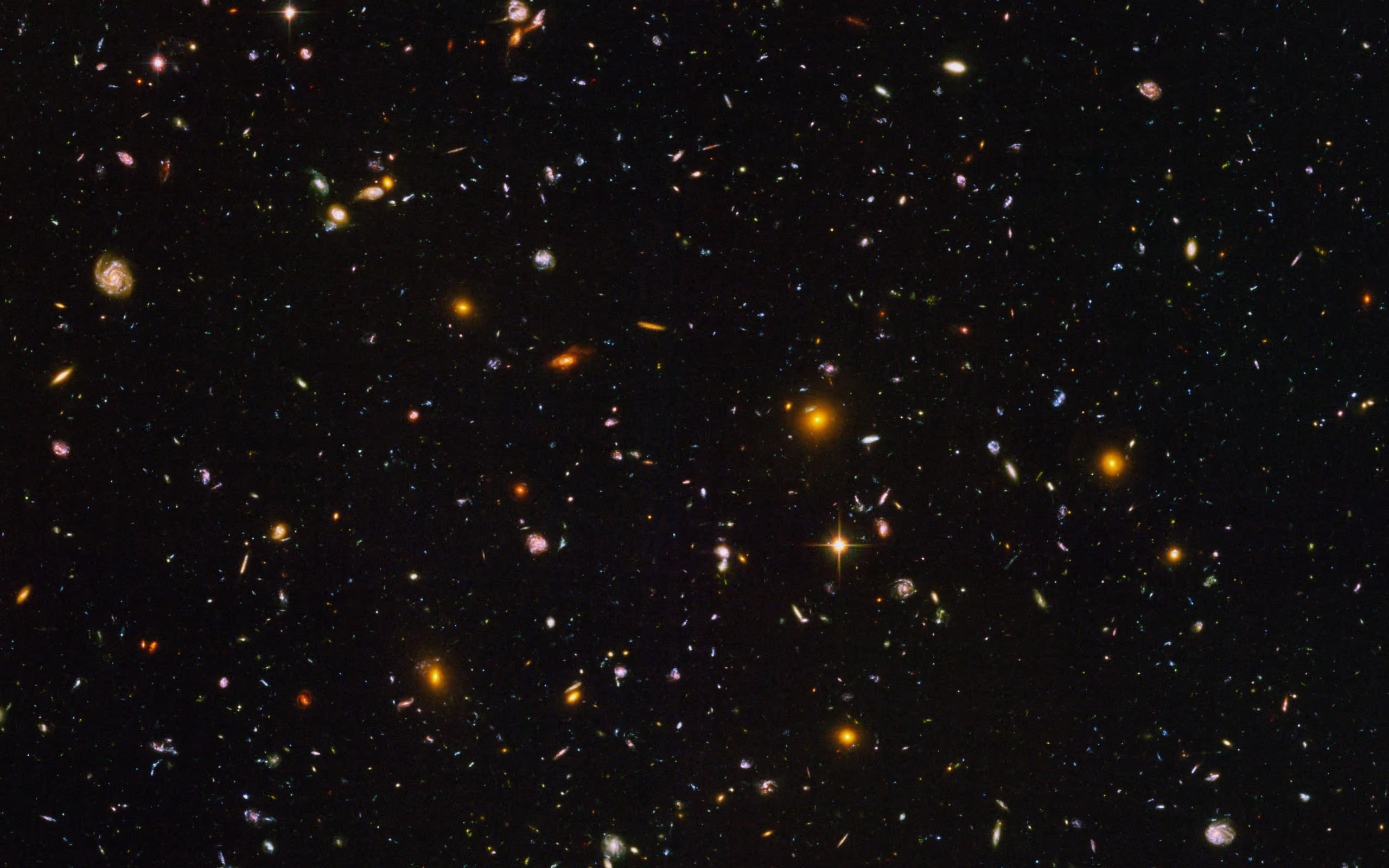
What these Hubble telescope images share with Henry Draper's Orion plate is method more than appearance: long exposures, separate filters, careful calibration and a final step where the data are turned into a picture someone can read. What is new is precision. Every frame carries a record of exactly which filter, detector and exposure produced it, so any published image can be traced back to its raw data.
Webb and the infrared chapter of the history
The James Webb Space Telescope launched on December 25, 2021. Its primary mirror is 6.5 meters across, built from 18 hexagonal gold-coated segments that unfolded in space, and it works from a point about 1.5 million kilometers (1 million miles) from Earth, known as the second Lagrange point. Webb observes mainly in infrared light, longer wavelengths than Hubble's cameras were built for, which lets it see through dust and catch light from the most distant galaxies, stretched toward the red by the expansion that Edwin Hubble discovered.
Webb's first deep field, released on July 12, 2022, shows of the galaxy cluster SMACS 0723, recorded with the Near-Infrared Camera through six filters between 0.9 and 4.44 micrometers. None of those wavelengths is visible to the eye, so each filter is given a color, the same principle Malin applied to his three plates. How the telescope's segments were brought into alignment before that picture could be taken is covered in Webb's first selfie.

A timeline of telescope size in astrophotography
Bigger mirrors gather more light, but the chart below shows that aperture alone does not explain the leap in quality. Hubble's mirror is smaller than the Hale telescope's, which opened in 1948. Location did the rest.
How this chart was made
The figures are the nominal diameters usually quoted for each instrument, converted from inches where the original was specified that way and rounded to two decimals; the Hubble and Webb values are NASA's. The chart compares light-gathering size only. It leaves out exposure time, detector sensitivity and the blurring of the air, which is where the space telescopes gain most.
Questions readers ask
What was the first astronomical photograph?
The first successful astronomical photograph is credited to John William Draper, who recorded the Moon on a daguerreotype in 1840. He used a reflecting telescope with a mirror about 5 inches across and exposed the plate for around twenty minutes. The image was crude by later standards, but it proved that a plate could record a celestial object, and that a long exposure could build up light in a way the eye never does.
Who took the first photograph of a star?
The first photograph of a star was made at Harvard College Observatory in 1850, when William Cranch Bond and the photographer John Adams Whipple recorded Vega with the observatory's Great Refractor. Vega was a sensible choice: it is one of the brightest stars in the northern sky, and the daguerreotype process of the time needed every bit of light a telescope could deliver to leave a visible trace on the plate.
When was the first nebula photographed?
Henry Draper made the first photograph of a nebula in 1880, a 51-minute exposure of the Orion Nebula on a dry plate. It showed only the bright core and a few heavily overexposed stars. In 1882 he exposed another plate for 137 minutes and captured much more of the cloud. Andrew Ainslie Common followed in 1883 with a larger reflector and recorded stars in the region that observers had never seen.
Why did dry plates matter so much for astronomy?
Dry plates could be exposed for hours. The earlier wet collodion plates stopped working as soon as their coating dried, which limited exposures to minutes and meant mixing chemicals at the telescope. A dry plate came pre-coated, was more sensitive, and kept collecting light all night. That combination made it possible to photograph faint nebulae, crowded star fields and eventually distant galaxies, and it turned photography into the standard tool of professional astronomy.
How did a glass plate prove that other galaxies exist?
In 1923 Edwin Hubble photographed the Andromeda spiral with the 100-inch Hooker telescope and found a Cepheid variable on the plate. Because a Cepheid's pulsation period reveals its true brightness, he could work out its distance. The result placed Andromeda far outside any accepted size of the Milky Way, so the spiral had to be a separate galaxy. The star, V1, was observed again by the Hubble Space Telescope in 2011.
When were the first color astronomical photographs taken?
William Miller produced the first color photographs of astronomical objects in 1958 at Palomar Observatory, using color film with the 48-inch Schmidt telescope and the 200-inch Hale telescope. His subjects included the Andromeda galaxy and several nebulae, among them the Ring Nebula. Later, in the late 1970s, David Malin achieved better-balanced color by combining three black-and-white plates exposed through red, green and blue filters.
Are Hubble telescope images in true color?
Hubble's detectors record only brightness, so every raw frame is black and white. Color comes from taking separate exposures through filters and assigning each a color, a method first proposed by James Clerk Maxwell in the 19th century. When the filters match red, green and blue light, the result is close to natural color. When they isolate a single gas, or record ultraviolet or infrared light, the colors are a chosen code that maps real differences in the data.
Why do Hubble telescope images look sharper than photographs taken from the ground?
Earth's atmosphere blurs starlight because air of different temperatures bends light by slightly different amounts. Hubble orbits about 547 kilometers up, above almost all of that air, so its 2.4-meter mirror can work close to its theoretical sharpness every time. It is not closer to its targets in any meaningful sense. Leaving the atmosphere also lets it record ultraviolet light that the air absorbs before it reaches the ground.
Did Hubble ever use film?
No. Hubble has always used electronic detectors. Film was discussed when a large space telescope was first proposed in the 1940s, including schemes to return exposed film to Earth in capsules or to develop and scan it on board, as NASA's Lunar Orbiters did in the 1960s. By the time Hubble was built, charge-coupled devices and other electronic sensors made it possible to read images out digitally and radio them to the ground.
What is a CCD and why did it replace photographic plates?
A charge-coupled device is a silicon chip divided into a grid of light-sensitive cells. Each cell turns incoming photons into electric charge, and the chip is read out to produce a digital image. Willard Boyle and George E. Smith invented it in 1969. The chip needs no developing, and its output is already a set of numbers ready for a computer.
When was the first Hubble image taken?
The Hubble Space Telescope was launched aboard the space shuttle Discovery on April 24, 1990, and deployed into orbit on April 25. Its first image, of the star cluster NGC 3532, was taken on May 20, 1990. Soon afterward engineers found a flaw in the shape of the primary mirror. Corrective optics installed during the first servicing mission in December 1993 brought the telescope to its intended sharpness.
What are the most famous Hubble telescope images?
The Pillars of Creation in the Eagle Nebula, photographed in 1995 and again in 2014, is probably the best known. The Hubble Deep Field, released in January 1996, and the Hubble Ultra Deep Field of 2004 changed how astronomers picture the early universe. Other widely reproduced views include the Orion Nebula mosaic released in 2006 and the series of Heritage images of nebulae and galaxies made for public release.
How long are the exposures behind a Hubble deep field?
The original Hubble Deep Field was assembled from observations of a single small patch of sky made over ten days in December 1995. The individual frames are short enough to limit cosmic-ray hits and are then combined, so the total time on the target adds up to days. The result shows galaxies nearly four billion times fainter than the faintest objects visible to the unaided eye.
How is Webb different from Hubble?
Webb's mirror is 6.5 meters across, built from 18 hexagonal segments, against Hubble's single 2.4-meter mirror. Hubble orbits Earth and covers ultraviolet, visible and near-infrared light. Webb sits about 1.5 million kilometers away near the second Lagrange point and works mainly in the infrared, which lets it see through dust and detect light from very distant galaxies whose light has been stretched to longer wavelengths.
Where can old astronomical plates and photographs be seen today?
The largest collection of astronomical glass plates is at the Harvard College Observatory, with more than 500,000 plates taken between 1885 and 1995 in both hemispheres. It is being digitized, which allows researchers to search a century of the sky for stars that brightened or faded. Prints of early lunar daguerreotypes, such as Whipple's Moon of 1851, are held by collections including the Library of Congress.
Who was the first astrophotographer?
John William Draper is usually called the first astrophotographer because of his 1840 daguerreotype of the Moon. His son Henry Draper continued the work and in 1880 made the first photograph of a nebula, which makes the Drapers one of the founding families of astronomical photography.