How images are made
Are Hubble Images Real? What Makes Hubble Pictures True Records
Nobody has seen a coronavirus or a helium atom with the naked eye either. Instruments that extend vision do not make what they show unreal.
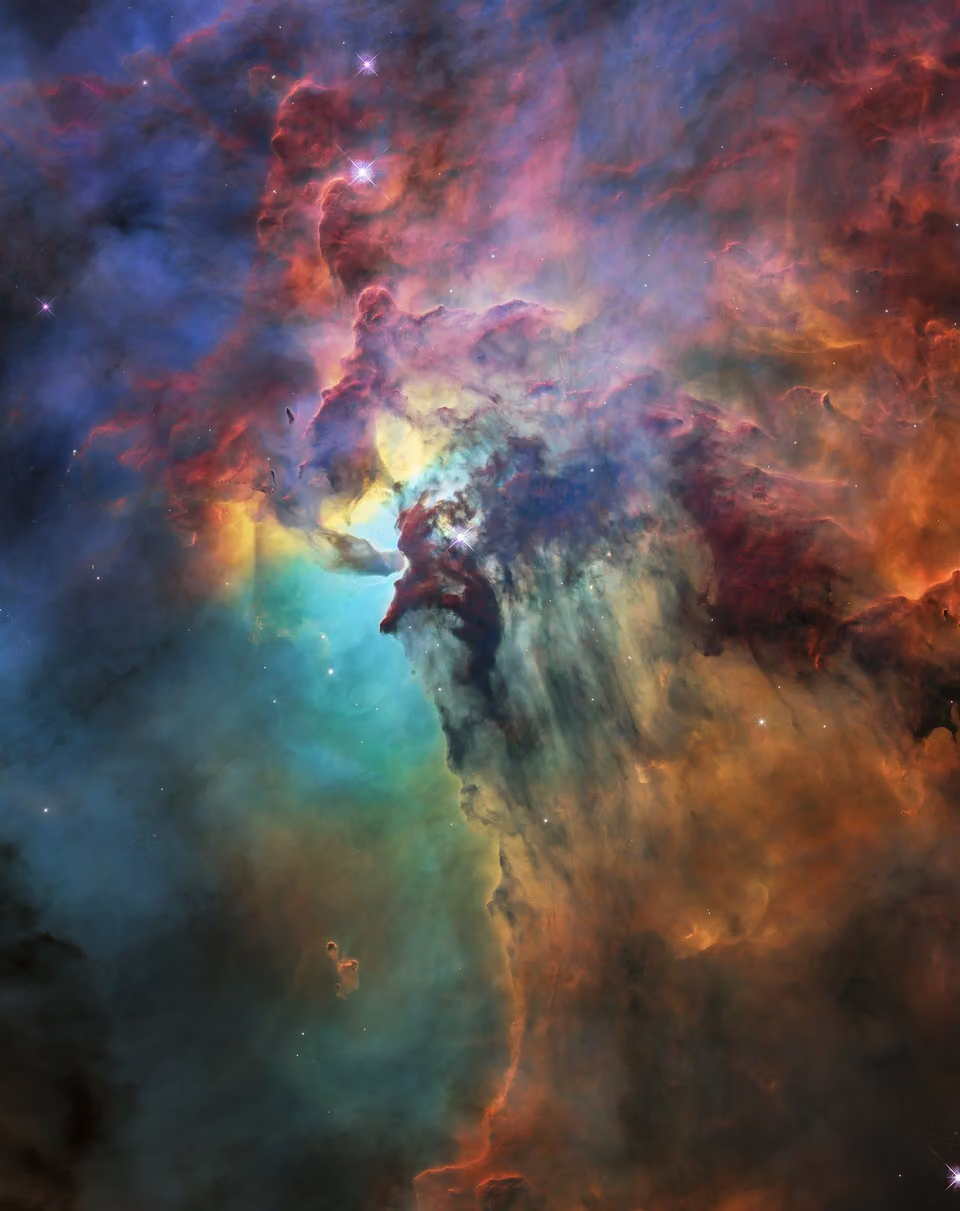
Yes, Hubble images are real. The harder question is what "real" should mean for a picture of something no human eye could ever see as it appears on the screen. Are Hubble Images Real? Image Artifacts Explained covered what gets removed from raw data and why. This article looks at what stays: how Hubble records light, what its colors stand for, and why asking how the scene would appear to a traveler flying there is the wrong test.
A world just as invisible, much closer
Telescopes are not the only instruments that show things beyond human sight. Microscopes, medical scanners and particle detectors have done the same for the very small, and nobody calls those images fake.
The virus that causes COVID-19 is a familiar example. Its particles measure roughly 0.1 to 0.5 micrometers across, roughly one hundredth of the thickness of a human hair, far below what the naked eye can resolve. A helium atom, measured by the extent of its electron cloud, is about 0.1 nanometers wide, a thousand times smaller again, and the nucleus at its center is some 100,000 times smaller than that cloud.
Light itself sets a limit on seeing at those scales. An object smaller than the shortest wavelength used to illuminate it cannot be imaged with that light, which is what drove the invention of the electron microscope: electrons have far shorter wavelengths than visible photons. A cloud chamber goes further still and shows the tracks of subatomic particles, not the particles themselves but their effect on a vapor designed to reveal them. In each case the image is real because it is a faithful record of a measurement, not because an eye could have seen it.
The limits of the human eye
Eyes are tuned to life under the Sun, whose output peaks in the narrow visible band. The retina carries two kinds of light-sensitive cells. Cones, packed around the center of vision, respond to color. Rods, spread across the rest of the retina, respond to faint light but not to color, and give the gray, low-light vision used at night.
That arrangement works against astronomy. Look at a nebula or a galaxy through a telescope from a dark site and it is barely there; observers learn to look slightly to one side so the faint light falls on the rod-rich part of the retina. Even in a large telescope, the light from most nebulae is too weak to trigger the cones, so little or no color appears.
Cameras get around the problem by collecting light for as long as needed. A single 20-second exposure of the Milky Way's core looks much as the scene does to the eye: a faint glow. Fifteen such exposures stacked into five minutes of light lift the noise and bring out the color and structure that were always arriving but too weak for the eye to register. Hubble works the same way with a far larger mirror, far more sensitive detectors and no atmosphere in the way.
How Hubble sees in gray and in color
Hubble's detectors have no color-sensitive cells. They count light across the visible range and somewhat beyond it into the ultraviolet and infrared, and every raw frame is black and white. Color information comes from filters placed in front of the detector, which pass only a chosen band of wavelengths. Broadband filters take in large stretches of the spectrum, medium-band filters less, and narrowband filters a sliver only a few nanometers wide.
Narrowband filters are the key to nebula images. When ultraviolet light from a hot star strips the single electron from a hydrogen atom, the atom is ionized. When it later captures a free electron again, it releases a photon at a precise wavelength, near 656 nanometers in the red part of the spectrum. Oxygen, nitrogen and sulfur do the same at their own wavelengths. A filter centered on one of those lines records where that element is glowing and almost nothing else.
The Lagoon Nebula image at the top of this page was made this way, with Wide Field Camera 3 between February 12 and 18, 2018, through filters for oxygen at 502 nanometers, hydrogen-alpha at 656, nitrogen at 658 and a medium-band filter at 547 nanometers for starlight. The frames were colored in chromatic order: the longest wavelengths red, the middle green, the shortest blue. The result is beautiful, but it is also a map of where each gas is, and so of temperature, density and the reach of the radiation from the bright star Herschel 36 near the center. Are the Colors Real? explains the choice of colors in more depth.
Infrared shows a different, equally real Lagoon

For the same 2018 anniversary, Hubble also photographed the region through two infrared filters. The view changes completely: dust that blocks visible light becomes partly transparent, and the frame fills with stars, most of them in the background, some young ones inside the nebula. Neither version is the true Lagoon and the other a fake. Each is an accurate record of a different band of light, and astronomers need both to understand the region. Peering Through the Dust shows more examples.
Why "would it look like this up close?" misses the point
The objects Hubble photographs are enormous and far away. The whole Lagoon Nebula is about 55 light-years wide and 20 light-years tall, some 4,000 light-years from Earth, and the Hubble frame shows only a region about four light-years across at its heart.
A mountain range makes a useful comparison. Seen through a long lens from far away, it has a clear shape. Walk toward it to climb it and the shape grows, distorts and finally fills the whole view, until the scene around the climber looks nothing like the photograph taken from a distance. The Pillars of Creation in the Eagle Nebula work the same way. Each column is several light-years tall. Anyone close enough to be among them would no longer see towers at all, only gas and dust in every direction.
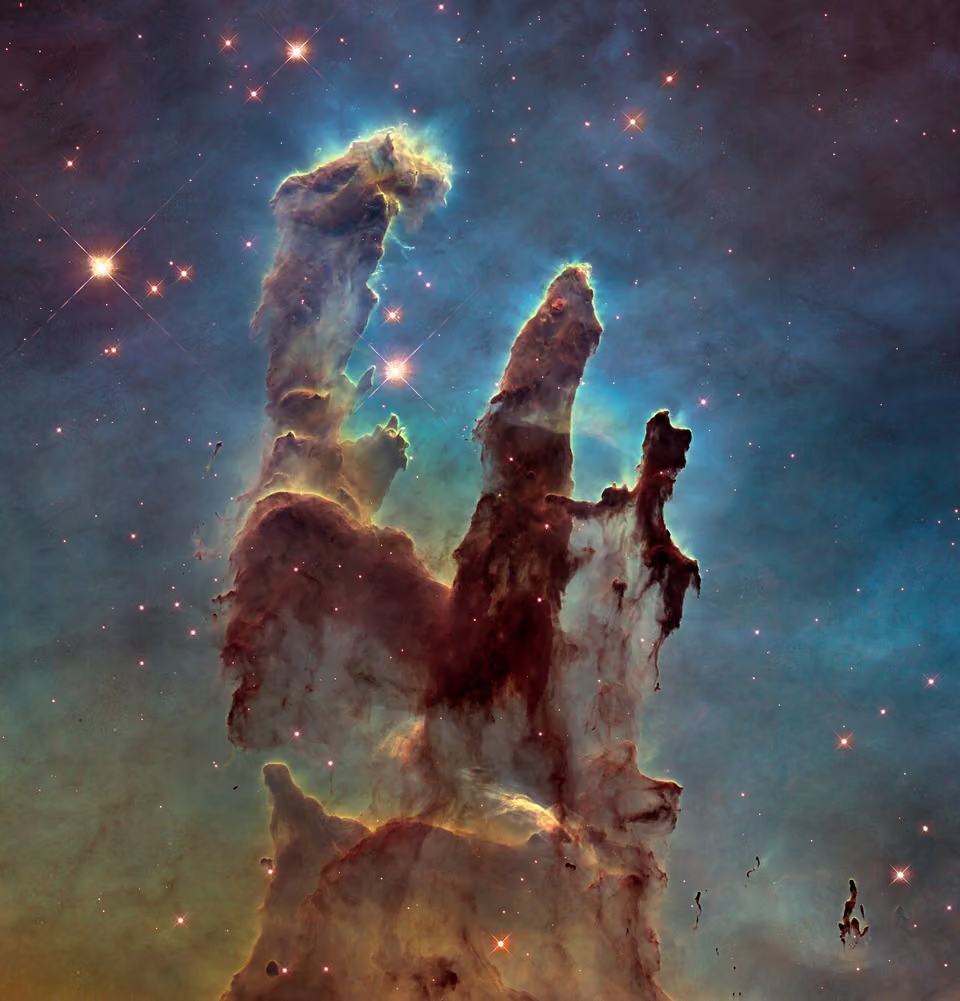
That does not make the photograph false. It is a true record of the light that reached the telescope from one direction and one distance, which is exactly what any photograph of a mountain is. The Eagle Nebula page has the details of that image and its filters.
The same reasoning carries over to the James Webb Space Telescope, which records infrared light from the earliest galaxies and from the atmospheres of planets around other stars. Its images are made with the same logic of filters and chromatic color, and are real in the same sense.
Questions readers ask
Are Hubble images real or fake?
They are real. Every structure in a Hubble image was recorded by the telescope's detectors. Processing assigns colors to black-and-white filter images and removes instrument artifacts, but it does not invent features. The colors stand for wavelengths of light, often beyond what the eye can see.
Would a nebula look like the Hubble picture to the naked eye?
No. Nebulae are too faint to trigger the color-sensitive cones in the eye, so even through a large telescope they appear as dim gray glows. Hubble collects light for long periods and records wavelengths and details the eye cannot register.
Why are Hubble's raw images black and white?
Its detectors measure how much light hits each pixel, not its color. Filters in front of the detector select a band of wavelengths for each exposure, and the color image is built afterward by combining several filtered exposures, each assigned a color.
What does the red color in nebula images usually mean?
Often hydrogen. Ionized hydrogen glows strongly at about 656 nanometers, a deep red. In images that use several narrowband filters, though, the colors follow wavelength order, so in some palettes hydrogen is shown green to separate it from sulfur or nitrogen.