How images are made
Apollo Moon Photos: The Evidence in the Pictures That They Are Real
One light source, a black sky without stars and dust that falls like nothing on Earth: the Apollo pictures carry their own proof.
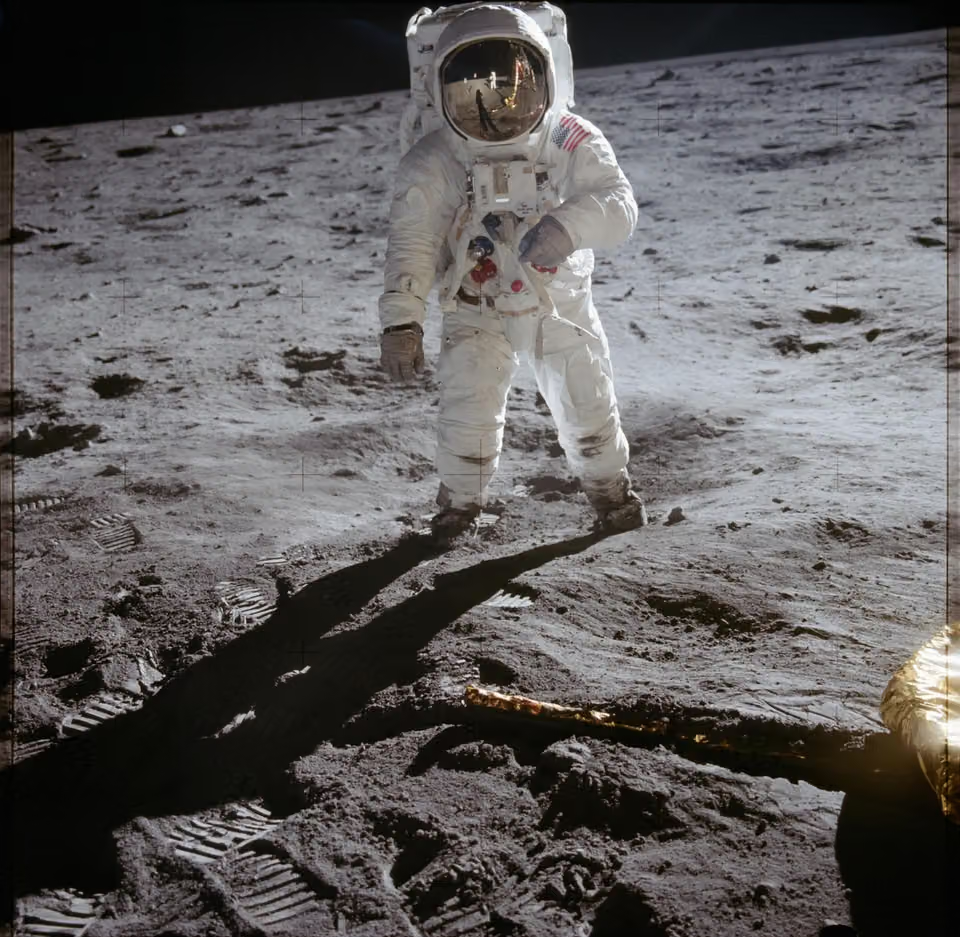
On July 20, 1969, about a billion people watched the first human step onto the Moon. Five more landings followed by the end of 1972. Ever since, a persistent claim has held that the landings were staged, and much of the supposed evidence comes from the astronauts' own photographs, scrutinized frame by frame for signs of trickery. Looked at with an understanding of photography and physics, those same pictures point the other way.
The scale of the alleged hoax
Some numbers frame the problem. Around 400,000 people worked on the Apollo program, and all of them would have had to keep a secret for half a century. Scientists worldwide have studied the returned Moon rocks, and all of them would have had to be fooled. The astronauts took roughly 5,000 photographs on the lunar surface and shot hours of moving film and television. Every frame would have had to survive the scrutiny it has received since.
Modern films can fabricate dinosaurs and alien worlds with computer graphics that control every light and movement. That technology did not exist in the 1960s. The landmark effects film of the decade, 2001: A Space Odyssey, released in 1968, used painstaking optical printing; its budget for effects has been put at the equivalent of about 40 million dollars today, with each shot going through around ten laboratory steps.
The wrong-looking Moon in the movies
A popular version of the hoax story says the director of 2001 secretly filmed the landings. A side-by-side comparison settles it. The film's lunar landscape is jagged, with sharp peaks, as space art of the 1950s imagined it. The real Moon looks nothing like that. Billions of years of micrometeorite impacts have worn its mountains into smooth, rounded mounds, and the Apollo photographs show that soft terrain at every site. The film also made no attempt at lunar gravity; its actors walk on the Moon with ordinary earthbound steps.
A joke among fans of the film runs that the director did fake the landings, but as a perfectionist he insisted on shooting on location.
Gravity at one-sixth
The motion in the Apollo footage is the hardest thing to fake. Astronauts bound across the surface in long, slow hops. Dust kicked up by boots and rover wheels flies out in clean, long arcs and drops straight back, with no air to hold it as a cloud. When the Apollo 16 ascent stage lifted off, the rover's camera recorded scraps of foil blown away from the descent stage on similar trajectories. Alan Shepard hit golf balls on Apollo 14. The lunar rover bounced and threw up plumes of dust that behaved exactly as they should in one-sixth of Earth's gravity.

The clearest demonstration came on Apollo 15. David Scott held a geological hammer in one hand and a feather in the other and let go of both at once. In the vacuum, with no air resistance, they fell at the same slow rate and hit the ground together, as Galileo had predicted. Reproducing all of this convincingly in 1969 would have required computers and animation software that would not exist for decades.
One light source, no studio
Many hoax claims center on lighting. Every Apollo photograph is consistent with a single, very bright light source: the Sun. A studio set lit for film typically keeps a contrast ratio of around 3 to 1 between the brightest and darkest parts of a frame. Photographs on the lunar surface show at least 20 to 1. Where shadowed areas look softly lit, the extra light is sunlight bouncing off the bright lunar ground. In wide panoramas, the shadows all run toward a single vanishing point on the horizon, which is what one distant light produces.
A soundstage would have betrayed itself in other ways. Shot outdoors in a desert, the shadows would have swung around during each long moonwalk as the Sun crossed the sky; the Moon rotates so slowly that the Sun angle barely changes over a few hours. The blue sky would have had to be removed from every frame. And the gold-coated visors would have been a liability. Curved mirrors reflect everything in front of them, and a studio's lights, cameras and crew would have appeared in them. A film director would have chosen clear helmets, and even then the floodlights would have shown in the glass.
The missing stars
The most repeated objection is that the Apollo sky has no stars. The landings took place in lunar daytime, and the cameras were set for a brightly sunlit scene, much like the settings for a beach on a sunny day. Those short exposures cannot record faint stars. The same thing happens on Earth: photograph the Moon with a fast shutter and the stars around it vanish.

If stars had shown up in the Apollo pictures, that would have been the real sign of fakery. How exposure, filters and processing decide what any space photograph can record is explored in What Makes Them Real?
The evidence from orbit
Every Apollo photograph is archived and available to the public, including through the Apollo Lunar Surface Journal. Crafting thousands of fake images would also have made no sense; a few dozen would have served any propaganda purpose.

NASA's Lunar Reconnaissance Orbiter has since photographed all of the Apollo landing sites from lunar orbit. Its pictures show the descent stages, the experiment packages and the paths trodden by the astronauts. Hubble cannot see them from Earth orbit; the reason is explained in Angular Resolution and What Hubble Can't See.
Questions readers ask
Why are there no stars in the Apollo photos?
The pictures were taken in bright lunar daylight with short exposures suited to a sunlit landscape. Stars are far too faint to register at those settings. Any camera on Earth behaves the same way when set for a sunny scene.
Could 1960s special effects have produced the Apollo footage?
No. The best effects of the period, such as those in the 1968 film 2001: A Space Odyssey, relied on slow optical printing and still showed a jagged, inaccurate Moon and earthbound walking. Convincing one-sixth gravity, dust trajectories and lighting across thousands of photos was beyond any studio of the time.
Why do the shadows in some Apollo photos look lit?
Sunlight reflects off the bright lunar surface and fills in the shadows a little. That is not a second lamp. All the shadows still point the same way and converge toward one vanishing point, as expected from a single light source, the Sun.
Has anything photographed the landing sites since?
Yes. NASA's Lunar Reconnaissance Orbiter has photographed all six Apollo landing sites from orbit around the Moon, showing the descent stages left behind, the scientific equipment and the trails the astronauts walked.