How images are made
SNR 0509-67.5: The Red Bubble Left by a Supernova, Seen in 3D
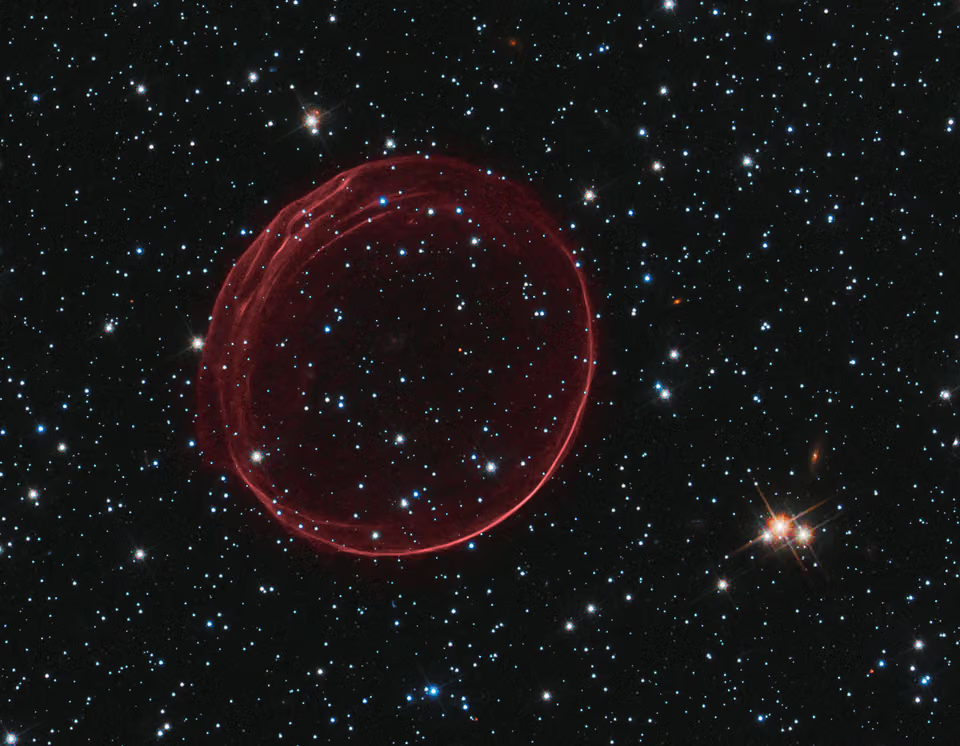
Supernova remnants are usually ragged. This one is a thin, near-perfect shell 23 light-years wide, still smooth after about 400 years.
A supernova is violence on a scale that is hard to picture. In the core of a dying star, runaway nuclear processes release enormous energy in a fraction of a second. The star's material is hurled outward at millions of miles per hour. A shock wave races ahead through interstellar space, followed by a blast of stellar debris heated to millions of degrees. Over hundreds to thousands of years the wreckage spreads into a cloud tens of light-years across: a supernova remnant.
What a remnant usually looks like
Since the energy comes from one point, the blast should start out roughly spherical. Almost everything after that pushes it out of shape. Rotation can make a star lopsided. It may have a companion star or be ringed by a disk of gas and dust. The space it explodes into is uneven, with pockets of denser and thinner gas at different pressures. Each of these distorts the expanding debris a little, and the combined effect is usually a lumpy shape filled with shredded filaments.

N49, also in the Large Magellanic Cloud, shows the expected result. Its debris is a bright, fractured tangle of sheets and ribbons, roughly rounded overall but broken up in detail. Also catalogued as DEM L 190, it is the wreck of a massive star whose explosion would have been visible from Earth thousands of years ago. Material like this is eventually recycled into new stars, and the Sun and its planets were built from similar supernova debris. Remnants in the Milky Way, such as the Veil Nebula, look similar.
A bubble that kept its shape
SNR 0509-67.5 breaks the pattern. Seen in the Large Magellanic Cloud, about 160,000 light-years away, it is a thin shell so smooth and nearly round that it resembles a soap bubble, which earned it the nickname "the red bubble." The red is light from glowing hydrogen, recorded with a filter that isolates it.
The shell measures about 23 light-years across. The explosion that made it happened around 400 years ago, and the bubble is still expanding at more than 18 million kilometers per hour, over 11 million miles per hour. Keeping a near-spherical shape across that size and over four centuries is unusual, and the deviations that do exist are small ripples on the surface. Those ripples may come from slight variations in the density of the surrounding gas, or from fragments of the original explosion pushing from inside.
The picture itself combines two sets of Hubble observations. The Advanced Camera for Surveys imaged the hydrogen shell on October 28, 2006, for a science program. On November 4, 2010, Wide Field Camera 3 photographed the surrounding star field in several filters, so the stars around the bubble could be shown in realistic colors.
Building the visualization
Alongside the still image, a short visualization was made that flies toward the bubble. Its aim was modest: to remind viewers that a Hubble picture is a view of a three-dimensional place, not a flat postcard.
The bubble was modeled as a semi-transparent sphere. The real work went into the stars. Several thousand of them were cut out of the Hubble image one by one, and each was placed on its own small flat panel, a billboard, floating in the model. The camera then makes a gentle fly-in with a small drift to the left. As it moves, near stars slide past faster than distant ones, and with thousands of these reference points the brain reads the scene as deep without any effort. The same parallax principle drives the Lagoon Nebula fly-through described in Deep Dive into the Lagoon.
Distances: statistical and squeezed
Two simplifications keep the visualization watchable. First, the distance of each star is not measured. Distances are assigned at random from a model that matches how stars are distributed in a galaxy, so the population looks right even though no individual star is placed accurately. Second, true distances are far too spread out. Placing stars at their real separations would leave the scene almost empty, so the distances are compressed on a roughly logarithmic scale, bringing far stars closer without changing their order.
Both choices serve the same purpose. The goal is to convey depth to a viewer, and accuracy of position for any single star is traded away to make the three-dimensional structure easy to see. The one thing the visualization does not adjust is the bubble's own shape, which needed no help to surprise anyone.
Questions readers ask
Why is SNR 0509-67.5 so round?
Most remnants are distorted by uneven surroundings, a spinning star or a companion. SNR 0509-67.5 shows only small ripples, a rare degree of symmetry for a blast that is 400 years old and 23 light-years wide. The ripples may come from slight density differences in the surrounding gas or from fragments pushing from inside.
How big and how old is the red bubble?
The shell is about 23 light-years across. Its light shows an explosion that happened roughly 400 years ago, and the shell is still expanding at more than 18 million kilometers per hour.
Why is the bubble red?
The shell was photographed with a filter that isolates light from glowing hydrogen, and that light is shown in red. The stars around it come from separate observations in several filters, combined to show their natural colors.
Are the star distances in the visualization real?
No. Each star was given a distance drawn at random from a model of how stars are spread through a galaxy, and all distances were compressed on a roughly logarithmic scale. The goal is a convincing sense of depth, not an accurate map.