Hubble Heritage Archive · Galaxy
Hoag's Object: Hubble's Image of a Nearly Perfect Ring Galaxy
A ball of old yellow stars, an empty-looking gap, and a ring of blue star clusters 120,000 light-years across, with no obvious cause in sight.
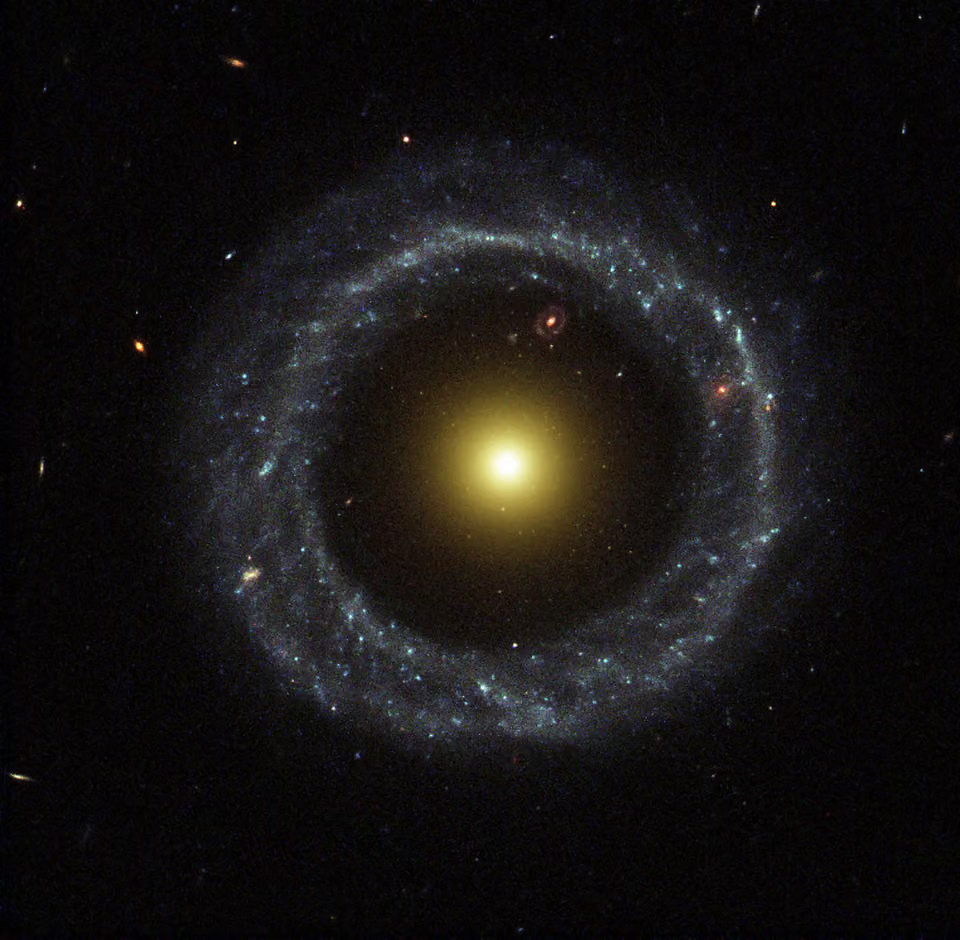
Hoag's Object looks almost too tidy to be real: a round, yellow ball of stars, a dark moat around it, and then a ring of blue light so even that it could have been drawn with a compass. The galaxy lies in Serpens, roughly 600 million light-years from Earth, and the ring measures roughly 120,000 light-years across at its outer edge, slightly more than the width of the Milky Way.
The Hubble Space Telescope photographed it on July 9, 2001, with the Wide Field and Planetary Camera 2, and the Hubble Heritage Team released the picture on September 5, 2002. It shows the ring face-on and in more detail than any earlier photograph of the object.
Two kinds of stars in one galaxy
The colors separate two populations. The yellow nucleus is made mostly of old stars, the kind that have long since used up their brightest, most massive members. The ring is blue because clusters of young, massive stars dominate its light, which are hot and give off most of their light at short wavelengths. At a distance of 600 million light-years Hubble cannot pick out single stars, so each blue knot along the ring is a large cluster, or a group of clusters, shining together.
The numbers make the proportions clearer. Subtracting the inner diameter from the outer one leaves a band of stars about 22,500 light-years wide on each side of the galaxy, far wider than the bright core inside it. And at a distance of 600 million light-years, the light in the Hubble picture left it about 600 million years ago.
Between the core and the ring sits what looks like an empty gap. It probably is not empty. Star clusters too faint to register in the picture may be spread through it, and the processing of the Heritage image was chosen to leave room for faint reddish objects in that zone to show up. The ring itself starts about 75,000 light-years out, at its inner edge, and its clumps are not spaced perfectly evenly around the core.
| Name | Hoag's Object |
|---|---|
| Type | Ring galaxy |
| Constellation | Serpens |
| Distance | About 600 million light-years (180 million parsecs) |
| Ring diameter | About 75,000 light-years at the inner edge, 120,000 light-years at the outer edge |
| Position (J2000) | R.A. 15h 17m 17s, Dec. +21° 34′ 45″ |
| Camera | Wide Field and Planetary Camera 2 |
|---|---|
| Observed | July 9, 2001 |
| Exposure | 3.6 hours |
| Filters | F450W (B), F606W (V), F814W (I) |
| Released | September 5, 2002 |
A second ring in the gap
Look at the gap at about the one o'clock position, just inside the ring. A small object there repeats the design of the galaxy in miniature: a reddish center surrounded by a bluish ring.

It is almost certainly a much more distant ring galaxy, seen through the gap by chance. Galaxies with this shape are rare. One published estimate put Hoag-type systems at about one galaxy in a thousand, so lining up two of them along the same line of sight is a striking coincidence. Its center also looks slightly elongated, unlike the perfectly round core of Hoag's Object, which makes it a cousin of the type more than a twin.
How rings can form
Ring-shaped galaxies can come about in several ways, and Hoag's Object does not fit any of them neatly.
One route is a collision. When a small galaxy plunges straight through the disk of a larger one, it sends a ripple of compressed gas outward, and new stars light up along the expanding wave. The Cartwheel Galaxy is the classic example. In Hoag's Object, though, there is no sign of the galaxy that would have done the plunging.
A second route works from the inside. A bar of stars across the middle of a spiral galaxy, or even an oval-shaped center, can gather gas into a ring at a particular distance. Hoag's Object has neither: its core is unusually round.
The third idea is that the ring is the remains of another galaxy that strayed too close, was torn apart, and settled into orbit around the central ball of stars. New star clusters would then have formed from the captured gas. Some astronomers put that encounter about 2 to 3 billion years ago. The history of these arguments, from 1950 to the Hubble image, is told in the story of Hoag's Object. The captured-material idea links Hoag's Object to polar-ring galaxies such as NGC 4650A, where a ring of gas and stars orbits nearly at right angles to an older disk.
Discovery in 1950
The galaxy is named after the astronomer Art Hoag, who described it in a short paper in the Astronomical Journal in 1950. He noted that the smoke-ring shape resembled a planetary nebula, the glowing shell thrown off by a dying Sun-like star, but he soon set that idea aside and argued that the object was most likely a galaxy. Spectroscopic observations in the 1970s confirmed it and gave a distance close to the modern value.
The Hubble image
The picture combines exposures through three broadband filters: F450W in blue light, F606W in visible light and F814W in the near-infrared, with a total exposure time of 3.6 hours. The contrast between the yellow core and the blue ring is real in the sense that it follows the colors of the starlight, though the balance was set by the image processors, as in every Hubble color picture. Are the Colors Real? goes into how three such exposures are combined.
Background galaxies are scattered across the frame, some of them visible through the ring itself.
Questions readers ask
How big is Hoag's Object?
The ring spans about 120,000 light-years at its outer edge and about 75,000 light-years at its inner edge. That makes the whole galaxy slightly larger than the Milky Way. The yellow nucleus is far smaller, and the dark-looking gap between the two may contain faint star clusters.
Why is the ring of Hoag's Object blue?
The ring is full of clusters of young, massive stars. Such stars are very hot and shine most strongly in blue and ultraviolet light, so they dominate the color of the ring. The core is yellow because it is made mostly of older, cooler stars.
What is the small ring inside Hoag's Object?
At about the one o'clock position in the gap there is a small reddish object with a bluish ring around it. It is probably a far more distant ring galaxy that happens to lie behind Hoag's Object along the same line of sight, not part of the galaxy itself.
Who discovered Hoag's Object?
Art Hoag reported it in 1950. He first compared it with a planetary nebula, then concluded it was probably a galaxy. Observations in the 1970s confirmed that it lies far outside the Milky Way, and the object has carried his name ever since.