Hubble Heritage Archive · Planetary nebula
NGC 3132, the Southern Ring Nebula: Hubble's 1998 Image and Its Colors
A shell of gas half a light-year wide around two stars, the fainter of which made it, colored by Hubble's Heritage Team to show how hot each layer is.
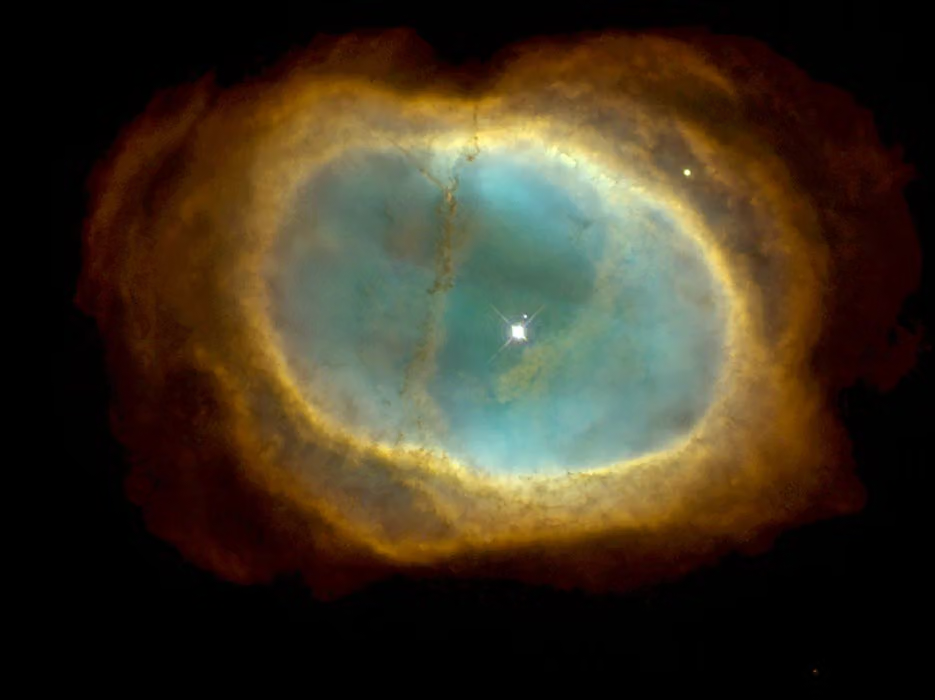
Amateur astronomers in the Southern Hemisphere know NGC 3132 by two nicknames, the Eight-Burst Nebula and the Southern Ring. It is an expanding cloud of gas around a dying star, about 2,000 light-years away in the constellation Vela and nearly half a light-year across. The gas is moving outward from the center at about 9 miles (15 kilometers) per second.
The Hubble image was one of the very first releases of the Hubble Heritage Project, published on November 5, 1998. It used archival data taken three years earlier, on December 7, 1995, by a team from the Jet Propulsion Laboratory and the Wide Field and Planetary Camera 2 Investigation Definition Team.
Two stars, one culprit
Near the center of the nebula Hubble shows two stars: a bright white one, and to its upper right a fainter companion. A third star near the edge of the nebula is unrelated and simply lies along the same line of sight.
The faint partner is the one that made the nebula. It is now smaller than the Sun but extremely hot, and the ultraviolet light pouring from its surface makes the surrounding gas glow by fluorescence. The bright star is younger in evolutionary terms. In the future it will probably throw off a planetary nebula of its own.
Like all planetary nebulae, NGC 3132 has nothing to do with planets. The name dates from the round disks many of these objects show in small telescopes. They are shells of gas ejected by stars near the ends of their lives, and the Sun may produce a similar one some 6 billion years from now.
| Names | NGC 3132, Eight-Burst Nebula, Southern Ring Nebula |
|---|---|
| Type | Planetary nebula |
| Constellation | Vela |
| Distance | About 2,000 light-years (590 parsecs) |
| Diameter | About 0.4 light-years |
| Position (J2000) | R.A. 10h 06m 58.54s, Dec. −40° 26′ 00″ |
| Camera | Wide Field and Planetary Camera 2 |
|---|---|
| Observed | December 7, 1995 |
| Exposure | 1 hour |
| Released | November 5, 1998 |
Colors that mean temperature
The original observers used five narrowband filters, each tuned to the light of one chemical element in a particular state. Each element responds to different physical conditions in the nebula, so the five grayscale images differ noticeably from one another. For the Heritage version, the team assigned the three primary colors of light to three of them.
| Filter | What it records | Shown as |
|---|---|---|
| F502N | Doubly ionized oxygen [O III], the hottest gas | Blue |
| F656N | Hydrogen-alpha | Green |
| F658N | Singly ionized nitrogen [N II], the coolest gas | Red |
The choice was made to show temperature. Blue marks the hottest gas, confined to the inner region; red marks the coolest gas, at the outer edge; and yellow appears where nitrogen and hydrogen glow together. The layers separate because each element needs a different amount of ionizing radiation to shine in these lines, and that radiation weakens with distance from the hot central star. Color here follows excitation energy, which depends on both the gas temperature and the amount of ultraviolet light reaching it. Are the Colors Real? explains the general principle behind such mappings.
The Hubble image also shows a set of filaments, among them one long band that wraps across the nebula like a waistband. They are made of dust particles that condensed out of the expanding gas, rich in elements such as carbon. In time those grains may be built into new stars and planets.
A hot spring on Earth
The release paired the nebula with an unexpected look-alike: Grand Prismatic Spring in Yellowstone National Park. The spring has a deep blue center ringed by bands of yellow, green and red-orange, and the order of those bands has a similar cause. Its colors come from different species of heat-loving bacteria, each living in a narrow range of water temperature as the water cools away from its source. The red-orange types survive in the coolest water at the edge, and the central pool is too hot for any of them. In NGC 3132 the colors trace atoms instead of bacteria, but in both cases they map how conditions fall off from a hot center.
The Southern Ring in Webb's infrared light
In July 2022 NGC 3132 was among the first images released from the James Webb Space Telescope.

Webb's Near-Infrared Camera showed the pair of central stars in a new light. The nebula's source, barely visible beside the bright star along one of its diffraction spikes, has ejected at least eight layers of gas and dust over thousands of years. The two stars are locked in a tight orbit, and the bright companion has stirred the outflow, giving the rings their jagged, uneven shape. Webb's release put the nebula at about 2,500 light-years. The classic Ring Nebula in Lyra, seen almost pole-on, makes a natural comparison.
Questions readers ask
Why is NGC 3132 called the Southern Ring Nebula?
The nickname, used mainly by amateur astronomers in the Southern Hemisphere, marks it as a ring-shaped planetary nebula of the southern sky, in the constellation Vela. It invites comparison with the Ring Nebula in Lyra, the best-known northern example. It is also called the Eight-Burst Nebula.
Which star made NGC 3132?
The fainter of the two stars near the center. It is smaller than the Sun but very hot, and its ultraviolet light makes the gas glow. The brighter star is less evolved and orbits the source closely, which Webb's 2022 images showed has disturbed the shape of the nebula.
What do the colors in Hubble's NGC 3132 image show?
They show the temperature and excitation of the gas. Blue traces doubly ionized oxygen in the hottest inner gas, green traces hydrogen-alpha, and red traces ionized nitrogen in the coolest outer gas. Yellow marks places where hydrogen and nitrogen both glow.
How big is NGC 3132?
It is nearly half a light-year across, about 0.4 light-years in the measurements published with the Hubble image. At a distance of about 2,000 light-years it ranks among the closest planetary nebulae known. Its gas expands outward at about 9 miles per second.