Hubble Heritage Archive · Galaxy
Polar-Ring Galaxy NGC 4650A: What It Is and How Its Ring Formed
An old, smooth disk of red stars wrapped by a younger, warped ring at nearly ninety degrees, probably the wreckage of a smaller galaxy.
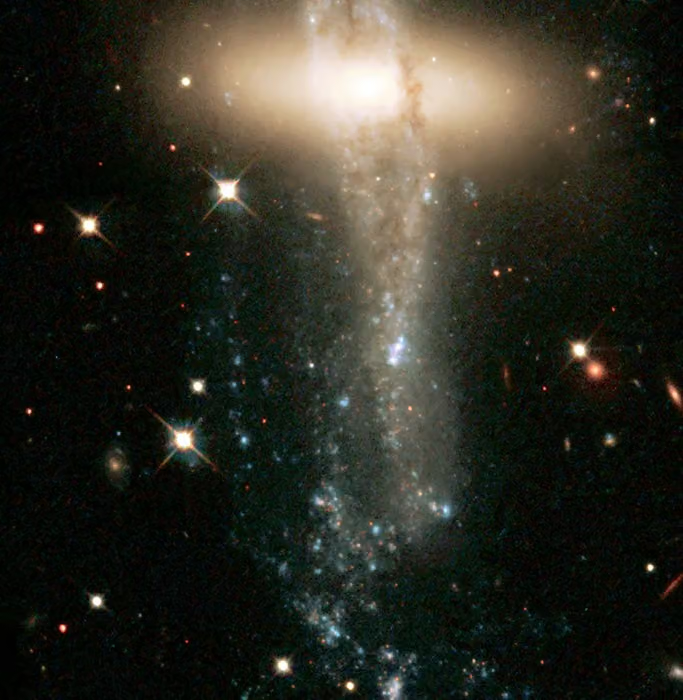
Most disk galaxies have one plane. Their stars, gas and dust circle the center in roughly the same flat layer, like the grooves of a record. NGC 4650A has two. An old, smooth disk of reddish stars turns in one plane, and a ring of gas, dust and young blue stars orbits almost at right angles to it, passing over the poles of the inner disk. Galaxies built like this are called polar-ring galaxies.
NGC 4650A lies about 130 million light-years away in Centaurus. When Hubble photographed it in April 1999, it was one of only about 100 known polar-ring galaxies, and the reason such a structure exists at all was still not fully understood.
Two galaxies in one
The inner disk is the older component. In Hubble's image its bright central concentration looks smooth and regular, a sign of a dense system of old stars with little gas or dust left in it. It was probably once a typical medium-sized galaxy, since altered by whatever built the ring.
The ring is everything the disk is not. It contains gas and dust, the raw materials of star formation, and it is forming stars. Bright bluish clumps, most prominent in its outer parts, are regions full of luminous young stars. Where the ring crosses in front of the inner disk, its dust blocks the light behind and forms dark lanes across the center. The ring spans about 60,000 light-years.
It is not flat. No regular spiral pattern stands out in it, and young stars sit beneath the main band on one side and over it on the other. The ring is bent, not flat.
| Name | NGC 4650A |
|---|---|
| Type | Polar-ring galaxy |
| Constellation | Centaurus |
| Distance | About 130 million light-years (40 megaparsecs) |
| Diameter of the polar ring | About 60,000 light-years (18 kiloparsecs) |
| Brightness | About magnitude 14 |
| Position (J2000) | R.A. 12h 44m 52s, Dec. −40° 42′ 52″ |
| Camera | Wide Field and Planetary Camera 2 |
|---|---|
| Observed | April 7-9, 1999 |
| Exposure | 5.6 hours |
| Filters | F450W (B), F606W (V), F814W (I), chromatically ordered |
| Released | May 6, 1999 |
How a polar ring may form
The leading idea, at the time of the Hubble image, was a collision. Probably more than a billion years ago, a smaller galaxy ventured too close to a larger one. The smaller galaxy was badly damaged or destroyed. Its gas was stripped away and captured by the larger galaxy, and that captured gas settled into a fresh ring of gas, dust and stars orbiting nearly perpendicular to the old disk. The larger galaxy survives as the spinning inner disk of old, red stars.
A captured ring at a steep angle fits what Hubble shows: an old, gas-poor center, a young, gas-rich ring, and a ring that is still warped, as if it has not fully settled. Determining the typical ages of the ring's stars was one of the first goals of the guest astronomers on the observation, because those ages would date the event that built it.
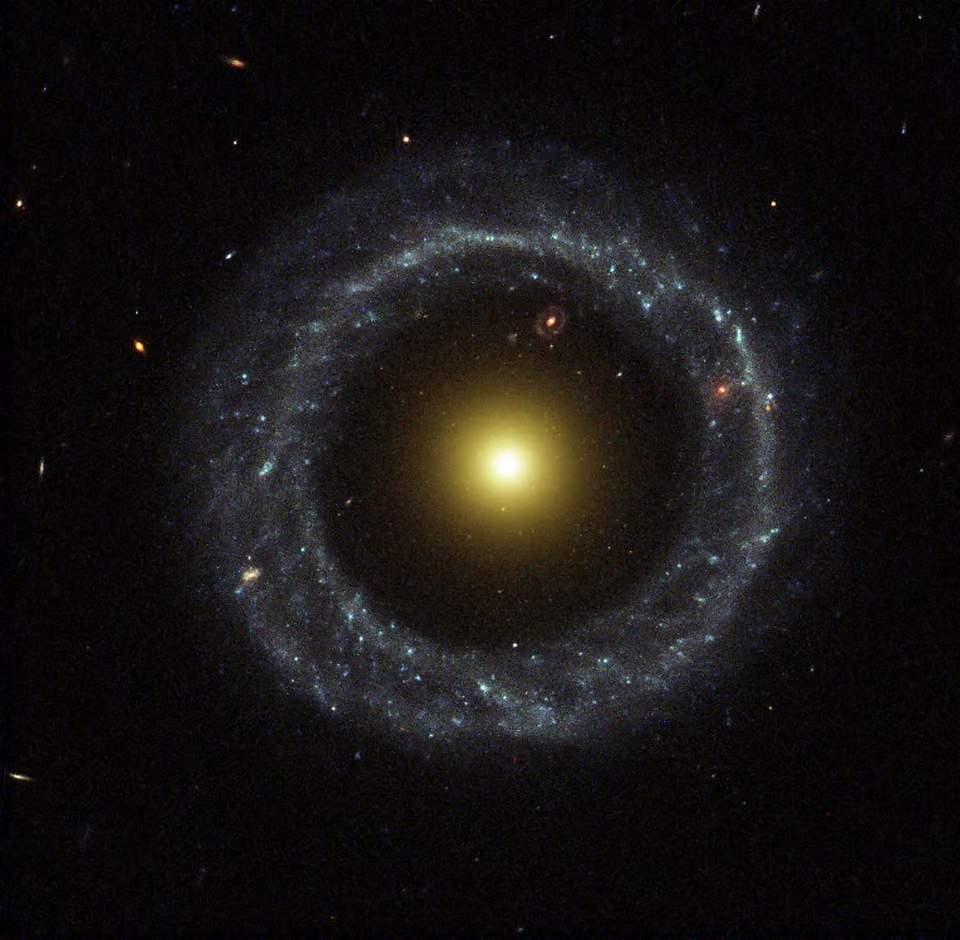
The same capture idea has been applied to other unusual ring galaxies. Hoag's Object has a nearly perfect ring around a round yellow core, and one explanation is a shredded companion caught in orbit, possibly a polar ring seen face-on. Its case is less clear-cut, and the history of Hoag's Object follows the debate over its geometry.
A probe of dark matter
A polar ring is also an unusual measuring tool. Disk stars in most spiral galaxies move around the center at nearly constant speeds, however far out they are. That is unlike the planets around the Sun, which move more slowly with distance as the Sun's pull weakens. A constant speed needs extra gravity, which points to unseen material, dark matter, surrounding most disk galaxies.
In an ordinary galaxy, everything orbits in the same plane, so the measurements only sample the gravity in that plane. In NGC 4650A the ring extends far into the galaxy's halo and orbits over the poles. Both the old disk and the dark matter pull on it, and comparing its motion with that of the inner disk lets astronomers probe the shape of the dark matter distribution in three dimensions.
Chosen by a public vote
NGC 4650A was a Hubble Heritage target chosen by the public. About 8,000 internet voters picked it from a list of candidates, and Hubble's Wide Field and Planetary Camera 2 observed it on April 7-9, 1999, for 5.6 hours through blue, green and near-infrared filters. The data became public in the Hubble archive on May 6, 1999, the day the image was released. Guest astronomers J. Gallagher and L. Sparke of the University of Wisconsin-Madison and L. Matthews of the National Radio Astronomy Observatory, together with A. Kinney, formed the science team. How the image itself was made, from raw frames to final colors, is covered in the second article on NGC 4650A in the Hubble Heritage image.
The name has its own history. NGC 4650A is the more luminous member of a galaxy pair that shares the number 4650 in the New General Catalogue of Nebulae and Clusters of Stars, which J. L. Dreyer published in 1888. The catalog drew mainly on observations by William and John Herschel, with Caroline Herschel checking and reducing the positions of objects.
Questions readers ask
What is a polar-ring galaxy?
It is a galaxy with an outer ring of gas, dust and stars that orbits nearly at right angles to its main disk, passing over the disk's poles. NGC 4650A is one of the best-known examples. In 1999 only about 100 such galaxies were known.
How did the ring of NGC 4650A form?
The favored explanation is an ancient encounter, probably more than a billion years ago. A smaller galaxy came too close and was torn apart. Its gas was captured by the larger galaxy and settled into a ring nearly perpendicular to the older disk, where new stars then formed.
Why are polar rings useful for studying dark matter?
The ring orbits in a different plane from the inner disk and reaches far into the galaxy's halo. Its motion responds to the gravity of both the disk and the surrounding dark matter, so it lets astronomers test how dark matter is distributed above and below the disk as well as within it.
Why is the galaxy called NGC 4650A?
The New General Catalogue of 1888 gives the number 4650 to a pair of galaxies. The A marks the brighter of the two. The catalog was compiled by J. L. Dreyer, mostly from observations by William and John Herschel.